
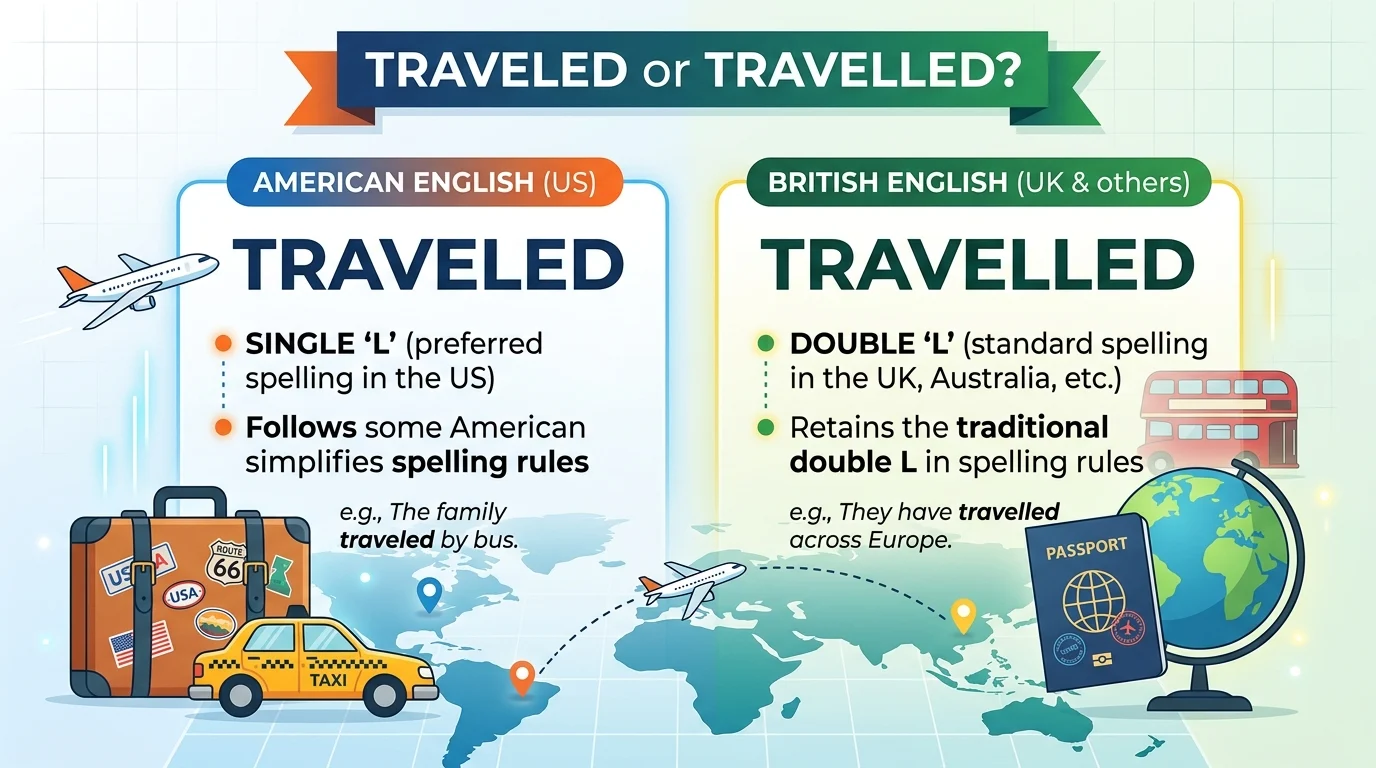
Quick Ans: Traveled and travelled are both correct spellings of the past tense and past participle of travel. Traveled is more common in American English, while travelled is preferred in British English and many other varieties. The meaning is exactly the same, so your choice mainly depends on the style of English you are using.
Introduction
Traveled or travelled is a common spelling question, especially when writing for an international audience. Both forms come from the verb travel, meaning to go from one place to another. The difference is simply the spelling of the past tense and past participle.
If you’re writing in American English, traveled is usually the standard form. In British English, travelled is generally preferred. The same spelling pattern also affects words such as traveling and travelling.
Understanding this difference helps you keep your writing consistent. It also prevents unnecessary spelling corrections when reading books, websites, academic work, or messages from different English speaking regions.
So, is one spelling wrong? No. Both are correct. The best choice depends on the variety and style of English you are following.
Quick Answer and Key Takeaway
| Spelling | Common Usage | Example |
|---|---|---|
| Traveled | American English | She traveled to Boston last year. |
| Travelled | British English and many other varieties | She travelled to London last year. |
Key takeaway: Use traveled for American style writing and travelled for British style writing. Both have the same meaning.
Definition and Explanation
Traveled and travelled are the past tense and past participle forms of travel.
The only difference is the number of l letters before the ending.
Travel → traveled
Travel → travelled
For example:
- We traveled across the country.
- We travelled across the country.
Both sentences mean that the journey happened in the past.
The spelling difference comes from regional conventions. American spelling usually uses one l before endings such as ed and ing in this word. British spelling commonly doubles the l.
Is This a Grammar, Usage, or Vocabulary Issue?
This is mainly a spelling and regional usage issue, not a grammar problem.
The verb remains the same, and its meaning doesn’t change.
| Form | Example |
|---|---|
| Present | I travel frequently. |
| Past, American style | I traveled frequently. |
| Past, British style | I travelled frequently. |
| Present participle, American style | I am traveling. |
| Present participle, British style | I am travelling. |
The important rule is consistency. Don’t switch between the two styles randomly in the same piece of formal writing.
Real World Usage Examples
Workplace
American style: Our manager traveled to Chicago for the conference.
British style: Our manager travelled to London for the conference.
Recap: Choose the spelling that matches your organization’s preferred English style.
Academic Writing
American style: The researchers traveled to several locations to collect data.
British style: The researchers travelled to several locations to collect data.
Recap: Either spelling can be correct when it follows the required style guide.
Everyday Writing
American style: We traveled by train last summer.
British style: We travelled by train last summer.
Recap: The meaning remains exactly the same.
Regional or Global Usage Differences
The biggest difference is regional preference.
Traveled is strongly associated with American English.
Travelled is common in British English and is also widely used in countries and regions that follow British spelling conventions.
| Region or Style | Preferred Form |
|---|---|
| United States | traveled |
| United Kingdom | travelled |
| British style writing | travelled |
| American style writing | traveled |
Some international organizations may follow their own style guides, so always check the required writing standard when working on professional or academic documents.
When NOT to Use It
Avoid these common situations:
- Don’t use traveled and travelled interchangeably in one formal document without a reason.
- Don’t assume travelled is a spelling mistake simply because you normally use traveled.
- Don’t assume traveled is incorrect because a British dictionary or website uses travelled.
- Don’t change the spelling randomly when editing someone else’s work.
- Don’t mix traveling with travelled if you’re trying to maintain one regional style.
- Don’t use either form when you actually need the present tense travel.
- Don’t treat the spelling difference as a difference in meaning.
Common Mistakes and Corrections
| Correct Sentence | Incorrect Sentence | Why |
|---|---|---|
| She traveled to Texas. | She travelled to Texas. | Incorrect only if strict American style is required. |
| She travelled to London. | She traveled to London. | Incorrect only if strict British style is required. |
| They traveled last year. | They travel last year. | The past event needs the past tense. |
| He has travelled widely. | He has travel widely. | A past participle is needed after has. |
| We are traveling today. | We are travelled today. | The present participle is needed after are. |
Simple Decision Rule
Use traveled for American style. Use travelled for British style. If your audience is international, choose one style and use it consistently.
Exercises With Answers
Choose traveled or travelled according to the requested style.
- American style: She ___ to California last month.
- British style: They ___ across Europe.
- American style: We ___ by plane.
- British style: He has ___ extensively.
- American style: My parents ___ abroad last year.
Answers
- traveled
- travelled
- traveled
- travelled
- traveled
Related Concepts and Comparisons
The same regional spelling pattern appears in other forms of travel.
| American Style | British Style |
|---|---|
| traveled | travelled |
| traveling | travelling |
| traveler | traveller |
The difference is particularly useful to remember when writing about trips, tourism, business travel, or personal experiences.
FAQs
Is traveled or travelled correct?
Both spellings are correct. Traveled is preferred in American style, while travelled is preferred in British style.
Is traveled the American spelling?
Yes. Traveled is the standard spelling commonly used in American English.
Is travelled the British spelling?
Yes. Travelled is the standard spelling commonly used in British English.
Do traveled and travelled mean the same thing?
Yes. They have exactly the same meaning and grammatical function. The difference is spelling preference.
Which is correct for academic writing, traveled or travelled?
Either can be correct. Follow the spelling conventions required by your school, university, publisher, or style guide.
Why does travelled have two l’s?
British spelling commonly doubles the l before certain endings in words such as travelled and travelling. American spelling usually keeps one l in these forms.
Is traveling or travelling correct?
Both are correct. Traveling is commonly used in American style, while travelling is commonly used in British style.
Is traveler or traveller correct?
Both are correct regional spellings. Traveler is common in American English, while traveller is common in British English.
Can I use traveled in British English?
You may encounter it, but travelled is the standard British spelling. For formal British writing, travelled is the safer choice.
Conclusion
The choice between traveled or travelled is straightforward once you know the regional spelling rule. Both forms are grammatically correct and have the same meaning. The main difference is where each spelling is commonly used.
Use traveled when following American spelling conventions. Use travelled when following British spelling conventions. The same pattern appears in traveling and travelling and traveler and traveller.
Neither spelling should automatically be considered wrong. What matters most is consistency. If you’re writing an essay, article, business document, or website content, check which style your audience or organization expects before choosing a form.
Practical tip: Decide whether you’re following American or British spelling before you start writing, then keep that choice consistent throughout the entire document.