
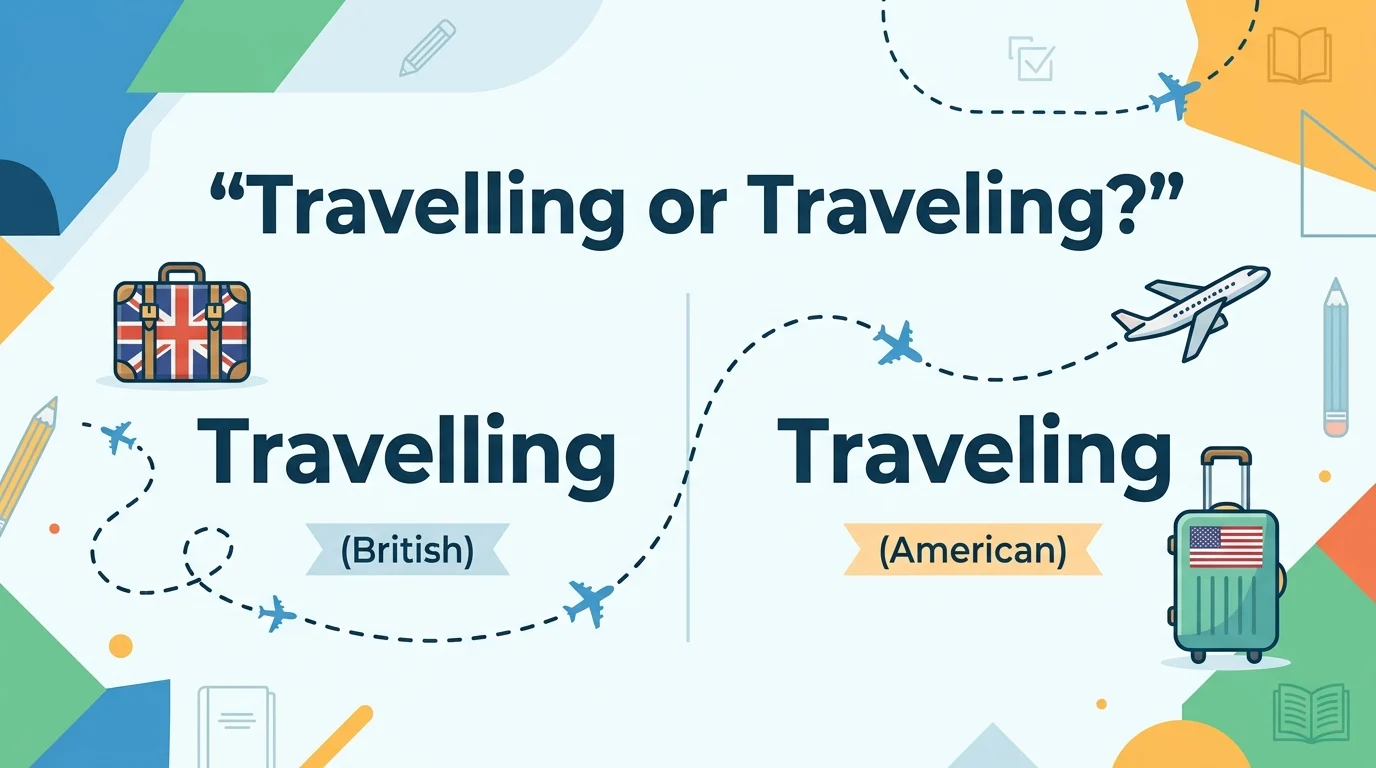
Quick Ans: “Travelling” and “traveling” have the same meaning and pronunciation. The difference is spelling. “Travelling” is the standard spelling in British English, while “traveling” is the standard spelling in American English. Both forms are correct, so your choice depends on the variety of English you are using.
Are you confused about whether to write “travelling or traveling”? Both spellings are correct, but they follow different English spelling conventions.
The word comes from the verb “travel,” which means to go from one place to another. When you add “ing,” the spelling changes slightly. British English usually doubles the final “l,” giving us “travelling.” American English normally keeps one “l,” giving us “traveling.”
This difference can cause problems in school assignments, websites, emails, and professional writing. You may see one spelling used in an American article and the other in a British publication.
Neither spelling is a mistake. The important thing is consistency. If you are writing for an American audience, use “traveling.” If your audience follows British English, use “travelling.”
Once you know this simple spelling rule, choosing the correct form becomes easy.
Quick Answer
| Spelling | Used Mainly In | Example |
|---|---|---|
| Travelling | British English | I love travelling by train. |
| Traveling | American English | I love traveling by train. |
Both forms are correct. Choose the spelling that matches your audience and keep it consistent.
Definition and Explanation
Travelling
“Travelling” is the present participle of “travel” in British English.
Example: She is travelling around Europe.
British English commonly doubles the final “l” before adding “ing.”
Traveling
“Traveling” is the present participle of “travel” in American English.
Example: She is traveling around Europe.
American English usually uses one “l” in this form.
| Form | Variety | Example |
|---|---|---|
| Travelling | British English | We are travelling tomorrow. |
| Traveling | American English | We are traveling tomorrow. |
The meaning does not change. Only the spelling differs.
Is This a Grammar, Usage, or Spelling Issue?
This is mainly a spelling and regional usage issue, not a grammar difference.
Both “travelling” and “traveling” describe the same action. The difference comes from spelling conventions used in different varieties of English.
British English generally doubles the final “l” in words such as “travel” when adding “ing” or “ed.”
American English usually does not double the “l” in “traveling” or “traveled.”
Therefore, neither form is more correct in every situation.
Real World Usage Examples
Workplace Examples
“I’m traveling to Chicago for a business meeting.”
This spelling fits American English.
“We’re travelling to London for a conference.”
This spelling fits British English.
Recap: Match the spelling to the English variety used by your workplace or audience.
Academic Examples
“The researchers are traveling to several locations to collect data.”
American spelling uses “traveling.”
“The researchers are travelling to several locations to collect data.”
British spelling uses “travelling.”
Recap: Academic writers should follow the spelling style required by their institution or publication.
Everyday Examples
“I enjoy traveling with my family.”
American English uses “traveling.”
“I enjoy travelling with my family.”
British English uses “travelling.”
Recap: Both spellings are natural in their respective varieties.
Regional or Global Usage Differences
The main difference is between American and British spelling conventions.
American English generally uses “traveling,” “traveled,” and “traveler.”
British English generally uses “travelling,” “travelled,” and “traveller.”
Other varieties, including Australian and New Zealand English, generally follow British spelling patterns.
As a result, “travelling” is common in many countries outside the United States, while “traveling” is especially common in the United States.
When NOT to Use It
Do not mix “travelling” and “traveling” randomly within the same article or assignment.
Avoid changing the spelling simply because you see another version online.
Do not assume that “travelling” is incorrect. It is the standard form in British English.
Likewise, do not assume that “traveling” is a spelling mistake. It is standard American English.
When following a specific style guide, use the spelling required by that guide.
Common Mistakes and Corrections
| Correct Sentence | Incorrect Sentence | Why |
|---|---|---|
| I am traveling to Texas. | I am travelling to Texas. | Use American spelling when following American English. |
| She is travelling to London. | She is traveling to London. | British English normally uses the double “l.” |
| He traveled last summer. | He travelled last summer. | American English uses one “l.” |
| They travelled across Europe. | They traveled across Europe. | British English normally uses the double “l.” |
Decision Rule: Writing for the United States? Use “traveling.” Following British English? Use “travelling.”
Exercises With Answers
Choose the correct form for the variety given.
- American English: She is _____ to New York.
- British English: They are _____ to France.
- American English: He _____ last summer.
- British English: She _____ around Asia last year.
- Which form is common in American English?
- Which form is common in British English?
Answer Key
- traveling
- travelling
- traveled
- travelled
- traveling
- travelling
Related Concepts and Comparisons
Readers may also search for traveled or travelled, traveler or traveller, canceled or cancelled, labeling or labelling, modeled or modelled, American vs British spelling, and British English spelling rules.
FAQs
Is travelling or traveling correct?
Both spellings are correct. “Travelling” is mainly used in British English, while “traveling” is standard American English.
Which is correct in American English, traveling or travelling?
“Traveling” is the standard American spelling. For American English writing, use one “l” before “ing.”
Which is correct in British English, travelling or traveling?
“Travelling” is the standard British spelling. British English normally doubles the final “l” in this word.
Why does travelling have two l’s?
British English commonly doubles the final “l” before adding “ing” in words such as “travel.” Therefore, “travel” becomes “travelling.”
Is traveling a misspelling?
No. “Traveling” is the standard spelling in American English. It is not a mistake when you are following American spelling conventions.
Is travelling British spelling?
Yes. “Travelling” is the standard British spelling. The same pattern appears in “travelled” and “traveller.”
Do Australia and Canada use travelling or traveling?
Australian English generally follows the British form, so “travelling” is common. Canadian English can show variation, but “travelling” is widely used.
Should I use traveling or travelling in an essay?
Follow the spelling system required by your school, university, teacher, or publication. If the assignment uses American English, choose “traveling”; if it uses British English, choose “travelling.”
Conclusion
“Travelling” and “traveling” mean exactly the same thing. The only difference is the spelling convention used by different varieties of English.
Use “traveling” when writing in American English. Use “travelling” when following British English. Australian English generally follows the British pattern as well.
The same difference appears in related words. American English uses “traveled” and “traveler,” while British English uses “travelled” and “traveller.”
Neither spelling is wrong. What matters most is consistency. If you start an article with “traveling,” don’t switch to “travelling” later unless you are discussing the spelling difference itself.
Practical tip: check your target audience before publishing. For U.S. readers, choose “traveling.” For British style, choose “travelling.”