
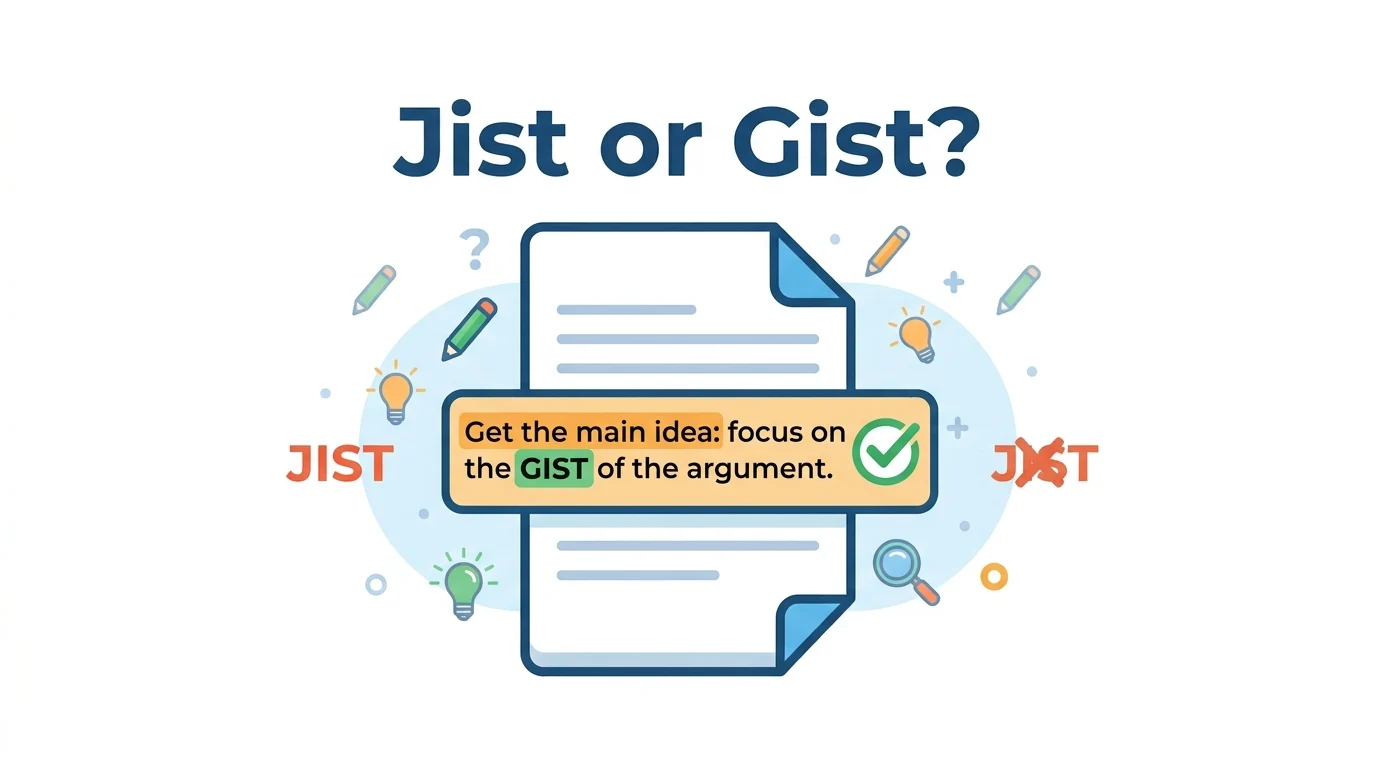
Quick Ans: “Gist” is the correct spelling when you mean the main idea, meaning, or essential point of something. “Jist” is a common spelling mistake. Although both forms may sound similar in casual speech, standard English uses “gist” for this meaning.
Are you confused about whether to write “jist or gist”? You may have heard the word many times but never seen it written down. Because the word starts with a soft sound, some people mistakenly spell it with a “j.”
The correct spelling is “gist.” It is a noun that means the main idea or most important part of something. For example, if you understand the gist of an article, you understand its basic meaning without remembering every detail.
The word appears often in everyday conversations, school assignments, workplace discussions, and reading tasks. You might say, “I didn’t read the whole report, but I understand the gist.”
“Jist,” on the other hand, is not the standard spelling of this word. It usually appears because someone writes the word the way they think it sounds.
Fortunately, the rule is easy. When you mean the main idea or essential point, always write “gist.”
Quick Answer: Jist or Gist?
| Word | Correct? | Meaning |
|---|---|---|
| Gist | Yes | Main idea or essential point |
| Jist | No | Common misspelling of “gist” |
Quick rule: If you mean “the main idea,” use gist, not “jist.”
Definition and Explanation
Gist
“Gist” is a noun. It means the main idea, basic meaning, or most important point of something.
Example: I didn’t understand every detail, but I got the gist.
The word is useful when you understand the general meaning without knowing every small detail.
Example: Can you give me the gist of the meeting?
Jist
“Jist” is generally considered a misspelling of “gist.” It does not have the standard meaning “main idea” in modern English.
For formal writing, academic work, emails, and professional communication, always use “gist.”
| Word | Part of Speech | Meaning | Example |
|---|---|---|---|
| Gist | Noun | Main idea or essential point | I understand the gist. |
| Jist | Not standard | Usually a misspelling | Avoid this spelling. |
In short, “gist” is the correct word. “Jist” is usually an error caused by the pronunciation.
Is This a Grammar, Usage, or Vocabulary Issue?
This is mainly a spelling and vocabulary issue. “Gist” is a standard English noun, while “jist” is not the standard spelling for this meaning.
The confusion often comes from pronunciation. In standard English, “gist” begins with a soft sound similar to the sound in “giant” or “gym.”
However, the spelling remains “gist,” even though some speakers may hear the opening sound and expect a “j.”
The word can appear in both formal and informal English. You can use it in an essay, email, conversation, or report.
Real World Usage Examples
Workplace Examples
“Can you give me the gist of the client’s email?”
The speaker wants the main point rather than every detail.
Recap: Use “gist” when someone wants a quick understanding of important information.
Academic Examples
“The student understood the gist of the research paper.”
The student understood the paper’s main idea without necessarily knowing every detail.
Recap: “Gist” works naturally when discussing reading comprehension.
Everyday Examples
“I missed the first part of the movie, so tell me the gist.”
The speaker wants a brief explanation of what happened.
Recap: In everyday speech, “gist” often means the basic story or main point.
Regional or Global Usage Differences
“Gist” is the standard spelling in major varieties of English, including American and British English.
The meaning also stays essentially the same across regions. You can use “gist” when referring to the main idea of a conversation, article, speech, story, or situation.
“Jist” may appear in informal online writing, but it is generally treated as a spelling error rather than a regional alternative.
When NOT to Use It
Do not write “jist” when you mean the main idea.
Do not use “gist” when you need to describe every detail of something.
Avoid saying “the gist of every detail,” because the word refers to the general meaning rather than individual details.
Do not replace “gist” with “jist” in academic or professional writing.
When you need a complete explanation, ask for the details rather than only the gist.
Common Mistakes and Corrections
| Correct Sentence | Incorrect Sentence | Why |
|---|---|---|
| I understand the gist of the story. | I understand the jist of the story. | “Gist” is the correct spelling. |
| Can you explain the gist of the article? | Can you explain the jist of the article? | “Jist” is a common misspelling. |
| She gave me the gist of the meeting. | She gave me the jist of the meeting. | Use “gist” for the main idea. |
| He understood the gist but missed some details. | He understood the jist but missed some details. | “Gist” is the standard form. |
Decision Rule: If you mean the main idea, basic meaning, or essential point, spell the word gist.
Exercises With Answers
Choose the correct word.
- I understand the _____ of the story.
- Can you give me the _____ of the report?
- She explained the _____ of the conversation.
- “Jist” is the standard spelling. True or false?
- The _____ of the article was easy to understand.
Answer Key
- gist
- gist
- gist
- False
- gist
Related Concepts and Comparisons
Readers may also search for gist meaning, gist definition, gist vs summary, main idea meaning, gist of a conversation, gist of a story, summary vs main idea, and commonly misspelled words.
FAQs
Is jist or gist correct?
“Gist” is correct when you mean the main idea or essential point. “Jist” is generally a misspelling.
What does gist mean?
“Gist” means the main idea or basic meaning of something. For example, “I understand the gist” means you understand the most important point.
Why do people spell gist as jist?
The mistake usually happens because of pronunciation. The beginning of “gist” has a soft sound, which can make some people assume that the word starts with “j.”
How do you use gist in a sentence?
You can say, “I got the gist of the conversation.” This means you understood the main idea without knowing every detail.
Is gist formal or informal?
“Gist” works in both formal and informal English. You can use it in academic writing, professional communication, and everyday conversation.
What is the difference between gist and summary?
A gist is the main idea or essential point. A summary usually provides a more complete account of the important information.
Is jist a real English word?
“Jist” may appear in informal writing or as a spelling mistake, but it is not the standard spelling when you mean the main idea. Use “gist” instead.
What is the gist of a conversation?
The gist of a conversation is its main point or overall meaning. You don’t need to remember every sentence to understand the gist.
Conclusion
When choosing between “jist or gist,” always choose gist if you mean the main idea, basic meaning, or essential point. “Jist” is generally a spelling mistake.
The word “gist” is a noun and works in many situations. You can talk about the gist of a story, article, meeting, conversation, report, or speech. It is useful when you want to describe the most important information without discussing every detail.
The confusion mainly comes from pronunciation. Although the beginning of “gist” has a soft sound, the correct spelling still starts with “g.”
Remember this simple rule: gist means the main idea. If you’re writing an email, assignment, article, or professional document, use “gist,” not “jist.”
Practical tip: connect gist with general idea. Both begin with “g,” which can help you remember the correct spelling.
2 thoughts on “Jist or Gist: What’s the Difference? Easy Rules, Examples & Tips”