
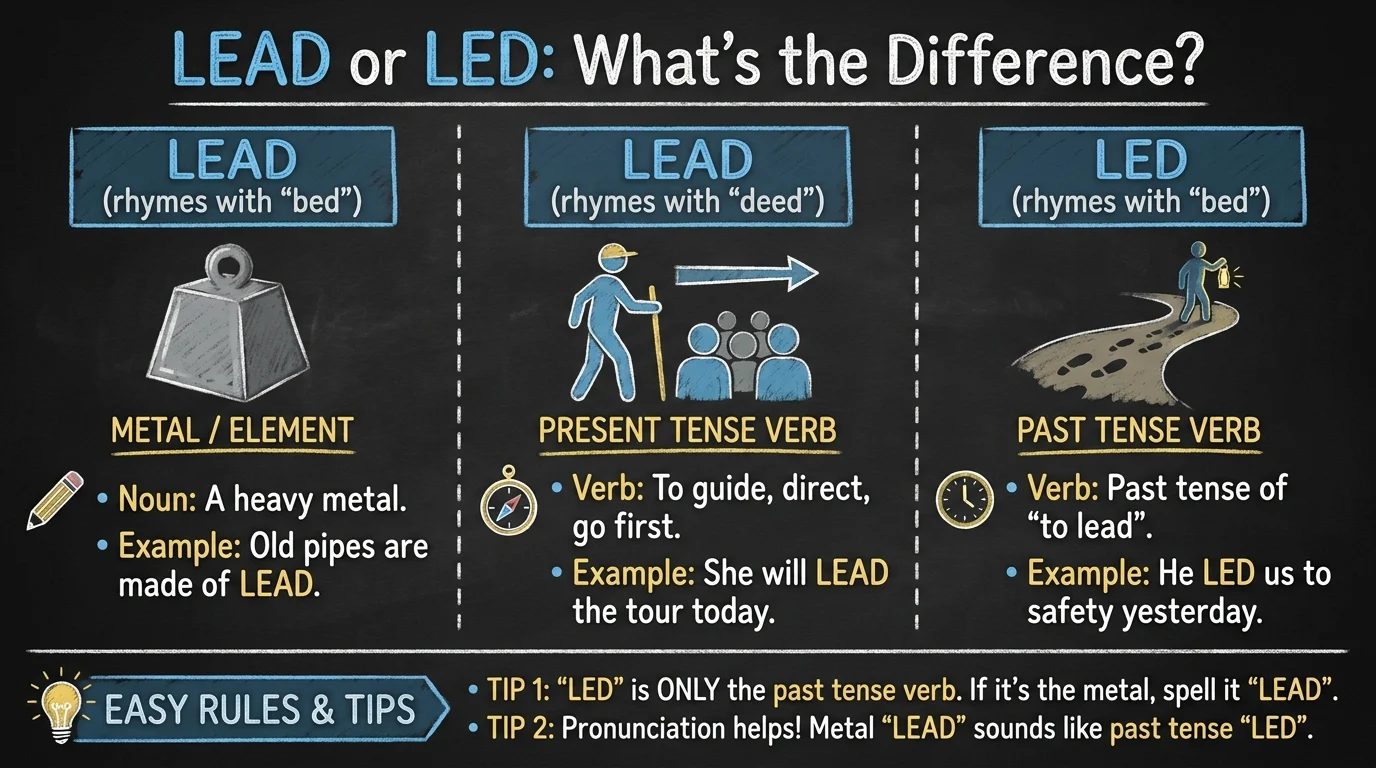
Quick Ans: “Lead” and “led” are both correct words, but they have different meanings and uses. “Lead” is the present form of the verb meaning to guide or direct, while “led” is its past tense.
Are you confused about whether to use “lead or led”? These two words often cause mistakes because they look almost the same. The main difference is their meaning, tense, and pronunciation.
When you talk about guiding someone now or in the future, use “lead.” For example, “She will lead the team.” When the action happened in the past, use “led.” You would say, “She led the team last year.”
There is one more detail that makes these words tricky. “Lead” can also refer to a heavy metal. In that meaning, it is pronounced like “led.” So, the pronunciation does not always tell you which word you are reading.
Fortunately, the basic grammar rule is simple. If you mean “guide” and the action happened in the past, choose “led.” Otherwise, “lead” is usually the correct form for the verb.
Quick Answer and Key Takeaway
| Word | Meaning | Pronunciation | Example |
|---|---|---|---|
| Lead | Guide or direct | “leed” | I lead the team. |
| Led | Past tense of lead | “led” | I led the team. |
| Lead | A heavy metal | “led” | The paint contains lead. |
Quick rule: Use “lead” for the present or future and “led” for the past.
Definition and Explanation
Lead
“Lead” is a verb meaning to guide, direct, or be in charge of someone or something.
Example: She leads the team.
It can also be a noun.
Example: Our team has the lead.
When “lead” means to guide, pronounce it like “leed.”
Led
“Led” is the past tense and past participle of “lead.”
Example: She led the team last year.
It always refers to the past form of the verb “lead.”
Pronounce “led” like the word “bed.”
Lead as a Metal
“Lead” is also a noun referring to a heavy metal.
Example: The old pipes contained lead.
In this meaning, “lead” is pronounced like “led.”
| Word | Part of Speech | Meaning | Example |
|---|---|---|---|
| Lead | Verb | Guide or direct | He will lead the group. |
| Led | Verb | Past form of lead | He led the group yesterday. |
| Lead | Noun | A heavy metal | The material contains lead. |
The main point is simple. “Led” is the past tense of the verb “lead.” The word “lead” can also have a separate meaning when it refers to the metal.
Is This a Grammar, Usage, or Vocabulary Issue?
The confusion involves grammar, vocabulary, and pronunciation.
The most common mistake occurs when someone uses “lead” for a past action.
Incorrect: She lead the project last year.
Correct: She led the project last year.
For present actions, use “lead” or “leads.”
Example: She leads the project.
After “will,” use the base form “lead.”
Example: She will lead the project.
The metal “lead” is different. It has the same pronunciation as “led,” but its meaning comes from the context.
Real World Usage Examples
Workplace Examples
“Our manager will lead the meeting tomorrow.”
The meeting has not happened yet, so “lead” is correct.
“James led the meeting yesterday.”
The meeting already happened, so “led” is correct.
Recap: Check when the action happened before choosing the word.
Academic Examples
“The professor led the research team for five years.”
The action occurred in the past, so “led” works here.
“Students will lead the discussion next week.”
The action will happen later, so “lead” is correct.
Recap: Past actions use “led,” while future actions use “lead.”
Everyday Examples
“Can you lead the way?”
The person is being asked to guide others.
“She led us to the restaurant.”
The guiding happened in the past.
Recap: The tense changes the word from “lead” to “led.”
Regional or Global Usage Differences
“Lead” and “led” have the same spelling and basic grammar rules in American, British, Canadian, and Australian English.
The pronunciation can cause confusion everywhere. The verb “lead” meaning “guide” sounds like “leed.” The past tense “led” sounds like “bed.”
When “lead” means the metal, it sounds like “led.”
Therefore, the difference is not mainly regional. English speakers generally follow the same rules.
When NOT to Use It
Do not use “lead” when describing a completed action of guiding or directing someone.
Do not write “She lead the team yesterday.” Use “She led the team yesterday.”
Do not use “led” after “will.” Say “She will lead the team.”
Do not confuse the metal “lead” with the verb “lead.” Their meanings and pronunciations differ.
Avoid choosing the word based only on pronunciation because “lead” has two pronunciations.
Common Mistakes and Corrections
| Correct Sentence | Incorrect Sentence | Why |
|---|---|---|
| She led the team last year. | She lead the team last year. | “Led” is the past tense of “lead.” |
| He will lead the meeting. | He will led the meeting. | Use the base verb after “will.” |
| They lead the project every month. | They led the project every month. | The sentence describes a regular present action. |
| The paint contained lead. | The paint contained led. | “Lead” is the correct spelling for the metal. |
Decision Rule: If you mean “guide” and the action happened in the past, use led. For present or future actions, use lead.
Exercises With Answers
Choose “lead” or “led.”
- She _____ the team last year.
- I will _____ the discussion tomorrow.
- They _____ the project every month.
- He _____ us to the building yesterday.
- The old paint contained _____.
- Who will _____ the meeting?
Answer Key
- led
- lead
- lead
- led
- lead
- lead
Related Concepts and Comparisons
You may also want to learn about lead vs led, lead pronunciation, led meaning, lead meaning, lead past tense, read vs read, past tense verbs, and commonly confused English words.
FAQs
Is lead or led correct?
Both are correct, but they serve different purposes. “Lead” is the present form of the verb meaning to guide, while “led” is its past tense.
Is led the past tense of lead?
Yes. “Led” is the past tense and past participle of the verb “lead.” For example, “She leads the team” becomes “She led the team.”
How do you pronounce lead and led?
The verb “lead” meaning guide is pronounced like “leed.” “Led” sounds like “bed,” while “lead” meaning the metal also sounds like “led.”
Why is lead pronounced differently?
“Lead” has two different meanings, so it has two pronunciations. The verb meaning “guide” sounds like “leed,” while the metal is pronounced “led.”
Is led a real word?
Yes. “Led” is the correct past tense of “lead.” For example, “He led the group through the museum.”
Should I use lead or led for past tense?
Use “led” for the past tense. For example, “She led the company for ten years” is correct.
What is the difference between lead and led?
“Lead” can mean to guide someone and is pronounced “leed.” “Led” is the past form of that verb and is pronounced “led.”
Is “I lead the team yesterday” correct?
No. Because “yesterday” shows that the action happened in the past, the correct sentence is “I led the team yesterday.”
Conclusion
The difference between “lead or led” is easier to remember when you focus on tense and meaning. “Lead” is the present form of the verb when you mean to guide or direct. “Led” is the past tense.
For example, say, “I lead the team today,” but say, “I led the team yesterday.” After “will,” use “lead,” as in “She will lead the meeting.”
There is also another meaning of “lead.” As a noun, it refers to a heavy metal. In this case, it is pronounced like “led.” Context tells you which meaning the writer intends.
These rules work consistently across major varieties of English. You don’t need to memorize a complicated grammar rule.
Practical tip: look for words such as yesterday, last year, or previously. If they show that the guiding action happened in the past, use “led.”
1 thought on “Lead or Led: What’s the Difference? Easy Rules, Examples & Tips”