
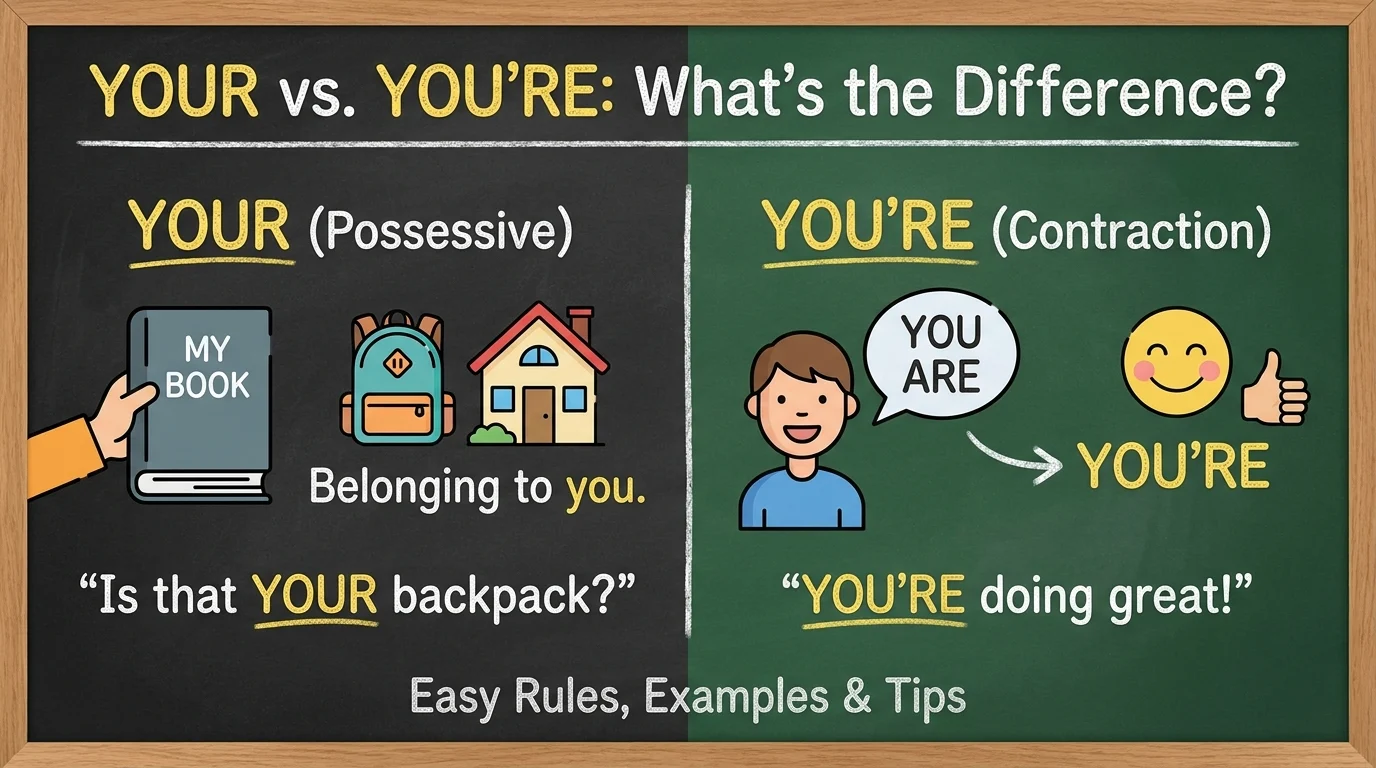
Quick Ans: Your and you’re sound alike but have different meanings. Your is a possessive adjective that shows something belongs to someone. You’re is a contraction of “you are.” Use your before a noun, while you’re should be used when you mean “you are.” Knowing this simple rule prevents one of the most common writing mistakes.
Your or you’re is a common English confusion, especially for students, ESL learners, and writers. The two words sound exactly the same in everyday speech, but they have completely different meanings and grammatical roles.
The good news is that the difference is easy to remember. Your shows possession or ownership. For example, “Where is your phone?” Here, your tells us that the phone belongs to you.
You’re is a shortened form of you are. For example, “You’re very helpful” means “You are very helpful.”
The mistake usually happens because both words sound identical. Writers may choose the wrong spelling when typing quickly or relying on pronunciation. This can make an otherwise correct sentence look careless.
In this guide, you’ll learn the simple rule for choosing your or you’re, see real world examples, review common mistakes, and practice with exercises.
Quick Answer and Key Takeaway
| Word | Meaning | Example |
|---|---|---|
| Your | Shows possession | Is this your book? |
| You’re | Means you are | You’re very kind. |
Easy rule: If you can replace the word with you are, use you’re. If that replacement doesn’t work, use your.
Definition and Explanation
What Does Your Mean?
Your is a possessive adjective. It tells us that something belongs to, relates to, or is associated with the person being addressed.
Examples:
- Is this your bag?
- I like your idea.
- Please check your email.
- What is your name?
A useful way to remember your is to connect it with possession.
What Does You’re Mean?
You’re is a contraction of you are.
Examples:
- You’re very talented. = You are very talented.
- You’re late. = You are late.
- I think you’re right. = I think you are right.
- You’re going to enjoy this book. = You are going to enjoy this book.
The apostrophe in you’re represents the missing letter in the phrase you are.
Is This a Grammar, Usage, or Vocabulary Issue?
The difference between your and you’re is mainly a grammar and usage issue.
Your functions as a possessive adjective, while you’re functions as a contraction containing a pronoun and verb. Their pronunciation is usually identical, which makes the confusion more common in writing than in speech.
Remember that your normally comes before a noun, while you’re can be followed by an adjective, noun phrase, or verb form depending on the sentence.
Real World Usage Examples
Workplace Examples
- Please send your report before Friday.
- You’re responsible for checking the figures.
- Is this your desk?
- You’re doing a great job.
Recap: Use your for possession and you’re when you mean you are.
Academic Examples
- Have you finished your assignment?
- You’re expected to submit the paper today.
- Check your answers carefully.
- You’re allowed to use a calculator.
Recap: Academic writing needs the correct form because these words have different grammatical functions.
Everyday Examples
- Where are your keys?
- You’re my best friend.
- I like your new shoes.
- You’re going to love this movie.
Recap: The same simple rule works in everyday conversations and informal messages.
Regional or Global Usage Differences
There is no major regional difference in the meanings of your and you’re. English speakers around the world use your to show possession and you’re as the contraction of you are.
The pronunciation is also generally the same, which is why this mistake can occur regardless of the variety of English someone speaks or writes.
When NOT to Use It
Avoid these common situations:
- Don’t use you’re when you mean possession.
Incorrect: I like you’re car.
Correct: I like your car. - Don’t use your when you mean you are.
Incorrect: Your very helpful.
Correct: You’re very helpful. - Don’t write your before an adjective when you mean you are.
Incorrect: Your amazing.
Correct: You’re amazing. - Don’t assume that an apostrophe always shows possession. In you’re, the apostrophe forms a contraction.
- Don’t rely only on pronunciation because your and you’re usually sound alike.
Common Mistakes and Corrections
| Correct Sentence | Incorrect Sentence | Why |
|---|---|---|
| Your phone is ringing. | You’re phone is ringing. | The phone belongs to you. |
| You’re very patient. | Your very patient. | You’re means you are. |
| I like your dress. | I like you’re dress. | Your shows possession. |
| You’re ready to leave. | Your ready to leave. | You are ready. |
| Where is your notebook? | Where is you’re notebook? | The notebook belongs to you. |
Decision Rule
Try replacing the word with “you are.”
If the sentence still makes sense, choose you’re.
If it doesn’t, choose your.
Example:
“You’re late” → “You are late.” ✓
“Your late” → “You are late.” ✗
“Your jacket” → “You are jacket.” ✗
So the correct sentence is “Your jacket.”
Exercises With Answers
Choose your or you’re.
- I like ___ new haircut.
- ___ going to enjoy this trip.
- Did you bring ___ passport?
- I think ___ correct.
- Where is ___ brother?
- ___ welcome to join us.
- Please finish ___ homework.
- ___ one of the best students here.
Answer Key
- your
- you’re
- your
- you’re
- your
- you’re
- your
- you’re
Related Concepts and Comparisons
Your and you’re belong to a larger group of commonly confused English words. Similar examples include its and it’s, whose and who’s, and their, there, and they’re.
The same principle often helps: learn what each word means rather than relying on pronunciation.
FAQs
What is the difference between your and you’re?
Your shows possession, while you’re means “you are.” For example, “Your car is clean” shows possession, while “You’re very kind” means “You are very kind.”
Is your or you’re correct?
Both are correct words, but they are used differently. Choose your for possession and you’re when you mean you are.
How do I remember your or you’re?
Use the substitution test. Replace you’re with “you are.” If the sentence makes sense, you’re is correct.
Is you’re a possessive word?
No. You’re is a contraction of “you are.” Your is the possessive form.
Why do your and you’re sound the same?
They are homophones, meaning they have the same or nearly the same pronunciation but different meanings and spellings.
Can you’re come before a noun?
Yes, but it represents “you are,” not possession. For example, “You’re a student” means “You are a student.”
Which is correct, your welcome or you’re welcome?
You’re welcome is correct because it means “You are welcome.” “Your welcome” would incorrectly suggest possession.
Is “your beautiful” correct?
No, if you mean “you are beautiful.” The correct sentence is “You’re beautiful.”
Is “your” always followed by a noun?
Your normally appears before a noun or noun phrase, such as “your book” or “your new car.” It can also appear before words that modify an implied noun in certain contexts.
Conclusion
Understanding your or you’re is simple once you focus on meaning rather than pronunciation. Your shows possession or a relationship to the person being addressed, as in “your phone,” “your house,” or “your opinion.” You’re is always a contraction of you are, as in “you’re happy” or “you’re ready.”
The easiest way to avoid mistakes is to use the you are test. Whenever you’re unsure, replace the word with “you are.” If the sentence works, use you’re. If it doesn’t, use your.
For example, “You’re very helpful” works because “You are very helpful” makes sense. However, “Your advice is helpful” cannot become “You are advice is helpful,” so your is correct.
With a little practice, this common spelling confusion becomes easy to avoid. Before submitting an important message, email, assignment, or article, take a quick look at every use of your and you’re. That small check can make your writing much clearer and more professional.
2 thoughts on “Your or You’re: What’s the Difference? Easy Rules, Examples & Tips”