
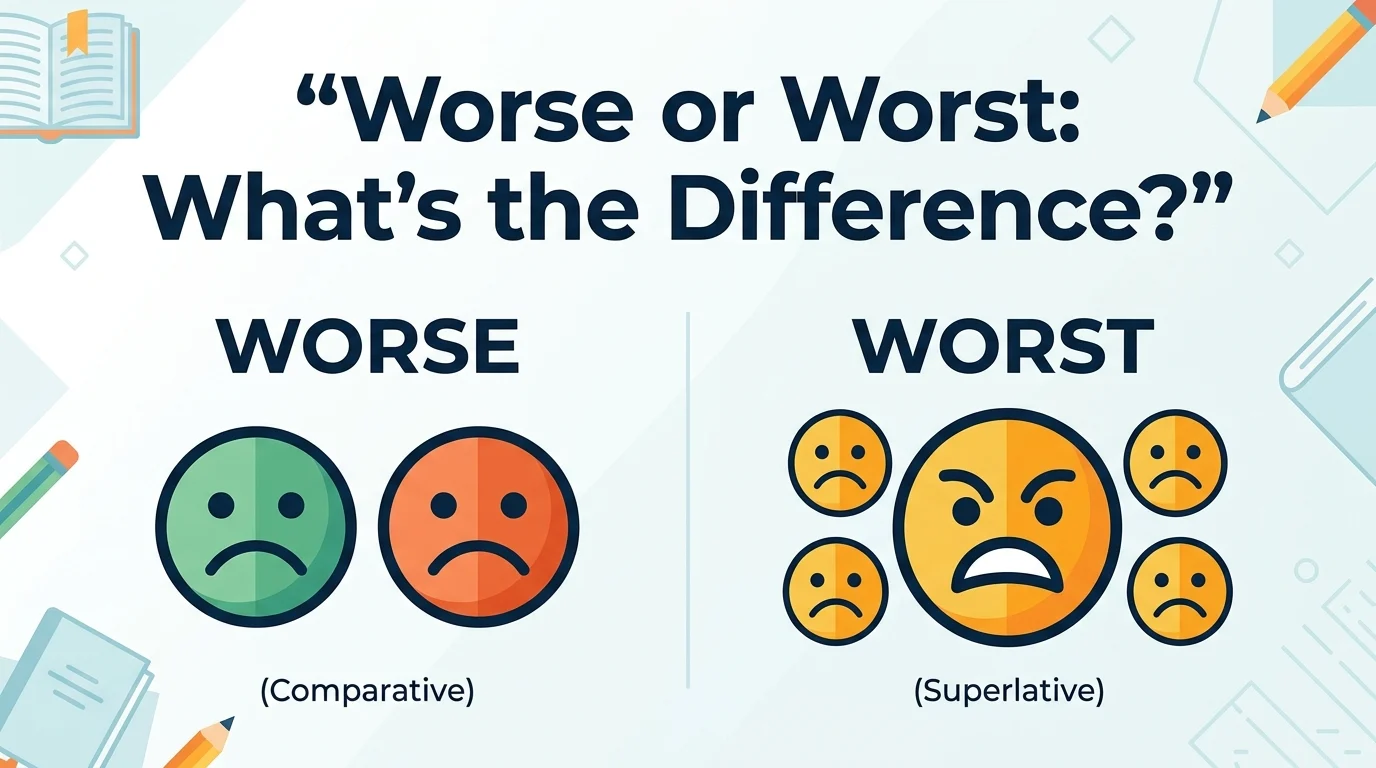
Quick Ans: “Worse” and “worst” both describe something bad, but they are used differently. “Worse” compares two people, things, or situations, while “worst” describes the lowest or most negative level among three or more. Knowing this simple difference will help you avoid one of the most common English comparison mistakes.
Are you confused about whether to use “worse or worst”? These words look similar, and both relate to something bad. However, they don’t have the same grammatical role.
Use “worse” when you compare two things. For example, “This movie is worse than the first one.” You are comparing two movies.
Use “worst” when something has the lowest quality or is the most unpleasant in a group. For example, “That was the worst movie I’ve ever seen.” Here, the movie is being compared with all the other movies the speaker has seen.
The confusion often happens because people use “worst” when they simply mean “worse.” The good news is that the rule is easy once you focus on the number of things being compared.
Whether you’re writing an email, completing an assignment, or speaking with others, choosing the correct form makes your English sound more natural and accurate.
Quick Answer and Key Takeaway
| Word | Use | Example |
|---|---|---|
| Worse | Compare two things | Today is worse than yesterday. |
| Worst | Compare three or more or describe the lowest level | Today was the worst day of the week. |
Quick rule: Use “worse” for two comparisons and “worst” for the lowest level in a larger group.
Definition and Explanation
Worse
“Worse” is the comparative form of “bad.” It means less good, more unpleasant, or lower in quality than something else.
Example: My headache is worse today.
You can also use “worse” with “than” when making a direct comparison.
Example: This restaurant is worse than the one we visited yesterday.
Worst
“Worst” is the superlative form of “bad.” It means the least good, most unpleasant, or lowest in quality among three or more possibilities.
Example: This is the worst restaurant in town.
It can also describe the most serious possible situation.
Example: We prepared for the worst.
| Word | Grammar Form | Meaning | Example |
|---|---|---|---|
| Bad | Positive | Not good | The weather is bad. |
| Worse | Comparative | More bad or less good | The weather is worse today. |
| Worst | Superlative | Most bad or least good | This is the worst weather this month. |
In simple terms, “bad” describes something negative, “worse” compares, and “worst” identifies the lowest level.
Is This a Grammar, Usage, or Vocabulary Issue?
This is mainly a grammar and usage issue involving comparative and superlative adjectives.
“Worse” compares one thing with another. “Worst” identifies something as the lowest or most negative among a group.
For example:
“His second test was worse than his first.”
“The third test was his worst result.”
Sometimes the number of things being compared is understood rather than directly stated. Even then, the meaning determines whether “worse” or “worst” is appropriate.
Real World Usage Examples
Workplace Examples
“The new system is worse than the old one.”
Here, two systems are being compared.
“This was the worst customer complaint we received this year.”
The complaint is considered the most serious among many.
Recap: Use “worse” for a direct comparison and “worst” for the lowest level in a group.
Academic Examples
“Students performed worse on the second test.”
The performance became less good compared with an earlier result.
“Students had their worst results in the final exam.”
The final exam produced the lowest results among several exams.
Recap: Academic writing follows the same comparison rule.
Everyday Examples
“My cold feels worse today.”
The condition has become more unpleasant.
“That was the worst day of my life.”
The speaker considers it the most unpleasant day among many.
Recap: Context tells you whether you need the comparative or superlative form.
Regional or Global Usage Differences
“Worse” and “worst” have the same meanings and spelling in American and British English.
Both forms are standard across major varieties of English. The main issue is not regional usage but choosing the correct level of comparison.
The same rule applies whether you’re writing a school assignment, business message, or casual conversation.
When NOT to Use It
Don’t use “worst” when you’re comparing only two things.
Incorrect: This phone is the worst than my old phone.
Correct: This phone is worse than my old phone.
Don’t use “worse” when you mean the lowest level in a group.
Incorrect: This is the worse restaurant in town.
Correct: This is the worst restaurant in town.
Don’t say “more worse.” “Worse” already expresses comparison.
Don’t say “most worst.” “Worst” already expresses the superlative form.
Also, don’t confuse “worse” with “worst” simply because both describe something negative.
Common Mistakes and Corrections
| Correct Sentence | Incorrect Sentence | Why |
|---|---|---|
| This is worse than yesterday. | This is worst than yesterday. | “Worse” is used for a comparison. |
| This is the worst day of my life. | This is the worse day of my life. | “Worst” identifies the lowest level. |
| My condition is getting worse. | My condition is getting worst. | “Worse” describes increasing negativity. |
| This is the worst option. | This is the worse option. | “Worst” is the superlative form. |
| The second plan is worse. | The second plan is more worse. | “Worse” already shows comparison. |
Decision Rule: If you are comparing two things, use “worse.” If something is the lowest or most negative among a group, use “worst.”
Exercises With Answers
Choose “worse” or “worst.”
- This weather is _____ than yesterday.
- That was the _____ mistake I ever made.
- My cold is getting _____.
- Which of the two options is _____?
- This is the _____ restaurant I’ve visited.
- Things became _____ after the meeting.
Answer Key
- worse
- worst
- worse
- worse
- worst
- worse
Related Concepts and Comparisons
Readers may also search for bad vs worse vs worst, better vs best, comparative adjectives, superlative adjectives, worse than grammar, worst meaning, worse meaning, and common English mistakes.
FAQs
What is the difference between worse and worst?
“Worse” is the comparative form of “bad,” while “worst” is the superlative form. Use “worse” when comparing two things and “worst” when identifying the lowest level.
Is worse or worst correct?
Both are correct, but the correct choice depends on the sentence. Use “worse” for comparisons and “worst” for the most negative option in a group.
Is worse than correct grammar?
Yes. “Worse than” is the standard structure for comparing two things. For example, “This book is worse than the first one.”
Can I say more worse?
Usually, no. “Worse” already functions as the comparative form of “bad,” so “more worse” is unnecessary and incorrect in standard English.
Can I say most worst?
No. “Worst” is already the superlative form of “bad.” Use “worst,” not “most worst.”
What is the comparative form of bad?
The comparative form of “bad” is “worse.” For example, “Today’s weather is worse than yesterday’s.”
What is the superlative form of bad?
The superlative form of “bad” is “worst.” For example, “That was the worst experience of my life.”
Which is correct: worse or worst than?
Use “worse than.” For example, “This situation is worse than before.” “Worst than” is not standard English.
Conclusion
Understanding “worse or worst” is simple once you remember the difference between comparative and superlative forms.
“Worse” means more bad or less good than something else. Use it when comparing two things, as in “This phone is worse than my old phone.”
“Worst” means the most bad or least good in a group. Use it when something reaches the lowest level, as in “This is the worst phone I’ve ever owned.”
You should also avoid forms such as “more worse” and “most worst” because “worse” and “worst” already contain the comparison.
The same rules apply in American and British English, so you don’t need to learn separate rules for different varieties.
Practical tip: When you’re unsure, ask yourself, “Am I comparing two things?” If yes, choose worse. If you’re talking about the lowest level among several possibilities, choose worst.