
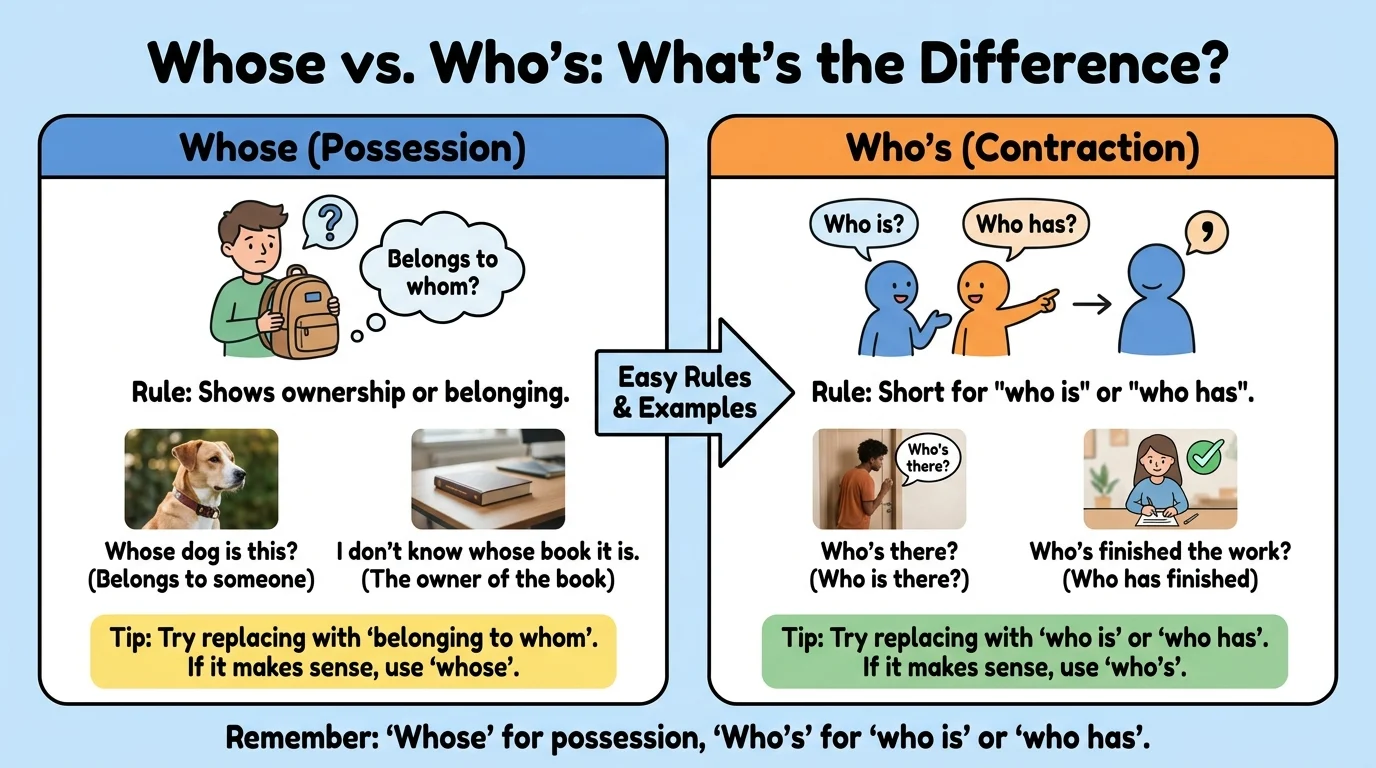
Quick Ans: “Whose” and “who’s” sound the same, but they have different meanings and uses. “Whose” shows possession or asks who owns something, while “who’s” is a contraction of “who is” or “who has.” Knowing this simple difference can help you avoid a very common English writing mistake.
Are you confused about whether to use “whose or who’s”? You’re not alone. These words sound exactly alike in most varieties of English, but their meanings are completely different.
The main problem comes from the apostrophe. Many people assume that “who’s” must show possession because apostrophes often appear in possessive words. However, that rule does not apply here. “Who’s” is a contraction, not a possessive form.
“Whose,” on the other hand, is used when you want to show ownership or ask about the person who owns something. For example, “Whose phone is this?” asks who owns the phone.
Meanwhile, “who’s” means “who is” or “who has.” For example, “Who’s coming to dinner?” means “Who is coming to dinner?”
Once you learn what the apostrophe represents, the difference becomes much easier to remember.
Quick Answer: Whose or Who’s?
| Word | Meaning | Example |
|---|---|---|
| Whose | Shows possession or ownership | Whose jacket is this? |
| Who’s | Short for “who is” | Who’s at the door? |
| Who’s | Short for “who has” | Who’s finished the work? |
Quick rule: If you can replace the word with “who is” or “who has,” use who’s. Otherwise, use whose.
Definition and Explanation
Whose
“Whose” is a possessive pronoun and determiner. It asks or tells us who something belongs to.
Example: Whose book is on the table?
Here, “whose” asks about the owner of the book.
It can also appear in statements.
Example: I know the student whose phone was lost.
In this sentence, “whose” shows the relationship between the student and the phone.
Who’s
“Who’s” is a contraction. It can mean either “who is” or “who has.”
Example: Who’s your teacher?
This means:
Who is your teacher?
Another example is:
Who’s finished the assignment?
This means:
Who has finished the assignment?
| Word | Full Form | Use | Example |
|---|---|---|---|
| Whose | No contraction | Possession | Whose car is this? |
| Who’s | Who is | Contraction | Who’s coming? |
| Who’s | Who has | Contraction | Who’s completed it? |
The key difference is simple. Whose relates to ownership. Who’s replaces “who is” or “who has.”
Is This a Grammar, Usage, or Vocabulary Issue?
This is mainly a grammar and usage issue involving possession and contractions.
The apostrophe in “who’s” does not indicate possession. Instead, it shows that letters have been removed from “who is” or “who has.”
For example:
Who’s ready?
means:
Who is ready?
By contrast:
Whose bag is this?
asks about ownership.
Because the two words sound alike, you cannot always identify the correct spelling by pronunciation. You need to look at the meaning and sentence structure.
Real World Usage Examples
Workplace Examples
“Who’s responsible for this report?”
Here, “who’s” means “who is.”
“Whose report is on the manager’s desk?”
Here, “whose” asks who owns or prepared the report.
Recap: Use “who’s” for “who is” and “whose” for possession.
Academic Examples
“Who’s presenting the research today?”
“Who’s” means “who is.”
“The researcher whose work we discussed received an award.”
“Whose” connects the researcher with the work.
Recap: Academic writing uses both forms, depending on their grammatical function.
Everyday Examples
“Who’s calling?”
This means “Who is calling?”
“Whose keys are these?”
This asks who owns the keys.
Recap: Replace “who’s” with “who is” or “who has” to check it.
Regional or Global Usage Differences
“Whose” and “who’s” have the same basic meanings in American, British, Canadian, and Australian English.
The main issue is not regional usage. Instead, writers often confuse the words because they are homophones, meaning they sound alike but have different spellings and meanings.
The same distinction applies in formal and informal writing.
When NOT to Use It
Do not use “who’s” when you are asking about ownership.
Avoid writing “Who’s car is this?” because “who’s” means “who is” or “who has.”
Do not use “whose” when you can clearly replace it with “who is.”
Avoid choosing the spelling based only on pronunciation because both words usually sound the same.
Do not assume that an apostrophe always indicates possession. In “who’s,” it indicates a contraction.
Common Mistakes and Corrections
| Correct Sentence | Incorrect Sentence | Why |
|---|---|---|
| Whose phone is this? | Who’s phone is this? | “Whose” shows ownership. |
| Who’s coming with us? | Whose coming with us? | “Who’s” means “who is.” |
| Whose idea was it? | Who’s idea was it? | The question asks about ownership or origin. |
| Who’s finished the project? | Whose finished the project? | “Who’s” means “who has.” |
Decision Rule: Try replacing the word with “who is” or “who has.” If the sentence still makes sense, use “who’s.” If it asks about ownership, use “whose.”
Exercises With Answers
Choose “whose” or “who’s.”
- _____ coming to the party?
- _____ jacket is this?
- _____ responsible for the project?
- _____ car is parked outside?
- _____ finished the assignment?
- Do you know _____ book this is?
Answer Key
- Who’s
- Whose
- Who’s
- Whose
- Who’s
- Whose
Related Concepts and Comparisons
Readers may also search for who vs whom, who’s vs whose, your vs you’re, its vs it’s, their vs they’re, there vs their, apostrophe rules, and possessive pronouns.
FAQs
What is the difference between whose and who’s?
“Whose” shows possession or asks who owns something. “Who’s” is a contraction of “who is” or “who has.”
Is whose or who’s correct?
Both are correct words, but they have different uses. Use “whose” for possession and “who’s” for “who is” or “who has.”
How can I remember whose vs who’s?
Try replacing “who’s” with “who is” or “who has.” If the sentence works, choose “who’s. If you’re asking about ownership, choose “whose.”
Is who’s possessive?
No. “Who’s” is not a possessive form. It is a contraction of “who is” or “who has.”
Whose car or who’s car?
The correct phrase is “whose car” when asking about ownership. For example, “Whose car is parked outside?”
Who’s coming or whose coming?
“Who’s coming?” is correct because it means “Who is coming?” “Whose coming?” is incorrect in this context.
Can whose be used for people and things?
Yes. “Whose” can refer to people and, in some contexts, things. For example, “The company whose products we reviewed has expanded.”
Why do whose and who’s sound the same?
They are normally pronounced alike, so they are homophones. Their different meanings and spellings make context essential.
Conclusion
The difference between “whose or who’s” is easy once you focus on what each word means. “Whose” shows possession or asks who owns something. “Who’s” is a contraction that means “who is” or “who has.”
For example, “Whose laptop is this?” asks about ownership. On the other hand, “Who’s using the laptop?” means “Who is using the laptop?”
Remember that the apostrophe in “who’s” does not make it possessive. It simply replaces letters from “who is” or “who has.” That is the key point that separates these two commonly confused words.
The best way to check your choice is to expand “who’s.” If “who is” or “who has” fits, use “who’s.” If the sentence asks about ownership, use “whose.”
Practical tip: Before publishing your sentence, replace “who’s” with “who is.” If the meaning still works, you’ve probably chosen the correct form.