
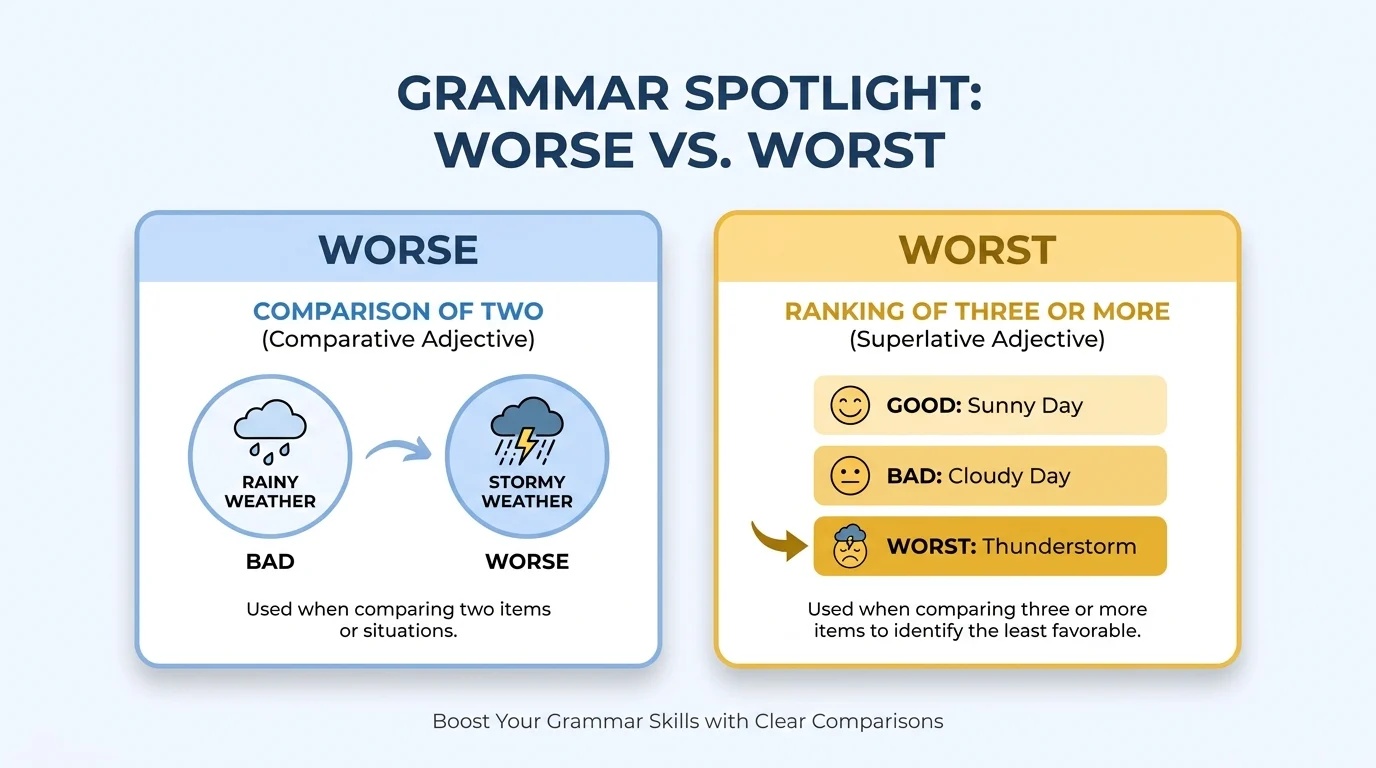
Quick Ans: Worse vs worst depends on how many things you compare. Use worse when comparing two people, things, or situations. Use worst when describing the least favorable option among three or more, or the lowest point in a situation. For example, “Today is worse than yesterday” and “Monday was the worst day of the week.”
Do you ever hesitate between writing worse or worst? You are not alone. These two words look similar and share a related meaning, but they serve different purposes in English.
Both words describe something negative, unpleasant, or below expectations. However, the key difference lies in the level of comparison. Worse compares one thing with another, while worst identifies the lowest quality, greatest problem, or least favorable option in a group.
For example, you might say, “My headache is worse today than it was yesterday.” However, if you experienced several difficult days and Monday was the most unpleasant, you could say, “Monday was the worst day of the week.”
Once you understand this simple rule, choosing the correct word becomes much easier. In this guide, you will learn the meanings of worse and worst, see practical examples, explore common mistakes, and test your knowledge with a short quiz.
What Does Worse Mean?
Worse is the comparative form of bad. Use it when one thing is less good, more unpleasant, or more serious than another.
In simple terms, worse means more bad.
Examples of Worse
- My cold is worse than it was yesterday.
- This restaurant is worse than the one we visited last week.
- Her handwriting is worse than mine.
- The traffic became worse after the accident.
- His financial situation is getting worse.
Notice that each sentence compares a condition, person, or thing with another. Words such as than often appear with worse, although they are not always necessary.
Example without “than”: I thought the situation was bad, but it got worse.
What Does Worst Mean?
Worst is the superlative form of bad. Use it when something ranks lowest in quality or represents the least favorable option among a group.
In simple terms, worst means the most bad.
Examples of Worst
- This is the worst movie I have ever watched.
- Monday was the worst day of my week.
- That was the worst mistake of his career.
- She received the worst score in the class.
- This is the worst weather we have experienced all year.
Unlike worse, worst often appears with the because it identifies one item as the lowest or least favorable in a group.
Worse vs Worst: Key Differences
| Feature | Worse | Worst |
|---|---|---|
| Meaning | More bad | Most bad |
| Grammar | Comparative adjective or adverb | Superlative adjective or adverb |
| Main use | Comparing two things or conditions | Identifying the lowest-ranked option |
| Common pattern | Worse than | The worst |
| Example | This test is worse than the last one. | This is the worst test of the year. |
Although these are the usual patterns, context matters. You can use worse without naming the comparison, and you can use worst when discussing an extreme situation rather than explicitly listing three or more options.
How to Use Worse and Worst Correctly
1. Use Worse for Comparisons
When one thing is less favorable than another, choose worse.
- Correct: My new phone performs worse than my old one.
- Incorrect: My new phone performs worst than my old one.
The word than usually signals a comparison, so worse is the correct choice here.
2. Use Worst for the Lowest Ranking
When something is the least favorable in a group, choose worst.
- Correct: That was the worst meal of our trip.
- Incorrect: That was the worse meal of our trip.
Because the sentence identifies the lowest-rated meal from the trip, worst fits best.
3. Remember “Worse Comes Before Worst”
The adjective forms follow this pattern:
Bad → Worse → Worst
For example:
- The first result was bad.
- The second result was worse.
- The third result was the worst of all.
Therefore, remember that worse expresses a comparison, while worst expresses the highest degree of negativity.
Common Mistakes to Avoid
Mistake 1: Using “worst than”
Incorrect: The weather is worst than yesterday.
Correct: The weather is worse than yesterday.
Use worse than when comparing two conditions.
Mistake 2: Using “more worse”
Incorrect: This plan is more worse than the first one.
Correct: This plan is worse than the first one.
Since worse already expresses comparison, adding more is unnecessary.
Mistake 3: Forgetting “the” before worst
Incorrect: That was worst experience of my life.
Correct: That was the worst experience of my life.
In this sentence, the helps identify the single most unpleasant experience.
Worse vs Worst: Practice Quiz
Choose the correct word to complete each sentence.
- My cough is getting _____.
- This is the _____ restaurant in town.
- Her second attempt was _____ than her first.
- That was the _____ decision he could have made.
- The traffic today is _____ than usual.
Answers:
- Worse
- Worst
- Worse
- Worst
- Worse
If you answered all five correctly, you understand the basic distinction.
Frequently Asked Questions
Is it worse or worst?
Use worse for comparisons and worst for the lowest ranking or most unfavorable option. For example, “This is worse than before” and “This is the worst result.”
Is worse a real word?
Yes. Worse is a standard English word and the comparative form of bad. It can also function as an adverb, as in “He performed worse today.”
Is it “for the worse” or “for the worst”?
The correct expression is “for the worse.” It describes a negative change. For example, “Their relationship changed for the worse.”
Can I say “worse and worse”?
Yes. The expression “worse and worse” describes something that continues to deteriorate. For example, “The weather is getting worse and worse.”
What is the opposite of worse and worst?
The opposite of worse is generally better, while the opposite of worst is best. These words follow the same comparative and superlative pattern.
Is “my worst nightmare” correct?
Yes. “My worst nightmare” refers to an extremely frightening or unpleasant possibility. The word worst emphasizes the highest degree of fear or concern.
Is “worst case scenario” correct?
Yes. The standard phrase is “worst-case scenario.” It describes the most unfavorable possible outcome. For example, “In the worst-case scenario, we may need to cancel the event.”
Conclusion
The difference between worse and worst is simple once you remember their grammatical roles. Use worse when comparing one thing with another, and use worst when identifying the least favorable option or the highest degree of something negative.
Remember the pattern: bad, worse, worst. With a little practice, you can choose the correct word confidently in conversations, schoolwork, emails, and professional writing.
1 thought on “Worse vs Worst: What’s the Difference? Simple Rules, Examples & Common Mistakes”