
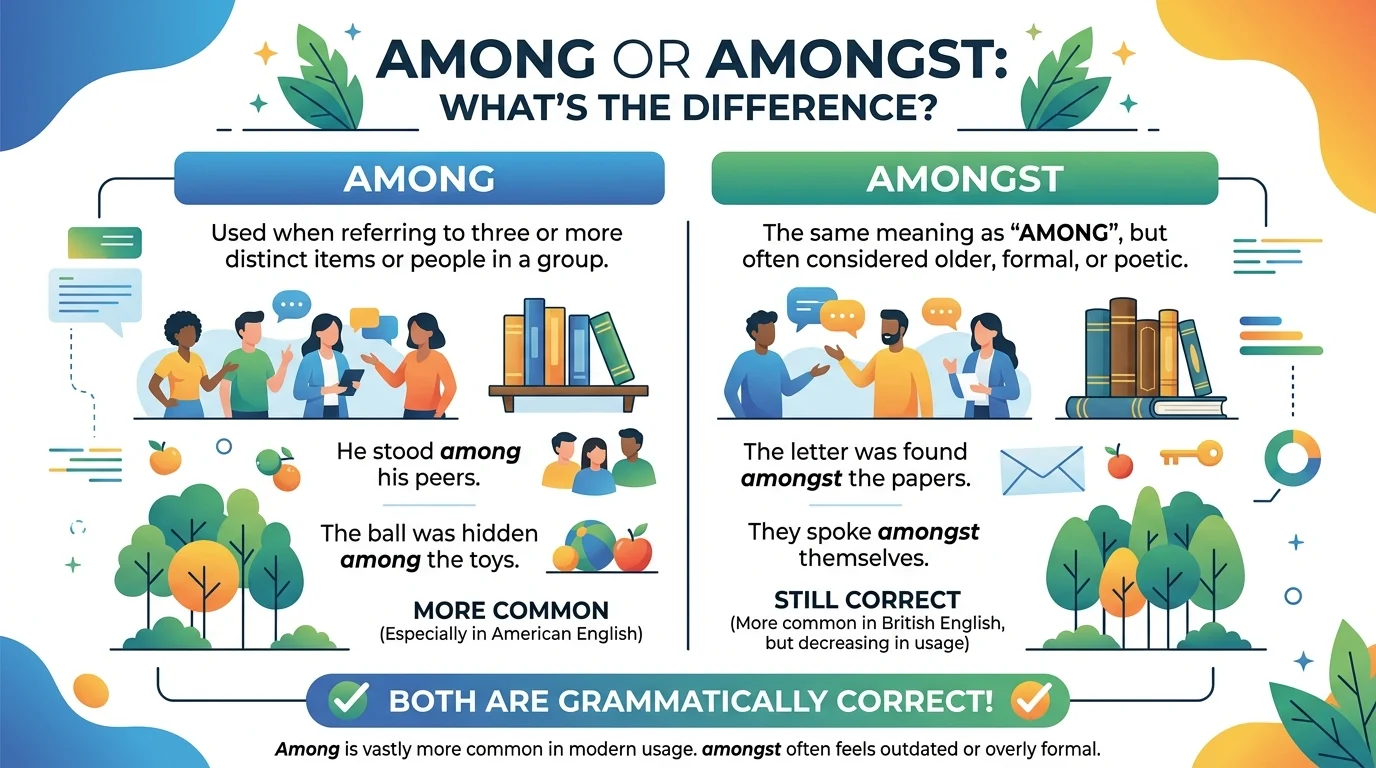
Quick Ans: Among and amongst are both correct prepositions with the same basic meaning. They describe someone or something surrounded by or included within a group. Among is more common in modern English, while amongst can sound more formal or traditional, especially in British usage. In most situations, among is the simpler choice.
Among or amongst is a common grammar question for English learners and writers. Both words can describe something within a group, so their meanings often seem identical. In fact, they usually are.
For example, you can say, “She was among her friends” or “She was amongst her friends.” Both sentences mean that she was surrounded by or in the company of her friends.
However, the two forms don’t always feel exactly the same. Among appears much more frequently in everyday English and modern writing. Meanwhile, amongst can sound more formal, literary, or traditional.
Therefore, choosing between them usually depends on style, context, and personal preference rather than grammar. Once you understand how each word works, you can use both forms confidently and avoid treating amongst as an incorrect version of among.
Quick Answer and Key Takeaway
| Word | Common Use | Example |
|---|---|---|
| Among | Everyday and general writing | She walked among the trees. |
| Amongst | More formal, literary, or traditional contexts | She walked amongst the trees. |
Key takeaway: Both among and amongst are correct. However, among is more common and usually sounds more natural in modern writing.
Definition and Explanation
Among means surrounded by or included within a group or collection.
For example:
- The child sat among the other students.
- She found her phone among the books.
- He felt comfortable among his friends.
Amongst has essentially the same meaning. You can use it in the same types of sentences.
- The child sat amongst the other students.
- She found her phone amongst the books.
- He felt comfortable amongst his friends.
As a result, the choice usually doesn’t change the meaning. Instead, it can change the tone of the sentence.
Is This a Grammar, Usage, or Vocabulary Issue?
This is mainly a usage and style issue.
Both words function as prepositions. They can introduce a group or collection that contains the person or thing being discussed.
| Among | Amongst |
|---|---|
| More common | Less common |
| Modern and neutral | More formal or traditional |
| Common in everyday writing | Often associated with literary writing |
| Widely used internationally | Especially familiar in British usage |
Therefore, among is usually the safest choice when you want simple, natural wording.
Real World Usage Examples
Workplace
Common: The manager divided the tasks among the team members.
Alternative: The manager divided the tasks amongst the team members.
Recap: Both forms work, but among usually sounds more natural in modern workplace writing.
Academic Writing
Common: The study found differences among the participants.
Alternative: The study found differences amongst the participants.
Recap: Among is generally the more straightforward choice for academic writing.
Everyday Writing
Common: We walked among the trees.
Alternative: We walked amongst the trees.
Recap: Both sentences are correct, although amongst can give the sentence a slightly more literary feel.
Regional or Global Usage Differences
Both forms appear in different varieties of English. However, among is much more common overall.
You may encounter amongst more frequently in British English, particularly in formal or literary contexts. Nevertheless, British speakers and writers also use among regularly.
In American English, among is generally the more common choice. Amongst isn’t necessarily incorrect, but it can sound more formal or old fashioned depending on the context.
| Context | Common Choice |
|---|---|
| Everyday English | among |
| American English | among |
| Modern professional writing | among |
| British English | among and amongst |
| Literary or formal style | amongst can appear |
When NOT to Use It
Avoid these common mistakes:
- Don’t assume amongst is grammatically wrong.
- Don’t use amongst simply to make ordinary writing sound complicated.
- Don’t assume among works only in American English.
- Don’t switch between the two forms without considering your intended tone.
- Don’t confuse among with between when discussing relationships involving specific individuals or groups.
- Don’t use either word when the sentence doesn’t involve a group, collection, or surrounding context.
Common Mistakes and Corrections
| Correct Sentence | Incorrect Sentence | Why |
|---|---|---|
| She sat among her friends. | She sat amongs her friends. | Among is the correct spelling. |
| He found the letter among the papers. | He found the letter amongst the papers. | This isn’t grammatically incorrect; amongst is also correct. |
| The prize was divided among the winners. | The prize was divided amongs the winners. | Amongst must not be shortened to “amongs.” |
| The students worked among themselves. | The students worked amongst themselves. | Both forms can be correct, depending on style. |
Simple Decision Rule
Use among when you want the most common, natural choice. Use amongst when you prefer a more formal, literary, or traditional tone. Both are grammatically correct.
Exercises With Answers
Choose the more natural option for each sentence.
- The teacher walked ___ the students.
- She searched ___ the old documents.
- The money was divided ___ the three children.
- He felt relaxed ___ his closest friends.
- The flowers grew ___ the tall trees.
Answers
- among
- among
- among
- among
- among
Note: You can replace each answer with amongst without changing the basic meaning.
Related Concepts and Comparisons
Among and amongst are closely related to between, but they aren’t always interchangeable.
Use among when referring generally to a group:
- She was sitting among her classmates.
Use between when referring to distinct people, things, or relationships:
- The agreement was made between the two companies.
The exact choice can depend on the sentence, but this simple distinction works well in many everyday situations.
FAQs
Is among or amongst correct?
Both are correct prepositions. Among is more common, while amongst can sound more formal, literary, or traditional.
Is among more common than amongst?
Yes. Among appears much more frequently in modern English. Therefore, it is usually the easier choice for general writing.
Is amongst grammatically correct?
Yes. Amongst is a standard English word and has essentially the same meaning as among.
Is amongst British or American English?
Amongst appears in both varieties, but writers may encounter it more often in British English. American English generally favors the shorter form among.
Can I use among in formal writing?
Yes. Among works perfectly well in formal writing. In fact, it is often the clearer and more natural choice.
Does among mean the same as amongst?
In most contexts, yes. Both words describe someone or something within, surrounded by, or included in a group.
Should I use among or amongst in academic writing?
Among is usually a simple and natural choice for academic writing. However, amongst is also grammatically acceptable if it fits the style of your work.
Why do people say amongst instead of among?
Some writers choose amongst because it sounds more formal, literary, or traditional. However, it doesn’t normally add a different meaning.
Can among and amongst be used interchangeably?
Usually, yes. You can often replace one with the other without changing the meaning, although the tone may feel slightly different.
Conclusion
The difference between among or amongst is mainly about usage and style. Both words are correct, and both usually carry the same meaning. They describe someone or something within a group, collection, or surrounding environment.
However, among is much more common in modern English. It works naturally in everyday conversations, professional documents, academic writing, and online content. Amongst, on the other hand, can create a more formal, literary, or traditional tone.
Therefore, if you’re unsure which word to choose, among is usually the simplest option. Still, there’s nothing grammatically wrong with amongst when it suits your writing style.
Practical tip: Choose among for clear, modern, everyday writing. Choose amongst when you deliberately want a slightly more formal or literary tone.