
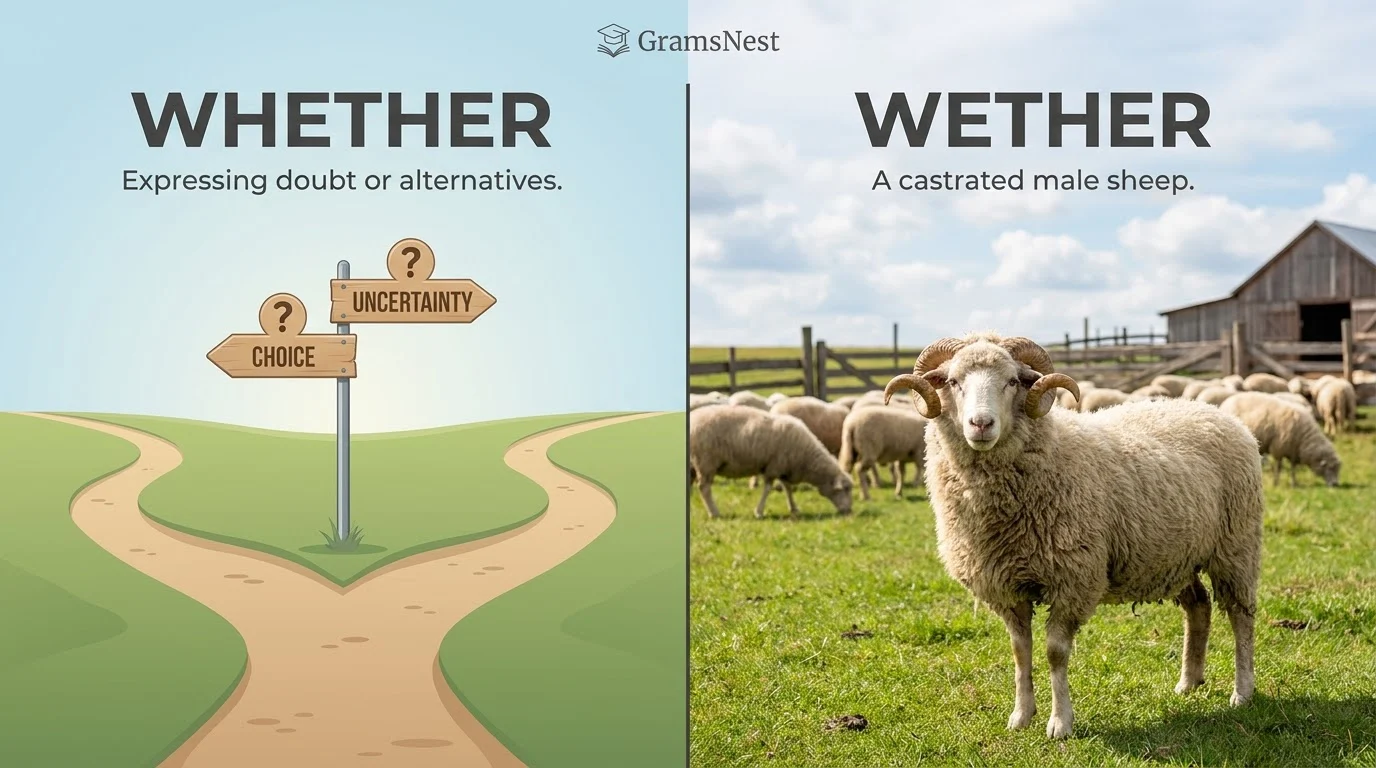
Quick Ans: Whether is the correct word when you mean expressing a choice, possibility, or uncertainty. Wether is a different and uncommon noun that refers to a castrated male sheep or goat. For everyday writing, use whether in phrases such as “whether or not” and “whether you agree.” Wether is rarely needed outside specific farming contexts.
Whether or wether is an easy spelling confusion because the two words sound alike in many varieties of English. However, they have completely different meanings and uses. If you are writing an email, school assignment, article, or everyday message, whether is almost certainly the word you need.
Whether is commonly used to introduce alternatives or express uncertainty. For example, you might say, “I don’t know whether she will come” or “Tell me whether you want tea or coffee.”
Wether, in contrast, is a specialized noun. It refers to a male sheep that has been castrated. The word can also be used for a castrated male goat, although its use is much less common in everyday English.
Because both words are pronounced similarly, spell check alone may not catch the mistake. Understanding their meanings is the best way to choose the correct spelling.
Quick Answer and Key Takeaway
Whether is the common word used when discussing choices, alternatives, or uncertainty.
Wether is a rare farming term for a castrated male sheep or goat.
Easy rule: If you mean “if” or are talking about two possibilities, use whether. If you mean a castrated male sheep or goat, use wether.
Whether vs Wether: Definition and Explanation
What Does Whether Mean?
Whether is used when talking about alternatives, possibilities, or uncertainty. It often appears before or, or not, or another alternative.
Examples:
- I don’t know whether he is coming.
- She asked whether I needed help.
- We must decide whether to stay or leave.
- I’m not sure whether it will rain.
In many sentences, whether can be similar in meaning to if, although the two words are not interchangeable in every situation.
What Does Wether Mean?
Wether is a noun used mainly in agricultural and livestock contexts. It traditionally refers to a castrated male sheep. Some dictionaries also include a castrated male goat.
Example:
The farmer moved the wether into a separate enclosure.
This word is uncommon in normal conversation, so most English learners will rarely need to use it.
Is This a Grammar, Usage, or Vocabulary Issue?
Whether or wether is primarily a spelling and vocabulary issue.
The words are pronounced similarly, making them homophones or near homophones depending on pronunciation. Their meanings, however, are completely different.
A simple spelling mistake can change the meaning of a sentence. For example:
Correct: I don’t know whether he will come.
Incorrect: I don’t know wether he will come.
The second sentence uses a livestock term where a conjunction is required.
Real World Usage Examples
Everyday Usage
- I can’t decide whether to go.
- She asked whether I was ready.
- Do you know whether the store is open?
Recap: Use whether for choices, possibilities, and uncertainty.
Academic Usage
- The study examined whether exercise affected memory.
- Researchers wanted to determine whether the treatment was effective.
Recap: Whether is common in formal and academic writing when presenting a question or possibility.
Farming Usage
- The farmer purchased a young wether.
- The flock included several ewes, rams, and wethers.
Recap: Wether is a specialized livestock term.
Regional or Global Usage Differences
The basic meanings of whether and wether do not change significantly between major varieties of English. Whether is widely used in everyday and formal English.
Wether remains a specialized agricultural term. You are more likely to encounter it in farming, livestock, veterinary, or historical writing than in ordinary conversation.
When NOT to Use Whether or Wether
Do not use wether when:
- You mean “if.”
- You are presenting two choices.
- You are expressing uncertainty.
- You are writing a normal question about possibilities.
Do not use whether when:
- You specifically mean a castrated male sheep or goat.
- You are writing about livestock and need the specific noun wether.
Common Mistakes and Corrections
| Correct Sentence | Incorrect Sentence | Why |
|---|---|---|
| I don’t know whether she will come. | I don’t know wether she will come. | Whether expresses uncertainty. |
| Tell me whether you agree. | Tell me wether you agree. | The sentence presents a possibility. |
| The farmer raised several wethers. | The farmer raised several whether. | Wether is the livestock noun. |
| We need to decide whether to stay. | We need to decide wether to stay. | Whether introduces an alternative. |
Easy Decision Rule
Remember this:
Whether = choice, possibility, or uncertainty
Wether = castrated male sheep or goat
If you can replace the word with “if” without changing the meaning, whether is usually the correct choice.
Exercises With Answers
Choose whether or wether.
- I don’t know ______ he will attend.
- The farmer owns several ______.
- She asked ______ I wanted coffee.
- We need to decide ______ to leave.
- The farmer separated the ______ from the other sheep.
Answers
- whether
- wethers
- whether
- whether
- wethers
Related Concepts and Comparisons
Whether or If
Whether and if can both introduce uncertainty in many sentences. However, whether is generally preferred when presenting alternatives, especially with or.
Example:
I don’t know whether to stay or leave.
Whether or Not
Whether or not means that something applies regardless of the outcome.
Example:
I’ll go whether or not you come.
Wether vs Weather
Wether is a livestock term, while weather refers to atmospheric conditions.
Example:
The weather is cold today.
Do not confuse weather with either whether or wether.
FAQs
What is the difference between whether and wether?
Whether is used to express choices, alternatives, or uncertainty. Wether is a specialized noun referring to a castrated male sheep or goat.
Is whether or wether correct?
Both are real English words, but they have different meanings. Whether is the correct choice for normal sentences involving uncertainty or alternatives.
Is wether a real word?
Yes. Wether is a legitimate but uncommon word used mainly in livestock and agricultural contexts.
How do you remember whether vs wether?
Remember that whether is connected with choices and possibilities. Wether is connected with sheep or goats.
Is whether the same as if?
Sometimes. Whether can often replace if when expressing uncertainty, but whether is especially useful when discussing alternatives.
What does wether mean in farming?
A wether is traditionally a castrated male sheep. The term can also refer to a castrated male goat in some usage.
Why do people confuse whether and wether?
They are pronounced similarly, so people often confuse their spellings. Their meanings are completely different.
Should I use whether or not?
Use whether or not when you want to show that the outcome does not affect what happens next.
Conclusion
Whether or wether may look almost identical, but the two words have very different jobs. Whether is the word you will use in almost all everyday situations involving choices, alternatives, or uncertainty. For example, “I don’t know whether she is coming” uses whether correctly.
Wether is much less common. It is a specialized livestock term referring to a castrated male sheep or, in some usage, a castrated male goat. You are unlikely to need this word unless you are discussing farming, animals, or agriculture.
The easiest way to remember the difference is to connect whether with choices and possibilities. If you could use “if” in the sentence, whether is often the right choice. Save wether for its specific agricultural meaning.
Next time you are unsure, stop and ask yourself what you mean. If you’re talking about a possibility, choice, or uncertainty, choose whether.
2 thoughts on “Whether or Wether: What’s the Difference? Meaning, Rules & Examples”