
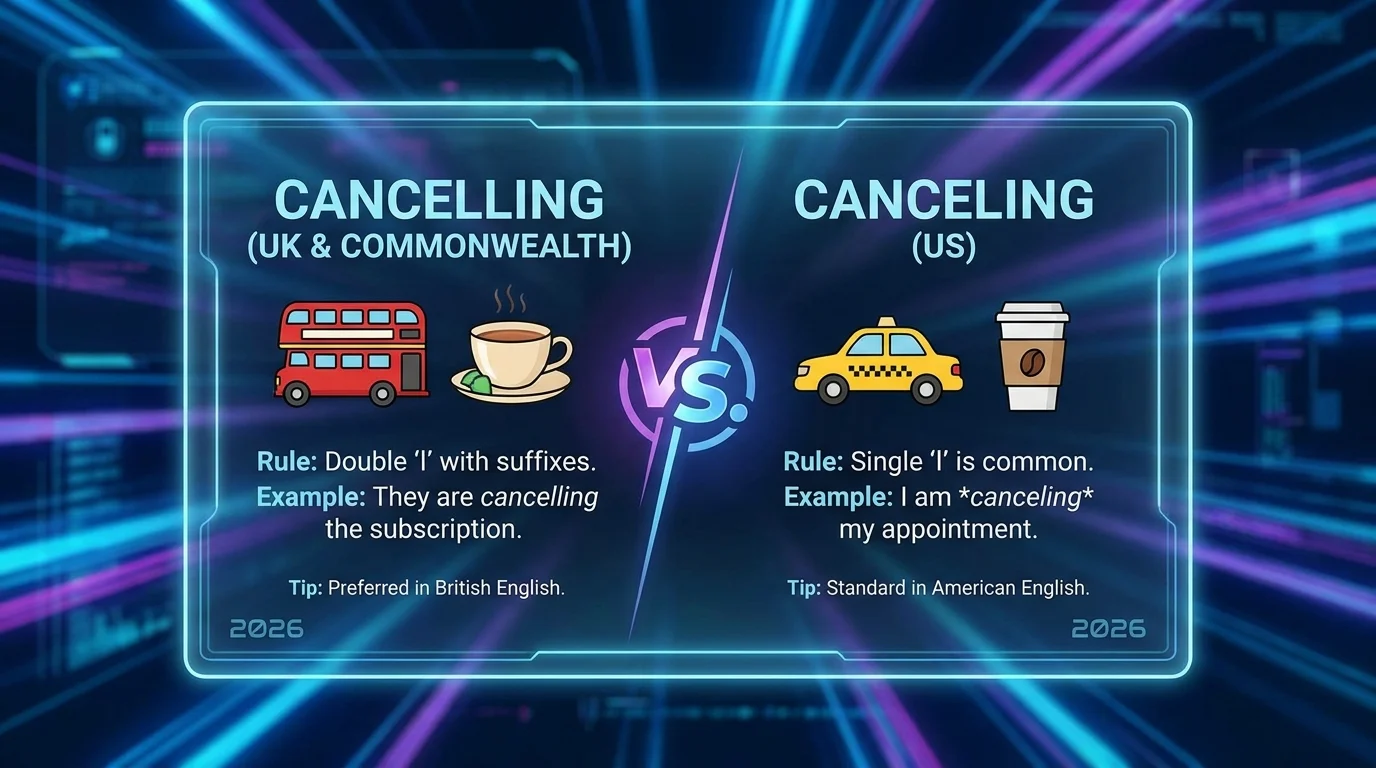
Quick Ans: “Cancelling” and “canceling” are both correct spellings of the present participle of “cancel.” The main difference is regional spelling. “Cancelling” is more common in British English, while “canceling” is standard in American English. Both forms have the same meaning and pronunciation.
Are you confused about whether to write “cancelling or canceling”? Both spellings are correct, so the choice depends mainly on the variety of English you are using.
The verb “cancel” means to stop something that was planned or arranged. For example, you can cancel a meeting, reservation, subscription, trip, or event. When you use the present participle or gerund form, you may see either “cancelling” or “canceling.”
The difference comes from spelling conventions. British English usually doubles the final “l” before adding “ing,” while American English normally keeps one “l” in “canceling.”
As a result, you may see both forms in books, websites, emails, and news articles. Neither spelling is a mistake when used according to the appropriate English variety.
The important thing is consistency. Once you choose a spelling style, keep using it throughout the same piece of writing.
Quick Answer: Cancelling or Canceling?
| Spelling | Common Usage | Example |
|---|---|---|
| Cancelling | British English | We are cancelling the meeting. |
| Canceling | American English | We are canceling the meeting. |
Both spellings are correct. Choose “cancelling” for British spelling and “canceling” for American spelling.
Definition and Explanation
Cancelling
“Cancelling” is the present participle and gerund form of “cancel.” It means stopping or ending something that was planned.
Example: They are cancelling the event because of the weather.
The double “l” spelling is common in British English and several other varieties that follow similar spelling patterns.
Canceling
“Canceling” has exactly the same meaning as “cancelling.” The main difference is spelling.
Example: They are canceling the event because of the weather.
American English generally uses one “l” in this form.
| Form | Meaning | Example |
|---|---|---|
| Cancel | Stop something planned | We need to cancel the meeting. |
| Cancelling | Stopping something | We are cancelling the meeting. |
| Canceling | Stopping something | We are canceling the meeting. |
| Cancelled | Past form, British spelling | The meeting was cancelled. |
| Canceled | Past form, American spelling | The meeting was canceled. |
The meaning does not change between “cancelling” and “canceling.” Only the spelling varies.
Is This a Grammar, Usage, or Vocabulary Issue?
This is mainly a spelling and usage issue, not a difference in grammar.
Both “cancelling” and “canceling” are grammatically correct. Your choice depends on the spelling convention you follow.
British English generally writes “cancelling” and “cancelled.” American English generally writes “canceling” and “canceled.”
Therefore, don’t mix styles without a reason. If your article uses American spelling, use “canceling.” If it follows British spelling, use “cancelling.”
Real World Usage Examples
Workplace Example
“We are cancelling the meeting due to a scheduling conflict.”
This spelling is common in British English.
American style would write:
“We are canceling the meeting due to a scheduling conflict.”
Recap: Both forms work in professional writing. Choose one spelling style and stay consistent.
Academic Example
“The researchers considered cancelling the experiment.”
American academic writing would usually use:
“The researchers considered canceling the experiment.”
Recap: Academic writers should follow the spelling style required by their institution or publication.
Everyday Example
“I’m thinking about cancelling my subscription.”
American spelling:
“I’m thinking about canceling my subscription.”
Recap: The pronunciation and meaning remain the same.
Regional or Global Usage Differences
The biggest difference between “cancelling” and “canceling” is regional.
British English generally uses “cancelling” with two “l” letters. American English generally uses “canceling” with one “l.”
Canadian, Australian, and New Zealand English often follow British spelling conventions and commonly use “cancelling.”
The same difference appears in the past tense. British English commonly uses “cancelled,” while American English commonly uses “canceled.”
When NOT to Use It
Don’t treat “cancelling” and “canceling” as different words. They have the same meaning.
Don’t switch between the two spellings randomly in the same article.
Don’t assume “canceling” is a spelling error when reading British English.
Avoid changing the spelling style halfway through formal writing unless you are quoting a source.
Don’t confuse “canceling” with “counseling.” They have completely different meanings.
Common Mistakes and Corrections
| Correct Sentence | Incorrect Sentence | Why |
|---|---|---|
| We are cancelling the event. | We are canceling the event. | Not incorrect in American English, but British style prefers “cancelling.” |
| We are canceling the event. | We are cancelling the event. | Not incorrect in British English, but American style prefers “canceling.” |
| She is cancelling her appointment. | She is canceling her appointment. | British spelling uses two “l” letters. |
| He is canceling his reservation. | He is cancelling his reservation. | American spelling usually uses one “l.” |
Decision Rule: Choose “cancelling” for British style and “canceling” for American style. Both forms are correct.
Exercises With Answers
Choose the spelling that matches the requested style.
- British English: We are _____ the trip.
- American English: She is _____ her appointment.
- British English: They are _____ the event.
- American English: He is _____ his subscription.
- Are both spellings correct?
Answer Key
- cancelling
- canceling
- cancelling
- canceling
- Yes
Related Concepts and Comparisons
Readers may also search for canceling vs cancelling, canceled vs cancelled, cancel spelling, cancel past tense, British vs American spelling, traveling vs travelling, labeling vs labelling, and modeling vs modelling.
FAQs
Is cancelling or canceling correct?
Both spellings are correct. “Cancelling” is common in British English, while “canceling” is standard in American English.
Which spelling is correct, cancelling or canceling?
Neither spelling is universally more correct. The right choice depends on the English variety you are using.
Is cancelling British spelling?
Yes. “Cancelling” is the usual British spelling of the present participle of “cancel.”
Is canceling American spelling?
Yes. “Canceling” is the standard American spelling. American English generally keeps one “l” before “ing.”
Why does British English spell cancelling with two Ls?
British spelling conventions often double the final “l” when adding an ending such as “ing.” Therefore, “cancel” becomes “cancelling.”
Why does American English spell canceling with one L?
American spelling generally does not double the final “l” in “canceling.” Therefore, the standard form is “canceling.”
Is canceled or cancelled correct?
Both are correct. “Cancelled” is common in British English, while “canceled” is standard in American English.
Should I use cancelling or canceling in an article?
Choose the spelling that matches your target audience and overall style. Most importantly, use the same spelling consistently throughout the article.
Conclusion
“Cancelling” and “canceling” are both correct forms of the verb “cancel.” They mean exactly the same thing, but English spelling conventions determine which version you will usually see.
British English generally uses “cancelling,” while American English uses “canceling.” The same pattern appears in the past tense, where British English commonly uses “cancelled” and American English uses “canceled.”
Neither form is a grammar mistake. The key is consistency. If you are writing for an American audience, choose “canceling.” If you are following British spelling, choose “cancelling.”
The difference is small, but it matters in polished writing. A consistent spelling style makes your content look professional and trustworthy.
Practical tip: check your target audience before choosing the spelling, then use that spelling throughout the entire article.
2 thoughts on “Cancelling or Canceling: What’s the Difference? Easy Rules, Examples & Tips 2026”