
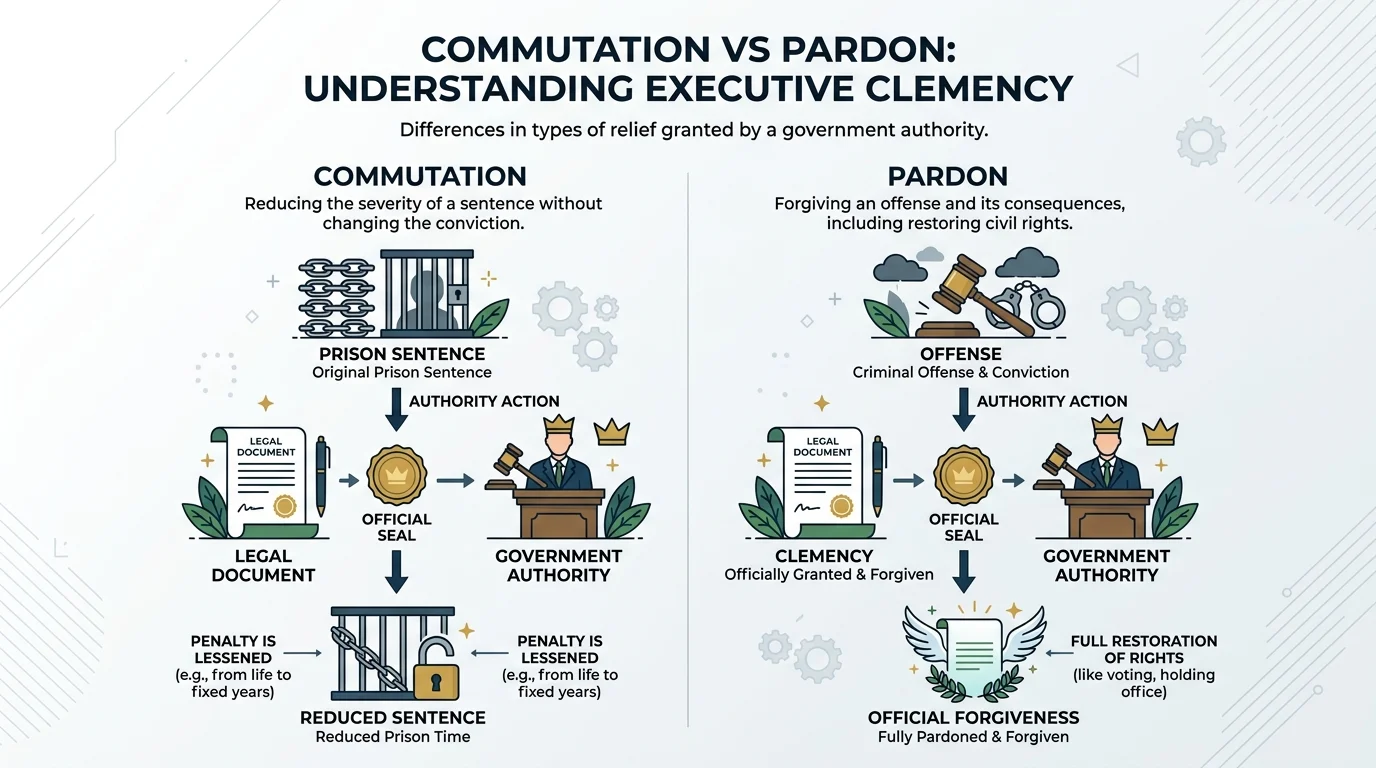
Quick Ans: Commutation and pardon are both forms of clemency, but they do different things. A commutation reduces or changes a person’s punishment without generally erasing the conviction. A pardon forgives an offense and may remove or reduce certain legal consequences. In simple terms, commutation changes the sentence, while a pardon provides forgiveness.
Commutation vs pardon can be confusing because both terms relate to government authority to provide relief from criminal penalties. They are often discussed together, especially when a president, governor, or other authorized official grants clemency.
The key difference is what happens to the punishment and the underlying offense. A commutation generally reduces a sentence. For example, a prison sentence might be shortened, while the conviction itself remains.
A pardon is an act of forgiveness for an offense. Depending on the legal system and the type of pardon, it can remove or reduce certain legal consequences of a conviction. However, a pardon does not necessarily mean that the underlying conviction is erased.
These distinctions matter in legal writing, news reports, government documents, and everyday discussions. Understanding the terms helps you describe criminal justice decisions more accurately.
Quick Answer and Key Takeaway
The simplest distinction is:
Commutation = reduction or change of a punishment.
Pardon = forgiveness of an offense and relief from certain legal consequences.
A commutation usually focuses on the sentence, while a pardon focuses more broadly on the offense and its legal consequences.
Commutation vs Pardon: Definition and Explanation
What Is Commutation?
Commutation is the reduction or alteration of a criminal sentence.
For example, suppose a person receives a 20 year prison sentence. An authorized official may commute the sentence to 10 years. The person’s conviction generally remains in place.
A commutation can therefore provide significant relief without completely removing the punishment.
What Is a Pardon?
A pardon is an official act of forgiveness for a criminal offense.
In the United States federal system, the president’s pardon power comes from the Constitution and applies to federal offenses, except cases of impeachment. A pardon does not itself establish innocence or automatically erase a conviction.
A pardon may relieve certain legal consequences associated with the offense, depending on the circumstances and applicable law.
Is This a Grammar, Usage, or Vocabulary Issue?
Commutation vs pardon is primarily a legal vocabulary and usage comparison.
Both words describe forms of clemency, but they are not interchangeable.
Use commutation when discussing a reduction or change to a sentence.
Use pardon when discussing official forgiveness and relief from certain consequences of an offense.
The exact legal effects can differ between jurisdictions, so legal documents should always be interpreted according to the relevant law.
Real World Usage Examples
Legal Usage
Commutation:
The governor commuted the prisoner’s sentence from life imprisonment to a fixed term.
Pardon:
The president granted a pardon for the federal offense.
Recap: Commutation changes the punishment, while a pardon provides official forgiveness and legal relief.
News Usage
Commutation:
The sentence was commuted after the review of the case.
Pardon:
The president announced several pardons before leaving office.
Recap: News reports use the terms differently because the legal action involved is different.
Everyday Explanation
You could explain the distinction simply:
A commutation makes the punishment less severe.
A pardon forgives the offense and may remove certain consequences.
Recap: Think sentence reduction for commutation and official forgiveness for pardon.
Key Differences Between Commutation and Pardon
| Feature | Commutation | Pardon |
|---|---|---|
| Main purpose | Reduces or changes a sentence | Forgives an offense |
| Conviction | Generally remains | Generally remains unless another legal process changes it |
| Prison sentence | Can reduce or end it | May provide relief from certain consequences |
| Focus | Punishment | Offense and its consequences |
| Type of clemency | Yes | Yes |
| Legal effect | Depends on jurisdiction | Depends on jurisdiction |
In the US federal system, the Department of Justice explains that commutation reduces a sentence, while a pardon is an expression of forgiveness for a federal offense.
Regional or Global Usage Differences
The exact meaning and legal effect of commutation and pardon vary between countries and legal systems.
In the United States, the president can grant clemency for federal offenses. Governors may have related powers under state law. Other countries may use different procedures, terminology, or authorities.
Therefore, a definition that applies to US federal law should not automatically be treated as universal legal practice.
When NOT to Use These Terms
Do not use commutation when:
- You mean that a conviction has been completely forgiven.
- You are simply describing an appeal.
- A court has overturned a conviction.
- A sentence has been changed through ordinary judicial review.
Do not use pardon when:
- You only mean that a prison sentence was shortened.
- A court reduced a sentence through normal legal proceedings.
- A conviction was overturned on appeal.
- You mean parole or probation.
These terms describe different legal actions.
Common Mistakes and Corrections
| Correct Sentence | Incorrect Sentence | Why |
|---|---|---|
| The governor commuted his sentence. | The governor pardoned his sentence. | A sentence can be commuted; pardon refers to an offense. |
| The president granted a pardon. | The president granted a commutation. | The action described was forgiveness rather than sentence reduction. |
| His sentence was reduced through commutation. | His conviction was erased through commutation. | Commutation generally changes punishment rather than erasing the conviction. |
| She received a pardon for the offense. | She received a pardon for her prison term. | A pardon concerns the offense and its legal consequences. |
Easy Decision Rule
Ask yourself:
Was the punishment reduced or changed?
Use commutation.
Was the offense officially forgiven?
Use pardon.
Remember: commutation changes the sentence; pardon forgives the offense.
Exercises With Answers
Choose commutation or pardon.
- The prison sentence was reduced from 15 years to 8 years through ______.
- The president granted a ______ for the federal offense.
- The official action reduced the person’s sentence but did not generally erase the conviction. This was a ______.
- The government officially forgave the offense. This was a ______.
- The prisoner received a shorter sentence through ______.
Answers
- commutation
- pardon
- commutation
- pardon
- commutation
Related Concepts and Comparisons
Commutation vs Clemency
Clemency is a broad term for official relief from criminal punishment. Commutation and pardon are both forms of clemency.
Pardon vs Expungement
A pardon and expungement are not the same. A pardon is an act of executive clemency, while expungement generally refers to a legal process affecting criminal records.
Commutation vs Parole
Commutation changes a sentence through an authorized clemency process. Parole generally involves supervised release from imprisonment under applicable law.
FAQs
What is the main difference between commutation and pardon?
Commutation generally reduces or changes a criminal sentence. A pardon is an official act of forgiveness that can provide relief from certain legal consequences.
Does a commutation erase a conviction?
Generally, no. A commutation usually changes the punishment while leaving the underlying conviction in place.
Does a pardon mean someone is innocent?
No. In the US federal system, a pardon does not itself establish innocence. It represents an act of clemency and forgiveness.
Is a pardon the same as a sentence reduction?
No. A sentence reduction is generally described as a commutation. A pardon has a different legal purpose.
Can a president grant both pardons and commutations?
In the US federal system, the president has constitutional authority to grant pardons and commutations for federal offenses, subject to the constitutional limitations on that power.
What does commutation mean in simple words?
Commutation means changing or reducing a criminal punishment. It does not normally mean that the conviction disappears.
What does pardon mean in simple words?
A pardon is official forgiveness for an offense. Its precise legal effects depend on the applicable legal system.
Is commutation the same as clemency?
No. Clemency is a broader category that includes different forms of relief, including commutation and pardon.
Conclusion
Commutation vs pardon is easier to understand when you focus on the difference between punishment and forgiveness. A commutation generally reduces or changes a person’s sentence. A pardon is an official act of forgiveness that may relieve certain legal consequences of an offense.
These terms are related because both are forms of clemency, but they should not be used interchangeably. Saying that someone received a commutation usually means the punishment was changed. Saying that someone received a pardon means an authorized official granted forgiveness for the offense.
The exact legal effects of either action can vary depending on the country, state, and type of offense involved. For that reason, legal documents should always be interpreted under the relevant jurisdiction’s laws.
For everyday writing, remember this simple rule: commutation changes the sentence, while a pardon forgives the offense. That distinction will help you use both legal terms accurately.