
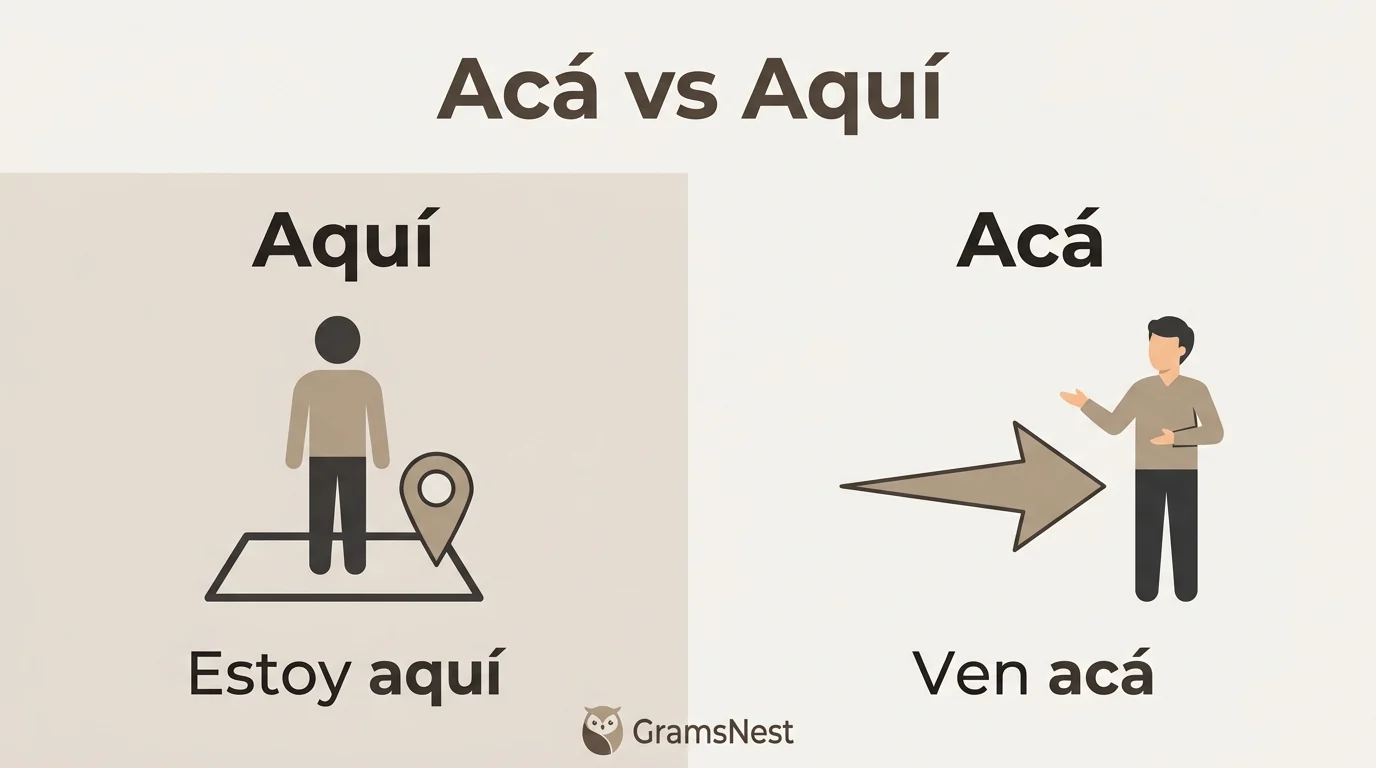
Quick Ans: Acá and aquí are Spanish words that both mean “here,” but they can have slightly different uses. Aquí usually refers to a specific place or location, while acá often refers to a general area or movement toward the speaker. In many regions, however, speakers use both words interchangeably.
Acá vs aquí is a common question for Spanish learners because both words can translate to “here” in English. At first, this can make them seem completely interchangeable. However, there are some useful differences in meaning, tone, and regional usage.
The word aquí generally points to a specific location close to the speaker. For example, Estoy aquí means “I am here.” Acá can also mean “here,” but it often has a broader or less precise sense. It can also appear naturally when talking about movement toward the speaker, such as Ven acá, meaning “Come here.”
The distinction becomes more interesting because Spanish speakers in different countries do not always use acá and aquí in exactly the same way. In some regions, aquí is more common, while other varieties use acá frequently in everyday conversation.
Learning this difference will help you understand natural Spanish and choose the right word based on context.
Quick Answer and Key Takeaway
Aquí and acá can both mean “here.” Aquí often identifies a specific location, while acá can refer to a general area or movement toward the speaker. However, the difference is not absolute, and regional preferences strongly influence how native speakers use these words.
Simple rule:
Aquí = here, at this specific place
Acá = here, around this area or toward here
Acá vs Aquí: Definition and Explanation
What Does Aquí Mean?
Aquí is an adverb that means “here.” It commonly identifies the speaker’s current or nearby location.
Examples:
Estoy aquí.
I am here.
El libro está aquí.
The book is here.
Aquí often sounds more precise when pointing to a particular location.
What Does Acá Mean?
Acá also means “here,” but it can suggest a broader area or movement toward the speaker.
Examples:
Ven acá.
Come here.
Quédate acá.
Stay here.
Acá is especially common in many varieties of Latin American Spanish.
Is This a Grammar, Usage, or Vocabulary Issue?
Acá vs aquí is mainly a vocabulary and usage issue involving Spanish demonstrative adverbs of place.
Both words are grammatically correct. The main challenge is understanding when native speakers prefer one over the other.
Unlike some vocabulary differences, there is no universal rule saying that acá is always correct in one situation and aquí is always wrong.
Real World Usage Examples
Everyday Conversation
Aquí:
Mi teléfono está aquí.
My phone is here.
Acá:
Ven acá un momento.
Come here for a moment.
Recap: Both can refer to “here,” but acá is especially natural in expressions involving movement toward the speaker.
Giving Directions
Aquí:
La estación está aquí.
The station is here.
Acá:
Puedes sentarte acá.
You can sit here.
Recap: Both words can identify a nearby place.
Casual Conversation
Acá:
Acá hace mucho calor.
It’s very hot here.
Aquí:
Aquí hace mucho frío.
It’s very cold here.
Recap: Regional preference often determines which word sounds more natural.
Acá vs Aquí: Key Differences
| Feature | Aquí | Acá |
|---|---|---|
| Basic meaning | Here | Here |
| Typical sense | More specific location | General area or location |
| Movement | Less common for movement | Very common with movement |
| Regional use | Common throughout Spanish | Especially common in many Latin American varieties |
| Example | Estoy aquí | Ven acá |
| Grammar | Adverb of place | Adverb of place |
Regional or Global Usage Differences
Regional usage is one of the most important parts of the acá vs aquí comparison.
In many parts of Spain, aquí is very common, while acá may sound less frequent or more marked in ordinary conversation.
In many Latin American countries, both words are widely understood, and acá can be extremely natural in everyday speech.
The exact preference varies by country and speaker. Therefore, Spanish learners should not assume that one word is universally more correct than the other.
When NOT to Use Acá or Aquí
Avoid treating the words as completely identical in every sentence.
Do not assume acá always means a broad location
Context matters, and native speakers can use acá for a specific nearby place.
Do not assume aquí is never used for movement
Spanish speakers can use aquí in movement related expressions depending on the construction and regional variety.
Do not use English sentence structure directly
Translate the meaning rather than replacing “here” with one Spanish word mechanically.
Do not treat regional preference as a grammar error
A speaker’s choice of acá or aquí may reflect their variety of Spanish rather than incorrect grammar.
Common Mistakes and Corrections
| Correct Sentence | Incorrect Assumption | Why |
|---|---|---|
| Ven acá. | Acá is never used for movement. | Acá commonly appears with movement toward the speaker. |
| Estoy aquí. | Aquí only means a precise physical point. | Aquí can simply mean “here.” |
| Quédate acá. | Acá is grammatically incorrect. | Acá is a standard Spanish adverb. |
| El libro está aquí. | You must always use acá for nearby objects. | Aquí is completely natural for nearby locations. |
Easy Decision Rule
When you want to say “here,” both aquí and acá may work.
Use aquí when you want a straightforward reference to the current or specific location.
Use acá when referring to the area around the speaker or when inviting someone to move toward the speaker.
Then consider the Spanish variety you’re learning because regional preference matters.
Exercises With Answers
Choose acá or aquí.
- Estoy ______ esperando.
- Ven ______, por favor.
- El restaurante está ______.
- Quédate ______ conmigo.
- Mi mochila está ______.
Answers
- aquí
- acá
- aquí
- acá
- aquí
Several answers can vary naturally depending on region and context.
Related Concepts and Comparisons
Aquí vs Allí
Aquí means “here,” while allí generally means “there,” referring to a location farther away.
Acá vs Allá
Acá generally means “here,” while allá generally means “over there” or refers to a more distant area.
Aquí vs Ahí
Aquí normally refers to a place close to the speaker. Ahí often refers to a place near the listener or a location that is not immediately where the speaker is.
FAQs
Is acá or aquí more correct?
Both are correct Spanish words. The choice often depends on context, regional usage, and personal speaking habits.
What is the difference between acá and aquí?
Both can mean “here,” but aquí often points to a specific location, while acá can suggest a broader area or movement toward the speaker.
Is acá used more in Latin America?
Acá is widely used in many Latin American varieties of Spanish. However, usage differs between countries and individual speakers.
Is aquí used in Latin American Spanish?
Yes. Aquí is widely understood and commonly used throughout the Spanish speaking world, including Latin America.
Does acá mean “over here”?
Acá can sometimes correspond naturally to the English expression “over here,” especially when referring to an area near the speaker.
Does aquí mean a specific place?
Aquí can point to a specific nearby location, but it does not always have to identify an exact physical point.
Which should Spanish beginners learn, acá or aquí?
Learning aquí first is useful because it is widely understood. However, learners should also recognize acá because it is common in many Spanish speaking regions.
Can acá and aquí be used interchangeably?
Sometimes, yes. In many sentences, either word can communicate the basic idea of “here,” although the nuance and naturalness can vary by context and region.
Conclusion
Understanding acá vs aquí becomes much easier when you remember that both words generally communicate the idea of “here.” The difference is more about nuance, context, and regional usage than a strict grammar rule.
Aquí often works well when pointing to a specific nearby location, while acá can refer to the surrounding area or appear naturally in expressions involving movement toward the speaker. For example, Estoy aquí means “I am here,” while Ven acá means “Come here.”
However, Spanish varies considerably across countries. A form that sounds especially natural in one region may be less common in another. That does not automatically make it incorrect.
For learners, the best approach is to understand both words and pay attention to the Spanish variety you’re studying. When in doubt, aquí is a broadly understood choice, while recognizing acá will help you understand and produce more natural Spanish in many contexts.
4 thoughts on “Acá vs Aquí: What’s the Difference? Simple Spanish Guide & Examples”