
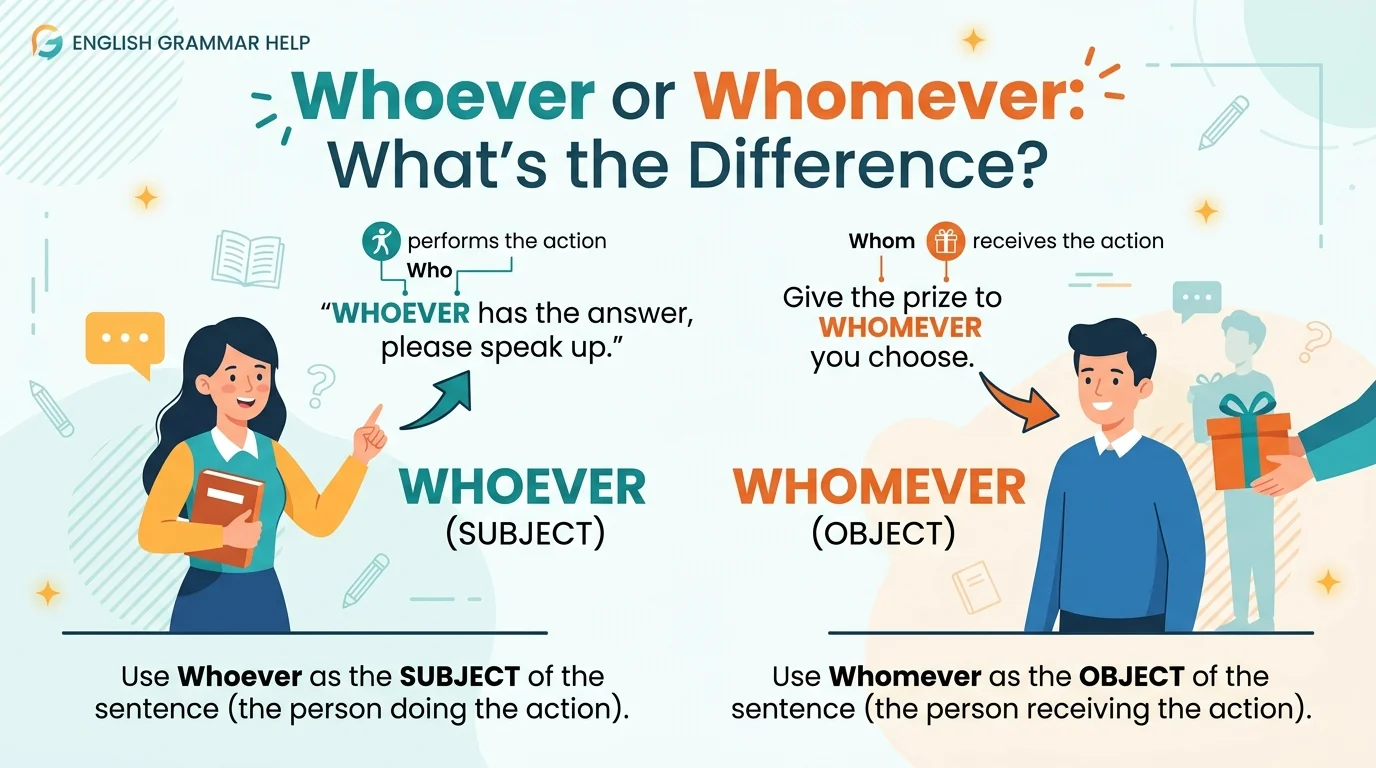
Quick Ans: Whoever and whomever are both correct pronouns, but they have different grammatical roles. Use whoever when the word acts as the subject of a clause. Use whomever when it acts as the object. In everyday English, however, whoever is often preferred when the choice sounds natural and clear.
Are you confused about whether to use whomever or whoever? You’re not alone. These two words look almost identical, and even experienced writers sometimes hesitate before choosing one.
The difference comes down to a simple grammar idea: subject versus object. Whoever performs an action, while whomever receives an action or follows a preposition.
For example, you can say, “Whoever arrives first can choose a seat.” Here, whoever performs the action of arriving. On the other hand, “Give the prize to whomever you choose” uses whomever because that person receives the prize.
However, real English can be more flexible than grammar rules suggest. In casual speech, whoever is much more common. Whomever often sounds formal or even unnatural, especially when the sentence is complicated.
Knowing the basic rule will help you make better choices in academic writing, professional communication, and everyday English. Once you learn how to test the word with “he or him” or “she or her,” the difference becomes much easier to spot.
Quick Answer: Whomever or Whoever?
| Word | Grammatical Role | Simple Meaning | Example |
|---|---|---|---|
| Whoever | Subject | Any person who | Whoever calls can leave a message. |
| Whomever | Object | Any person whom | Choose whomever you prefer. |
Quick rule: Use whoever for the subject and whomever for the object.
Definition and Explanation
Whoever
“Whoever” is an indefinite relative pronoun. It refers to any person who performs an action or serves as the subject of a clause.
Example: Whoever finishes first will win.
Here, whoever performs the action of finishing.
Another example is “Invite whoever wants to come.” In this sentence, whoever is the subject of “wants.”
Whomever
“Whomever” is the objective form of whoever. It refers to any person who receives an action or functions as the object of a verb or preposition.
Example: Choose whomever you trust.
Here, “you” performs the action of choosing, while whomever receives that action.
Another example is “Give the award to whomever you select.”
| Feature | Whoever | Whomever |
|---|---|---|
| Role | Subject | Object |
| Related pronoun | Who | Whom |
| Example | Whoever calls can speak. | Call whomever you trust. |
| Commonness | Very common | More formal |
The main difference is grammatical role. Whoever acts, while whomever receives the action. However, the correct choice can depend on the clause where the pronoun appears.
Is This a Grammar, Usage, or Vocabulary Issue?
This is primarily a grammar and usage issue.
The easiest way to choose is to look at the clause immediately after whoever or whomever.
If the pronoun performs the action, use whoever.
Example: Whoever wins gets the prize.
If another person performs the action and the pronoun receives it, use whomever.
Example: Choose whomever you want.
A useful test is to replace the word with “he” or “him.”
If “he” sounds correct, choose whoever.
If “him” sounds correct, choose whomever.
For example, “Whoever arrives first” becomes “He arrives first,” so whoever is correct.
“Give it to whomever you choose” becomes “Give it to him,” so whomever works.
Real World Usage Examples
Workplace Examples
“Whoever handles the account should contact the client.”
Whoever is the subject of “handles.”
“Send the report to whomever you think is responsible.”
Whomever receives the report.
Recap: In professional writing, choose the form based on its grammatical role.
Academic Examples
“Whoever completes the experiment first should record the results.”
Whoever performs the action of completing.
“The researcher can interview whomever the participants recommend.”
The recommended person receives the action of being interviewed.
Recap: Academic writing often requires careful attention to subject and object roles.
Everyday Examples
“Whoever wants pizza can order some.”
“Invite whomever you like.”
Both forms can work in conversation, although whoever is much more common in everyday speech.
Recap: Casual English often favors whoever because it sounds simpler and more natural.
Regional or Global Usage Differences
Whoever and whomever are used in major varieties of English, including American and British English.
The grammar rule remains the same, but actual usage can vary. Whomever sounds formal to many speakers, and some people rarely use it in conversation.
Modern English also shows a growing preference for whoever in places where traditional grammar would expect whomever. As a result, you may encounter sentences that use whoever even when the formal rule suggests whomever.
When NOT to Use It
Do not automatically use whomever simply because a sentence sounds formal.
Do not use whoever when the pronoun clearly functions as the object of a verb or preposition in formal writing.
Avoid changing the word based only on what sounds sophisticated.
Do not assume that whomever must always appear after “to.” Check the entire clause instead.
Avoid relying only on the word immediately before the pronoun. The pronoun’s role inside its clause determines the correct choice.
Common Mistakes and Corrections
| Correct Sentence | Incorrect Sentence | Why |
|---|---|---|
| Whoever calls should leave a message. | Whomever calls should leave a message. | Whoever is the subject of “calls.” |
| Give the book to whomever you choose. | Give the book to whoever you choose. | Whomever functions as the object of “choose.” |
| Whoever wins will receive the award. | Whomever wins will receive the award. | Whoever performs the action. |
| Hire whomever you think is best. | Hire whoever you think is best. | In formal grammar, whomever is the object of “hire.” |
Decision Rule: Replace the word with “he” or “him.” If “he” fits, use whoever. If “him” fits, use whomever.
Exercises With Answers
Choose whoever or whomever.
- _____ arrives first can start the meeting.
- Invite _____ you want.
- _____ wins the competition will receive a prize.
- Give the documents to _____ you trust.
- _____ she chooses will lead the project.
- _____ wants to join can sign up.
Answer Key
- Whoever
- whomever
- Whoever
- whomever
- Whomever
- Whoever
Related Concepts and Comparisons
Readers who search for whoever or whomever may also want to learn about who vs whom, whoever vs who, whomever meaning, indefinite pronouns, relative pronouns, subject vs object pronouns, who vs whom examples, and whom vs whomever.
FAQs
What is the difference between whoever and whomever?
Whoever functions as a subject, while whomever functions as an object. A simple who versus whom grammar test can help you choose the right form.
Is whoever or whomever more correct?
Neither is always more correct. The right choice depends on grammatical function, although whoever is more common in everyday English.
Should I say whoever or whomever?
Check whether the pronoun performs or receives the action. Use whoever for the subject and whomever for the object.
Is whomever still used?
Yes. Whomever remains grammatically correct and appears in formal writing. However, many speakers prefer whoever in casual conversation.
Is “Whoever you choose” correct?
Yes. In modern everyday English, “whoever you choose” is very common. Traditional formal grammar may prefer “whomever you choose” because the pronoun functions as the object of “choose.”
Is it “to whoever” or “to whomever”?
Traditional grammar generally favors “to whomever” when the pronoun follows the preposition “to.” However, “to whoever” is also common in modern usage.
Can whoever be an object?
Yes. In modern English, whoever can function as an object, especially in informal speech. Formal writing may use whomever in such situations.
How can I remember whoever vs whomever?
Use the “he or him” test. If you can replace the word with “he,” use whoever. If “him” fits, use whomever.
Conclusion
The difference between whoever and whomever mainly depends on whether the pronoun acts as a subject or an object. Use whoever when the person performs the action. Use whomever when the person receives the action or follows a preposition.
For example, “Whoever arrives first can choose a seat” is correct because whoever performs the action. In “Choose whomever you trust,” whomever receives the action of choosing.
However, English usage has become more flexible. Whoever appears frequently in everyday speech, even in places where traditional grammar might suggest whomever. Therefore, you don’t always need to force whomever into a sentence simply to make it sound formal.
For formal writing, the safest approach is to check the pronoun’s role within its clause.
Practical tip: replace whoever or whomever with he or him. If “he” works, choose whoever. If “him” works, choose whomever.