
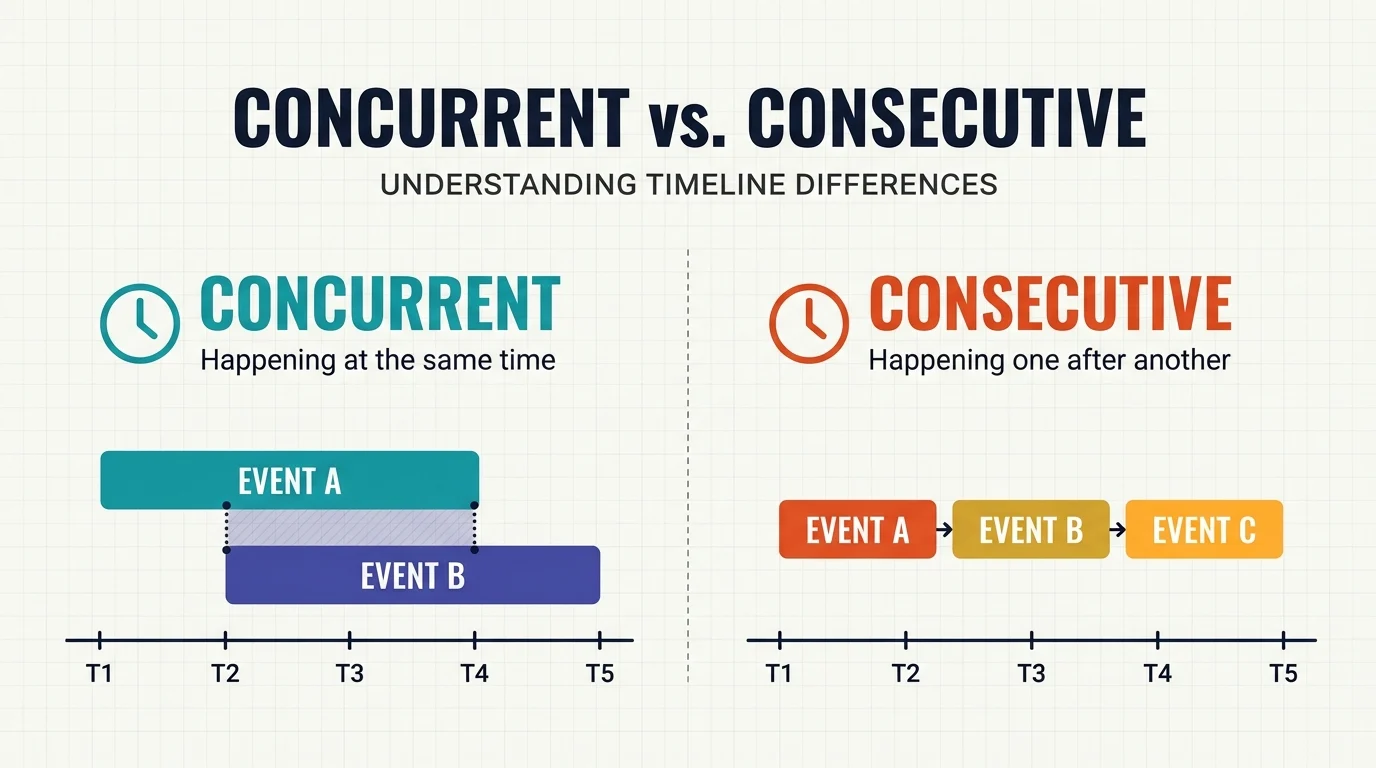
Quick Answer: Concurrent vs consecutive describes two different ways events can happen. Concurrent means two or more events occur at the same time or overlap, while consecutive means events happen one after another in an uninterrupted sequence. For example, two meetings happening simultaneously are concurrent, while meetings held one after another are consecutive.
Have you ever confused the words concurrent and consecutive? Both describe how events relate to one another, but they refer to different timing patterns. Understanding the difference can help you communicate more clearly in everyday conversations, academic writing, workplace instructions, and legal or technical documents.
The word concurrent describes events that happen at the same time or during overlapping periods. In contrast, consecutive describes events that follow one another in a continuous sequence without a break in between.
For example, two employees working on separate projects at the same time are working concurrently. However, if one employee completes the first project and then starts the second, the projects are completed consecutively.
In this guide, you will learn the meaning of concurrent and consecutive, explore practical examples, compare their differences, and discover common mistakes to avoid.
Concurrent vs Consecutive: Quick Answer
The main difference between concurrent and consecutive is timing.
- Concurrent: Happening at the same time or during overlapping periods.
- Consecutive: Happening one after another in an uninterrupted sequence.
Examples:
- Concurrent classes take place at the same time.
- Consecutive classes take place one after another without a gap.
Remember this simple rule: concurrent means together, while consecutive means in a row.
What Does Concurrent Mean?
Concurrent is an adjective that describes events, activities, or processes that happen at the same time or overlap in duration.
These events do not always need to begin and end at precisely the same moment. They can also be concurrent if they occur during overlapping periods.
For example, a student might attend an online lecture while participating in a group discussion. If both activities occur during the same period, they are concurrent.
Examples of Concurrent
- Two meetings were scheduled concurrently.
- She manages two concurrent research projects.
- The software allows users to complete several tasks concurrently.
- The company launched two concurrent marketing campaigns.
- Both patients received treatment during concurrent hospital visits.
In each example, the activities happen at the same time or overlap.
Common Uses of Concurrent
The word concurrent appears frequently in professional, academic, and technical settings.
In computing, concurrent processes make progress during overlapping periods. In education, concurrent courses may have overlapping schedules. In business, concurrent projects may require employees to manage multiple responsibilities at once.
The word emphasizes timing and overlap rather than order.
What Does Consecutive Mean?
Consecutive is an adjective that describes things happening one after another in an uninterrupted sequence.
It often refers to days, weeks, numbers, wins, losses, meetings, or events that occur in a particular order without a break.
For example, if a student attends classes on Monday, Tuesday, and Wednesday, those are three consecutive days.
Examples of Consecutive
- She worked for five consecutive days.
- The team won three consecutive games.
- He missed two consecutive appointments.
- The company reported profits for four consecutive quarters.
- The numbers 12, 13, and 14 are consecutive integers.
Each example describes a sequence in which one item follows the previous item without interruption.
Common Uses of Consecutive
People often use consecutive when describing streaks, continuous periods, and ordered sequences.
For instance, a runner might complete a workout for seven consecutive days. A student might achieve excellent grades in three consecutive examinations. A business might experience increased sales for several consecutive months.
The word emphasizes uninterrupted order rather than simultaneous activity.
Concurrent vs Consecutive: Key Differences
| Feature | Concurrent | Consecutive |
|---|---|---|
| Main meaning | Happening at the same time or overlapping | Happening one after another |
| Timing | Simultaneous or overlapping | Sequential |
| Order | Events may overlap | Events follow a continuous order |
| Common examples | Projects, meetings, processes | Days, wins, numbers, events |
| Memory trick | Together | In a row |
| Example | Two concurrent classes | Three consecutive classes |
The easiest way to remember the difference is to ask whether events overlap or follow a sequence.
If two activities happen during the same period, they are concurrent. If several events happen one after another without interruption, they are consecutive.
Concurrent vs Consecutive in Real Life
Understanding these words becomes easier when you see how they work in everyday situations.
At work: An employee managing two projects during the same week may be handling concurrent projects. If the employee finishes one project before starting the next, the projects are completed consecutively.
At school: Two lessons scheduled for the same time are concurrent. However, a mathematics lesson followed by an English lesson is consecutive if they occur one after another without a break.
In sports: A team playing two tournaments during overlapping periods participates in concurrent competitions. A team winning five games in a row achieves five consecutive wins.
In healthcare: Concurrent treatments may occur during overlapping periods. Consecutive appointments happen one after another in a continuous schedule.
These examples show why choosing the correct word matters. The words describe different relationships between events, even when the events themselves are similar.
Common Mistakes to Avoid
1. Using Concurrent When You Mean Consecutive
Incorrect: The team won three concurrent games.
Correct: The team won three consecutive games.
The games happened one after another, so consecutive is the appropriate word.
2. Using Consecutive for Simultaneous Events
Incorrect: The two meetings were consecutive because they happened at the same time.
Correct: The two meetings were concurrent because they happened at the same time.
When events overlap, concurrent is usually the better choice.
3. Assuming Consecutive Always Means Immediately
Consecutive events follow one another without interruption in the relevant sequence. However, the exact meaning of an interruption depends on context.
For example, consecutive business days do not necessarily include weekends or public holidays because those days may not count as business days.
4. Assuming Concurrent Events Must Have Identical Start and End Times
Concurrent events can overlap without having exactly matching start and finish times. One activity might begin earlier and end later than another while both remain concurrent.
Frequently Asked Questions
What is the main difference between concurrent and consecutive?
Concurrent means events happen at the same time or overlap. Consecutive means events happen one after another without interruption.
Are concurrent and consecutive opposites?
They often describe contrasting timing patterns. However, they are not strict opposites in every situation because the exact relationship depends on the events being described.
Does consecutive mean back to back?
Generally, yes. Consecutive events occur one after another in an uninterrupted sequence, although the relevant time period depends on the context.
Can two events be concurrent and consecutive?
Two activities can overlap while each contains its own consecutive sequence of steps. However, the same two events are not usually described as both concurrent and consecutive when referring to their timing relative to each other.
What does five consecutive days mean?
It means five days in a row without a break in the relevant sequence.
What does concurrent work mean?
Concurrent work means handling or performing tasks during overlapping periods rather than completing every task strictly one after another.
What is the difference between consecutive and successive?
Both can describe things that follow one another. Consecutive more strongly emphasizes an uninterrupted sequence, while successive can refer more broadly to things occurring one after another.
How can I remember concurrent vs consecutive?
Remember that concurrent means happening together, while consecutive means happening in a row.
Conclusion
The difference between concurrent vs consecutive comes down to how events occur over time. Concurrent events happen simultaneously or during overlapping periods, while consecutive events follow one another in an uninterrupted sequence.
You can use concurrent to describe overlapping meetings, simultaneous projects, or processes happening during the same period. In contrast, consecutive works for winning streaks, continuous days, ordered numbers, and events that occur one after another.
To choose the correct word, consider the timing of the events. If they overlap, use concurrent. If they follow a continuous sequence, use consecutive. This simple distinction will help you use both words accurately in conversations, academic assignments, and professional writing.