
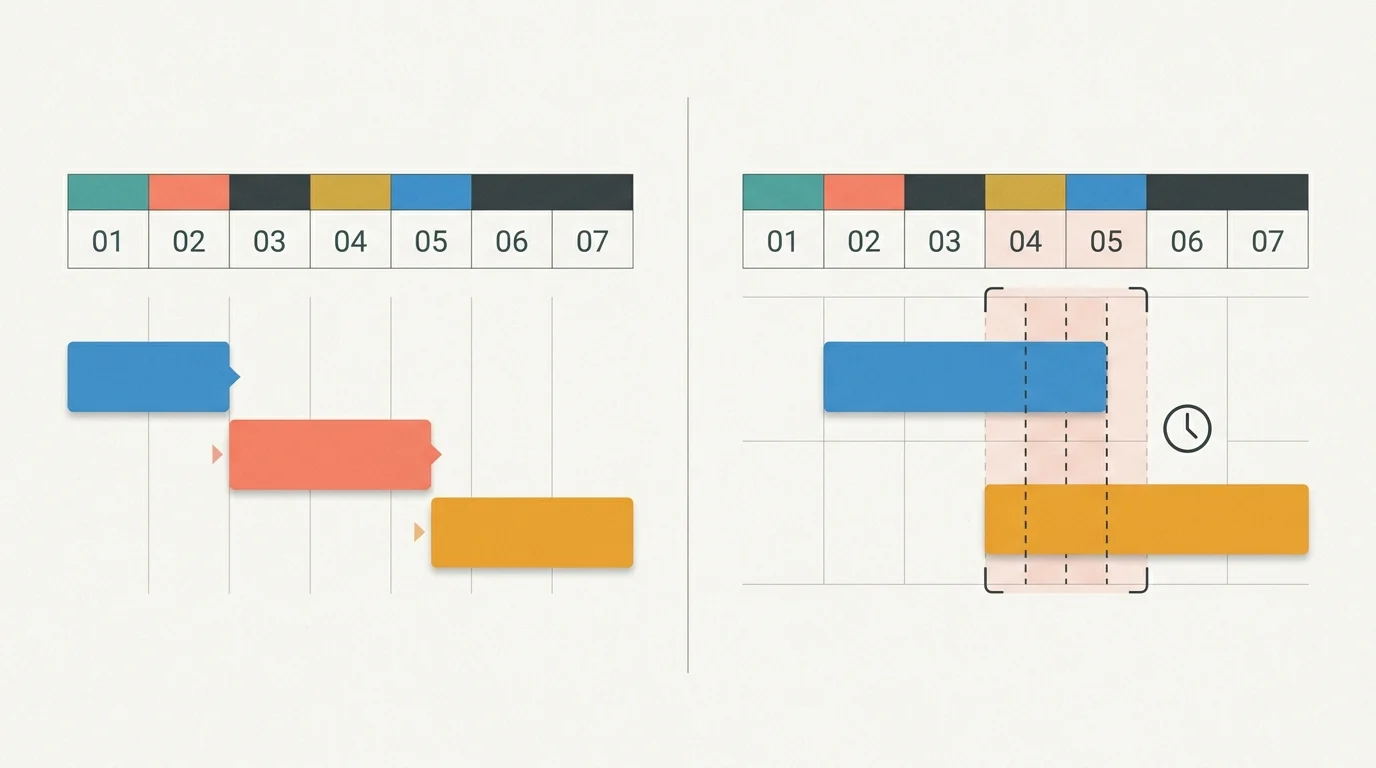
Quick Answer: Consecutive means happening one after another without interruption, while concurrent means happening at the same time. For example, three consecutive days occur in a continuous sequence, whereas two concurrent meetings take place simultaneously. Although both terms describe timing, they express different relationships between events, tasks, or activities.
The words consecutive and concurrent both describe when things happen. However, they refer to two different types of timing. Understanding the difference can help you use these words correctly in everyday conversations, academic writing, workplace communication, and legal or technical contexts.
For example, if you exercise for five consecutive days, you exercise each day in a row. In contrast, if two projects run concurrently, they take place during the same period.
Although these words sometimes appear in similar contexts, you cannot always use one in place of the other. One focuses on sequence, while the other focuses on overlap. Therefore, knowing their meanings makes your writing clearer and helps you avoid common mistakes.
What Does Consecutive Mean?
Consecutive means following one after another in an uninterrupted sequence.
People commonly use this word to describe days, weeks, numbers, wins, events, or periods that occur in order without a break.
Examples of consecutive in a sentence:
- She worked five consecutive days without taking a day off.
- The team won three consecutive matches.
- I received payments for four consecutive months.
- He arrived late on two consecutive mornings.
- The numbers 10, 11, and 12 are consecutive numbers.
In each example, the events or items follow one another in sequence.
Easy way to remember: Consecutive means in a row.
What Does Concurrent Mean?
Concurrent means happening or existing at the same time, or during overlapping periods.
This word often appears in discussions about meetings, projects, legal sentences, responsibilities, and processes.
Examples of concurrent in a sentence:
- Two meetings took place concurrently.
- She managed two concurrent projects at work.
- The courses run concurrently during the summer.
- The company launched concurrent marketing campaigns.
- The court ordered concurrent prison sentences.
In these examples, the activities or periods overlap in time. They do not necessarily need to start and finish at exactly the same moment.
Easy way to remember: Concurrent means at the same time.
Consecutive vs Concurrent: Key Differences
| Feature | Consecutive | Concurrent |
|---|---|---|
| Meaning | Following one after another | Happening during the same time |
| Main idea | Sequence | Overlap |
| Timing | One event follows another | Two or more events share a time period |
| Example | Three consecutive days | Two concurrent meetings |
| Common contexts | Days, wins, numbers, events | Projects, tasks, courses, legal sentences |
| Memory trick | In a row | At the same time |
The key difference is simple: consecutive events follow a sequence, while concurrent events overlap.
Consecutive vs Concurrent Examples in Real Life
1. At Work
If an employee works three consecutive shifts, the shifts follow one another in sequence. However, if the employee manages two concurrent projects, both projects are active during overlapping periods.
2. In Education
A student may attend classes on four consecutive days. Meanwhile, two online courses may run concurrently if their schedules overlap.
3. In Sports
A team that wins four consecutive games wins four games in a row. By comparison, concurrent sporting events take place at the same time.
4. In Law
The terms have a specific meaning in criminal sentencing. Consecutive sentences are served one after another, while concurrent sentences are served at the same time. As a result, concurrent sentences generally lead to a shorter combined period than consecutive sentences, although the actual outcome depends on the court’s order and applicable law.
Common Mistakes to Avoid
Mistake 1: Using consecutive for events happening at the same time
Incorrect: The two meetings were consecutive because they happened simultaneously.
Correct: The two meetings were concurrent because they happened at the same time.
Mistake 2: Using concurrent for events that happen one after another
Incorrect: She won three concurrent matches.
Correct: She won three consecutive matches.
Mistake 3: Assuming concurrent means exactly identical start and end times
Concurrent activities only need to overlap in time. They may start or finish at different moments.
Mistake 4: Assuming consecutive always means days
Consecutive can describe many things, including numbers, victories, events, months, and attempts.
Quick Practice: Test Your Understanding
Choose the correct word for each sentence.
- The company reported profits for six _____ quarters in a row.
- Two employees worked on _____ assignments during the same week.
- He scored in four _____ games.
- The two workshops took place at the same time, so they were _____.
Answers:
- Consecutive
- Concurrent
- Consecutive
- Concurrent
Frequently Asked Questions
1. Is consecutive the same as concurrent?
No. Consecutive describes things that happen one after another, while concurrent describes things that happen during overlapping periods.
2. Does consecutive mean back to back?
Yes, consecutive commonly means back to back or in a row, without a break in the sequence.
3. Does concurrent mean at the same time?
Yes. Concurrent events or activities happen simultaneously or overlap in time.
4. Can two tasks be consecutive and concurrent?
Two tasks can overlap with other activities, but the same two tasks are not generally described as concurrent if one finishes before the other begins. Consecutive emphasizes sequence; concurrent emphasizes overlapping timing.
5. What are consecutive days?
Consecutive days are days that follow one another without a missing day. For example, Monday, Tuesday, and Wednesday are three consecutive days.
6. What are concurrent projects?
Concurrent projects are projects that take place during overlapping periods. They may begin and end on different dates.
7. What is the difference between consecutive and successive?
Both words can describe things that follow one another. However, consecutive usually emphasizes an uninterrupted sequence, while successive more broadly means following one after another.
8. What is the opposite of consecutive?
Depending on the context, concurrent can contrast with consecutive. However, there is no single opposite that fits every use of consecutive.
Conclusion
Consecutive and concurrent describe different relationships between events. Consecutive means happening one after another without interruption, while concurrent means happening at the same time or during overlapping periods. Remember “in a row” for consecutive and “overlapping in time” for concurrent to choose the right word confidently.