
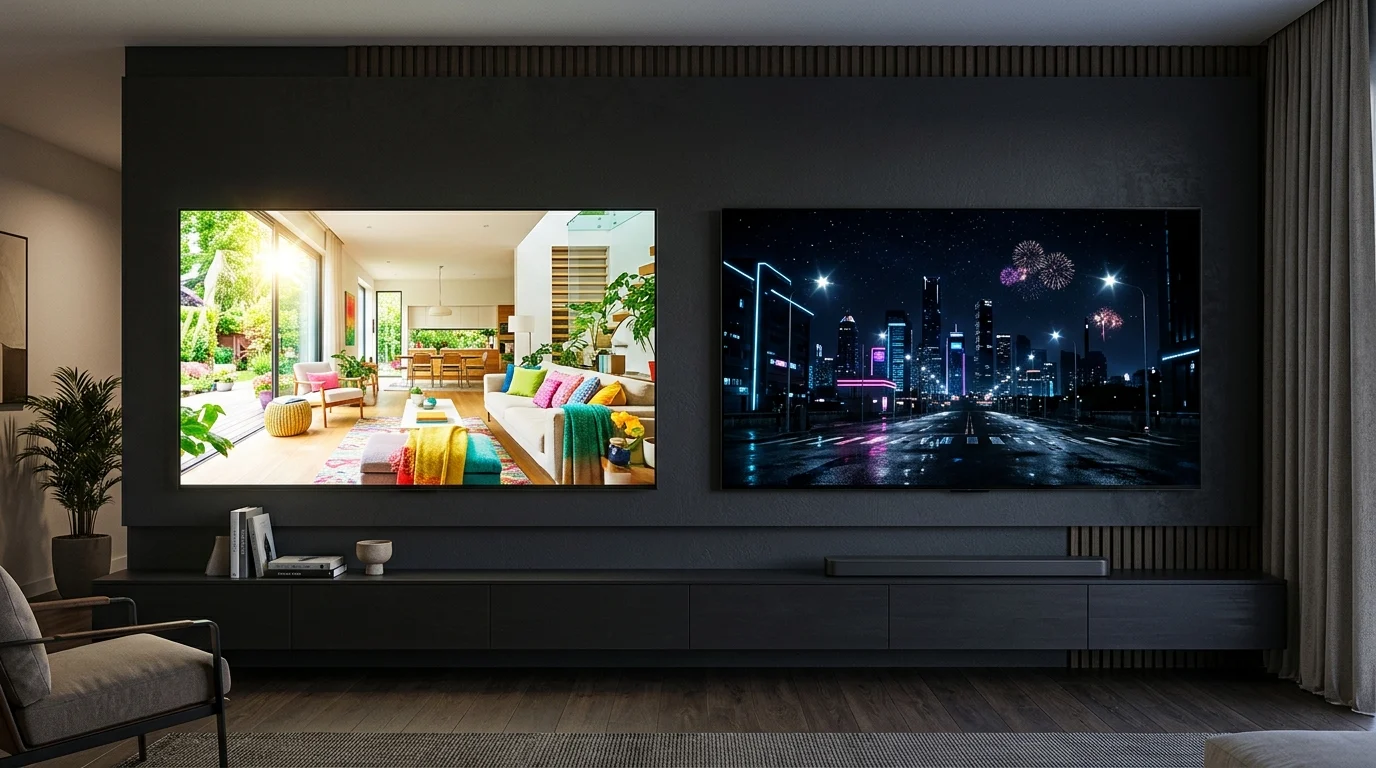
Quick Answer: QNED vs OLED comes down to brightness, contrast, price, and viewing habits. QNED TVs use LCD technology with advanced color and backlighting systems, while OLED TVs use self-lit pixels for deep blacks and excellent contrast. OLED is usually better for movies and dark rooms, whereas QNED can be a strong choice for bright rooms and budget-conscious buyers.
Choosing a new TV can feel confusing when brands advertise technologies such as QNED and OLED. Both can deliver sharp images, vibrant colors, and impressive entertainment experiences. However, they create pictures in different ways, which affects how they perform in everyday use.
QNED is a TV technology name used by LG for LCD televisions that combine color-enhancement technologies. Depending on the model, these TVs may also use Mini LED backlighting. OLED, on the other hand, uses individual pixels that produce their own light. This difference gives OLED a major advantage when displaying dark scenes and deep blacks.
So, which technology should you choose? The answer depends on your room’s lighting, viewing habits, gaming needs, and budget. Let’s compare their main features to help you make the right decision.
What Is a QNED TV?
QNED is LG’s branding for certain LCD TVs that use technologies such as Quantum Dot and NanoCell to improve color reproduction. The screen relies on a backlight to illuminate its pixels.
Some QNED models use Mini LED backlighting, which divides the backlight into smaller, more precisely controlled zones. As a result, these models can deliver stronger brightness and better contrast than many conventional LCD TVs.
Main advantages of QNED:
- High brightness for well-lit rooms
- Vivid colors and clear images
- No typical OLED-style permanent burn-in concern
- Often available at more affordable prices than comparable OLED models
- Mini LED options that offer improved local dimming
However, QNED performance varies considerably by model. Less advanced versions may show light blooming around bright objects against dark backgrounds.
What Is an OLED TV?
OLED stands for Organic Light Emitting Diode. Unlike QNED, OLED does not need a separate backlight because each pixel produces its own light.
When a pixel needs to display black, it can switch off completely. Therefore, OLED TVs deliver exceptionally deep blacks and outstanding contrast. They also provide wide viewing angles and fast pixel response times.
Main advantages of OLED:
- Perfect black levels and excellent contrast
- Detailed, cinematic images in dark rooms
- Wide viewing angles
- Fast response times for gaming
- Precise control over bright and dark parts of a scene
Nevertheless, OLED TVs can cost more than comparable QNED models. Some OLED screens also face a risk of permanent image retention or burn-in after prolonged exposure to certain static images, although modern models include protective features.
QNED vs OLED: Key Differences
| Feature | QNED | OLED |
|---|---|---|
| Display technology | LCD with advanced color technologies and a backlight | Self-lit pixels |
| Black levels | Good to very good, depending on local dimming | Excellent, with true blacks |
| Contrast | Varies by model | Generally superior |
| Brightness | Often very bright, especially Mini LED models | Varies by model; some premium models are very bright |
| Viewing angles | Vary by panel type | Generally wider |
| Gaming response | Good on suitable models | Excellent pixel response |
| Burn-in risk | No typical OLED-style burn-in risk | Possible with prolonged static images |
| Price | Often more budget-friendly | Often more expensive |
| Best use | Bright rooms and value-focused buying | Movies, dark rooms, and contrast-focused viewing |
Keep in mind that specifications differ between individual TVs. A premium QNED model may outperform a basic OLED model in some areas, particularly peak brightness.
Picture Quality: Which Looks Better?
OLED generally wins for contrast and black levels. Because its pixels can switch off individually, dark movie scenes look more natural, with fewer distracting halos around bright objects.
QNED, however, can be an excellent choice for daytime viewing. High-brightness models, especially those with Mini LED backlighting, can make colorful content stand out in a bright living room.
Furthermore, both technologies can deliver excellent color. The final result depends on the TV’s panel, processing, HDR capabilities, and picture settings, not just its technology label.
Gaming: QNED or OLED?
OLED is usually the stronger choice for gamers who prioritize fast response times, smooth motion, and excellent contrast. Many OLED models also offer high refresh rates, HDMI 2.1, and variable refresh rate support.
QNED can also be excellent for gaming. Some models offer high refresh rates, low input lag, and modern gaming features. In addition, their brightness can help games look vivid in rooms with lots of daylight.
Before buying, check the exact model’s refresh rate, HDMI ports, input lag, and variable refresh rate support. Neither technology guarantees that every gaming feature will be available.
Lifespan and Burn-In: What Should You Know?
QNED TVs use LCD panels, so they do not have the same typical permanent burn-in concern associated with OLED screens. This can make QNED appealing for households that display news tickers, static computer interfaces, or the same game interface for long periods.
OLED TVs can develop burn-in when certain pixels experience uneven wear over time. However, the risk depends on usage, brightness, viewing patterns, and the TV’s protective features. For varied everyday viewing, many users can enjoy OLED for years without noticeable problems.
Which TV Should You Buy?
Choose QNED if you:
- Watch TV mainly in a bright living room.
- Want high brightness for daytime viewing.
- Prefer a more affordable large-screen option.
- Frequently display static content for long periods.
Choose OLED if you:
- Watch movies in a dim or dark room.
- Want the deepest blacks and excellent contrast.
- Play games that benefit from fast pixel response.
- Often watch TV from different seating positions.
Ultimately, compare specific models at your budget. A well-reviewed QNED TV can be a better purchase than an entry-level OLED if brightness, screen size, or price matters more to you.
Frequently Asked Questions
1. Is QNED better than OLED?
Not overall. OLED usually offers better black levels and contrast, while QNED can provide higher brightness at a more accessible price.
2. Is OLED worth the extra money?
OLED may be worth the extra cost if you watch movies, enjoy dark-room viewing, or want premium contrast. However, QNED may offer better value for bright rooms and larger screen sizes.
3. Which lasts longer, QNED or OLED?
Both can last for years. QNED avoids the typical OLED burn-in risk, while OLED longevity depends on usage and pixel wear. Neither technology has a guaranteed lifespan advantage in every situation.
4. Is QNED better for bright rooms?
Often, yes. Many QNED models, particularly Mini LED versions, deliver high brightness that helps overcome daylight and room lighting.
5. Is OLED better for gaming?
OLED generally offers faster pixel response and excellent contrast. However, some QNED models also provide high refresh rates and useful gaming features.
6. Can OLED suffer from burn-in?
Yes. Prolonged display of static images can cause permanent uneven pixel wear. Modern OLED TVs include features that help reduce this risk.
7. Is QNED the same as QLED?
No. Both are LCD-based technologies, but they use different branding and may combine different color-enhancement technologies. Their performance depends on the specific model.
8. Which is better for watching movies?
OLED is usually better for dark-room movie watching because it produces true blacks and excellent contrast. A high-quality QNED TV can still deliver an impressive movie experience, especially in a bright room.
Conclusion
The choice between QNED and OLED depends on what matters most to you. OLED is usually the better option for deep blacks, cinematic contrast, and fast gaming response. QNED is often a practical choice for bright rooms, high brightness, and better value. Compare the specifications and prices of individual models before making your final decision.
2 thoughts on “QNED vs OLED: Which TV Is Better for Picture Quality, Gaming & Price?”