
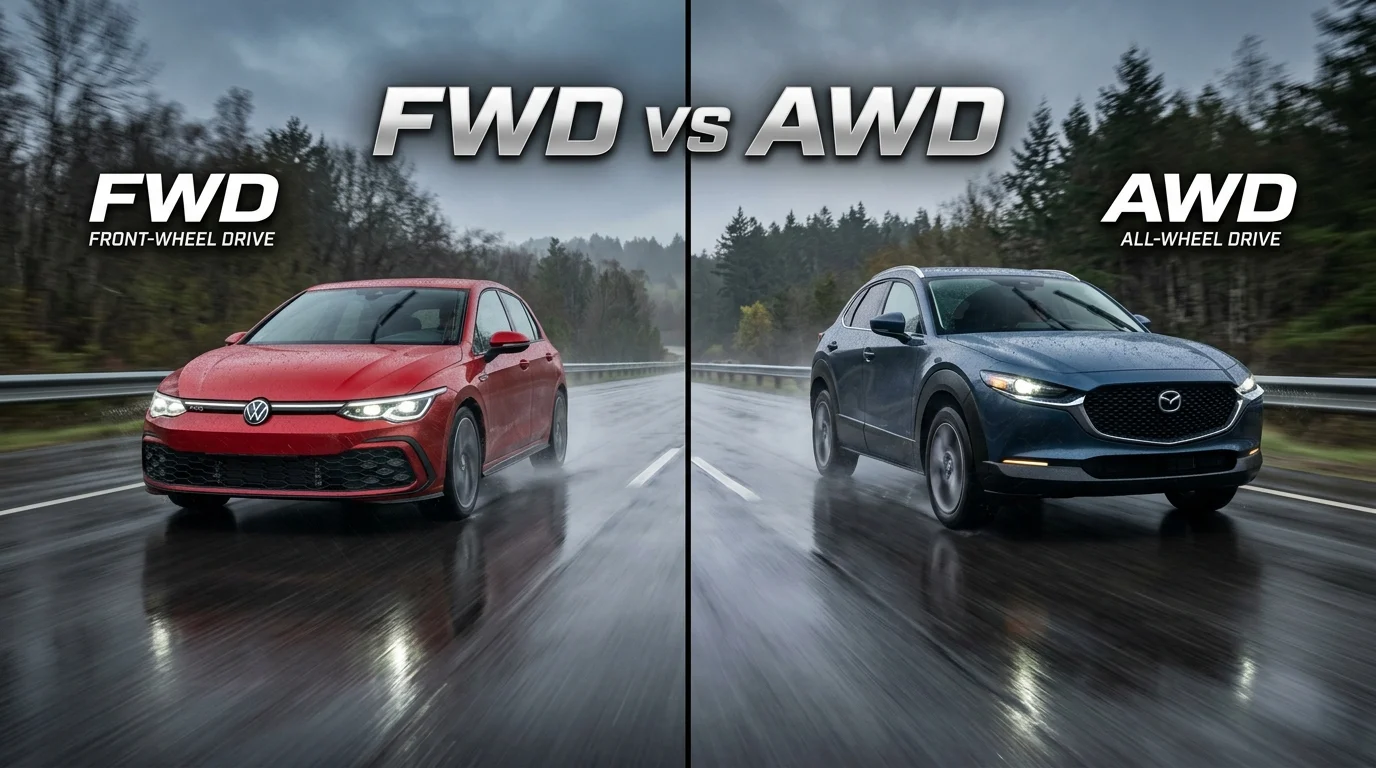
Quick Answer: FWD vs AWD comes down to how a vehicle delivers power to its wheels. Front wheel drive (FWD) sends power to the front wheels, while all wheel drive (AWD) can send power to all four wheels when needed. FWD usually costs less and offers better fuel economy, whereas AWD provides better traction on slippery roads.
Choosing between front wheel drive and all wheel drive can affect your car’s performance, fuel costs, and handling. Both systems have advantages, but the right option depends on where you drive and what you expect from your vehicle.
For example, a driver who mainly travels on city streets may benefit more from FWD. It often costs less to buy and maintain, and it can deliver excellent fuel efficiency. On the other hand, someone who regularly drives on snowy roads, wet hills, or uneven surfaces may prefer AWD because it can improve traction.
However, AWD does not automatically make a car safer in every situation. Tires, road conditions, and driving habits also play important roles.
Let’s compare FWD and AWD to help you decide which drivetrain suits your needs.
What Is FWD?
FWD stands for front wheel drive. In this system, the engine sends power to the front wheels, which pull the vehicle forward.
Most everyday sedans, compact cars, and many small SUVs use FWD because it offers a practical balance of cost, efficiency, and performance.
Advantages of FWD
- Better fuel economy: FWD systems generally weigh less and have fewer drivetrain components.
- Lower purchase cost: Many FWD vehicles cost less than comparable AWD models.
- Affordable maintenance: A simpler drivetrain can mean fewer components to service.
- Good everyday handling: FWD works well for commuting and normal road conditions.
Disadvantages of FWD
- It may struggle for traction on snow, ice, or slippery inclines.
- The front tires handle both steering and power delivery, which can affect handling during hard acceleration.
- It generally offers less traction than AWD when accelerating on loose or uneven surfaces.
What Is AWD?
AWD stands for all wheel drive. This system can deliver power to all four wheels, either continuously or automatically when additional traction is needed.
Many modern AWD systems adjust power distribution based on driving conditions. Therefore, they can help a vehicle maintain traction on wet roads, gravel, and light snow.
Advantages of AWD
- Improved traction: Power can reach all four wheels to help reduce wheelspin.
- Better performance on slippery roads: AWD can help when accelerating on wet or snowy surfaces.
- Useful for varied conditions: It suits drivers who regularly encounter changing road conditions.
- More confidence on difficult routes: AWD can help on slippery hills and unpaved roads.
Disadvantages of AWD
- Higher cost: AWD models often have a higher purchase price.
- Lower fuel economy: Extra weight and drivetrain losses can increase fuel consumption.
- More complex maintenance: Additional components may increase repair costs.
- No guaranteed safety advantage: AWD does not automatically shorten braking distances or prevent skidding.
FWD vs AWD: Key Differences
| Feature | FWD | AWD |
|---|---|---|
| Power delivery | Front wheels | All four wheels when required or continuously |
| Fuel economy | Usually better | Usually lower |
| Purchase price | Generally lower | Generally higher |
| Maintenance | Often simpler | Often more complex |
| Wet roads | Good with suitable tires | Can provide better acceleration traction |
| Snow and ice | Capable with proper tires | Often offers better acceleration traction |
| Dry roads | Excellent for daily driving | Excellent, depending on the vehicle |
| Best for | City driving and commuting | Mixed conditions and slippery roads |
Keep in mind that these differences vary by vehicle model, engine, tires, and drivetrain design.
Which Is Better for Rain, Snow, and Off-Road Driving?
Rainy roads
Both FWD and AWD can perform well in the rain. However, AWD may help the car accelerate with less wheelspin on slippery surfaces. Good tires and appropriate speeds remain essential.
Snow and ice
AWD usually has an advantage when moving off in snow because it can send power to more wheels. Nevertheless, winter tires often make a major difference. AWD does not provide extra grip when braking simply because all four wheels receive power.
Off-road driving
AWD can work well on gravel roads and light trails. However, serious off-road driving may require four wheel drive (4WD), suitable ground clearance, and specialized equipment. Not every AWD vehicle is designed for demanding terrain.
Is AWD Worth the Extra Cost?
AWD may be worth paying more for if you regularly drive through snow, slippery hills, or rough weather. It can also be useful if you frequently travel on unpaved roads.
However, FWD is often the smarter financial choice for everyday commuting in areas with mild weather. It generally costs less to purchase and operate.
Before deciding, compare the price difference, expected fuel consumption, maintenance costs, and tire options for the specific vehicles you are considering.
Common Mistakes When Comparing FWD and AWD
- Assuming AWD is always safer: AWD helps with acceleration traction, but it cannot overcome poor tires or excessive speed.
- Ignoring tire quality: Good tires are essential for both drivetrains.
- Choosing AWD without considering the budget: Extra purchase and running costs may not be worthwhile for every driver.
- Confusing AWD with 4WD: These systems can work differently, and their capabilities depend on the vehicle’s design.
Frequently Asked Questions
1. Is FWD better than AWD?
FWD is often better for affordability and fuel economy. However, AWD can provide better traction when accelerating on slippery surfaces.
2. Does AWD use more gas than FWD?
Generally, yes. AWD systems often add weight and mechanical losses, although actual fuel economy depends on the vehicle.
3. Is AWD worth it for daily driving?
It can be worthwhile if your daily routes include snow, slippery hills, or loose surfaces. Otherwise, FWD may meet your needs at a lower cost.
4. Is FWD good in snow?
Yes, FWD can handle snow with suitable tires and careful driving. However, AWD may provide better traction when accelerating in slippery conditions.
5. Does AWD help with braking?
AWD does not automatically improve braking distance. Tires, road conditions, speed, and the braking system have a much greater influence.
6. Which drivetrain lasts longer?
Neither drivetrain always lasts longer. Reliability depends on the vehicle’s design, maintenance, driving habits, and operating conditions.
7. Is AWD the same as 4WD?
No. AWD systems commonly manage power automatically for everyday traction, while many 4WD systems are designed for more demanding terrain. The exact differences depend on the vehicle.
8. Can FWD cars drive on gravel roads?
Yes. Many FWD vehicles can handle maintained gravel roads when driven carefully. However, rough terrain may require greater ground clearance and a more capable drivetrain.
Conclusion
The choice between FWD and AWD depends on your driving conditions and budget. FWD is usually the more economical option for commuting, city driving, and everyday use. In contrast, AWD can provide extra traction on snow, wet hills, and loose surfaces.
Ultimately, choose the drivetrain that matches your real driving needs, and do not overlook the importance of quality tires and safe driving.
3 thoughts on “FWD vs AWD: Which Drivetrain Is Better for Your Car?”