
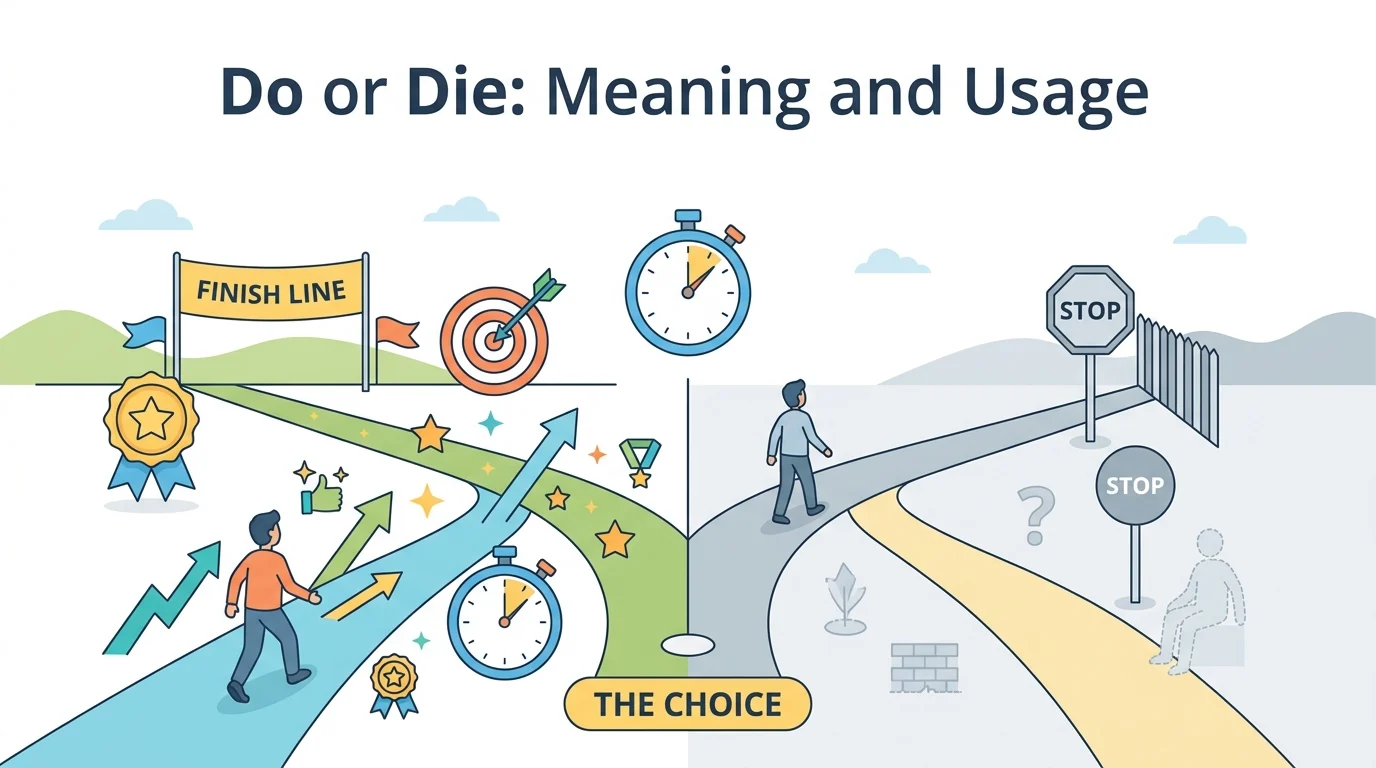
Quick Ans: “Do or die” is an expression that means a situation is extremely important and requires complete effort because failure may have serious consequences. It can describe a final attempt, urgent decision, or moment when someone must succeed. The phrase is often used in sports, work, and everyday conversations.
What does “do or die” mean? This common English expression describes a situation where success feels absolutely necessary. It does not usually refer to actual life or death. Instead, it shows strong determination, urgency, or a final chance to achieve something.
People often use “do or die” when talking about competitions, goals, deadlines, or difficult challenges. For example, a team may describe an important match as a “do or die game” because losing could end their chances.
The phrase can sometimes sound dramatic, so understanding the context matters. In casual conversations, it often shows motivation and commitment. In formal writing, it should be used carefully because it carries a strong emotional meaning.
For English learners, the phrase is easier to understand when you remember its basic idea: give everything you have because the result matters greatly.
Quick Answer and Key Takeaway
| Phrase | Meaning | Example |
|---|---|---|
| Do or die | A situation requiring maximum effort | This is a do or die situation. |
| Do | To take action or make an effort | We must do our best. |
| Die | To stop living or fail completely | The plan may die without support. |
Key takeaway: “Do or die” means a situation where success is extremely important and failure is not an acceptable option.
Definition and Explanation
Do or Die
“Do or die” is an idiomatic phrase. It means someone must succeed or make their strongest effort because the situation is very serious.
Example: The final exam was a do or die moment for the student.
The phrase expresses urgency, determination, and pressure.
Do
“Do” is a verb that means to perform an action, complete something, or make an effort.
Example: I will do my best.
Die
“Die” is a verb that usually means to stop living. However, in the expression “do or die,” it often suggests failure, ending, or losing an opportunity.
Example: Without funding, the project could die.
| Expression | Meaning | Example |
|---|---|---|
| Do or die | A critical situation | It was a do or die match. |
| Do your best | Give maximum effort | She will do her best. |
| Die out | Disappear gradually | Some traditions may die out. |
Is This a Grammar, Usage, or Vocabulary Issue?
“Do or die” is mainly a vocabulary and usage issue. It is an idiom, which means the meaning cannot always be understood by looking at each individual word.
The phrase is usually informal and expressive. Writers often use it in news reports, sports discussions, motivational speeches, and everyday conversations.
It does not mean that someone will literally die. Instead, it highlights the importance of a situation.
For example:
“The championship game is do or die.”
This means the team must win to continue, not that anyone’s life is in danger.
Real World Usage Examples
Workplace Examples
“The project deadline is do or die for our team.”
This means the team feels the deadline is extremely important.
Recap: In business, the phrase shows pressure or a critical goal.
Academic Examples
“The final exam was a do or die situation for students hoping to pass.”
This shows that the exam had a major impact.
Recap: Students may use the phrase for very important academic moments.
Everyday Examples
“It’s do or die. We have to catch the last train.”
This means there is no room for delay.
Recap: In daily speech, the phrase adds urgency.
Regional or Global Usage Differences
“Do or die” is understood in many English speaking countries, including the United States, the United Kingdom, Canada, and Australia.
The phrase has a similar meaning across regions. However, some speakers may consider it dramatic or intense.
In professional writing, alternatives such as “critical,” “essential,” or “extremely important” may sound more neutral.
When NOT to Use It
Do not use “do or die” for ordinary situations that are not serious.
Avoid using it when discussing actual death unless the context is literal.
Do not use the phrase in every situation where you simply want to say something is difficult.
Avoid using it in sensitive situations where dramatic language may sound inappropriate.
Do not assume it always means failure will have permanent consequences.
Common Mistakes and Corrections
| Correct Sentence | Incorrect Sentence | Why |
|---|---|---|
| This is a do or die situation. | This is a do and die situation. | The standard phrase uses “or.” |
| It was a do or die match. | It was a do or died match. | “Die” remains in its base form. |
| We must win this do or die game. | We must win this do or dying game. | The idiom has a fixed form. |
| The decision felt like do or die. | The decision felt like doing or dying. | The phrase should not be changed. |
Decision Rule: Use “do or die” when you mean a situation requires maximum effort because the outcome is very important.
Exercises With Answers
Complete the sentences.
- The final match was a _____ situation.
- She will _____ her best to succeed.
- The phrase “do or die” shows a sense of _____.
- The project may _____ without support.
- A normal task is not always a _____ situation.
Answer Key
- do or die
- do
- urgency
- die
- do or die
Related Concepts and Comparisons
Readers may also search for do or die meaning, do or die situation, idioms about success, no pain no gain meaning, sink or swim meaning, last chance expressions, and motivational phrases.
FAQs
What does do or die mean?
“Do or die” means a situation where success is extremely important and someone must make a strong effort. It usually describes urgency rather than a literal life or death situation.
Is do or die an idiom?
Yes, “do or die” is a common English idiom. Its meaning goes beyond the individual words and describes a critical moment.
What is a do or die situation?
A do or die situation is a moment when failure could have major consequences. For example, a final competition may feel like a do or die situation.
Is do or die used in formal writing?
It can be used, but it is often considered expressive or dramatic. More neutral words like “critical” or “essential” may work better in formal documents.
Does do or die mean someone will die?
Usually, no. The phrase is generally figurative and means someone must succeed or give maximum effort.
What are examples of do or die moments?
A final sports game, important exam, or major business deadline can be described as a do or die moment when the outcome matters greatly.
Is do or die positive or negative?
It can be either. The phrase can show determination and motivation, but it can also describe pressure or stress.
What is another word for do or die?
Similar expressions include critical, make or break, last chance, all or nothing, and crucial.
Conclusion
“Do or die” is a powerful English idiom used to describe situations where success is extremely important. Although the words “do” and “die” have their own meanings, together they create a phrase about determination, urgency, and strong effort.
People commonly use this expression when talking about important games, difficult goals, exams, deadlines, and challenges. However, it is usually figurative, not a literal reference to life or death.
The phrase adds emotion and intensity to communication, but it should be used carefully. In formal situations, simpler words such as “critical” or “important” may sound more appropriate.
Remember that “do or die” means give your best effort because the result matters a lot.
Practical tip: Use “do or die” when describing a truly important moment, not just a normal challenge.