
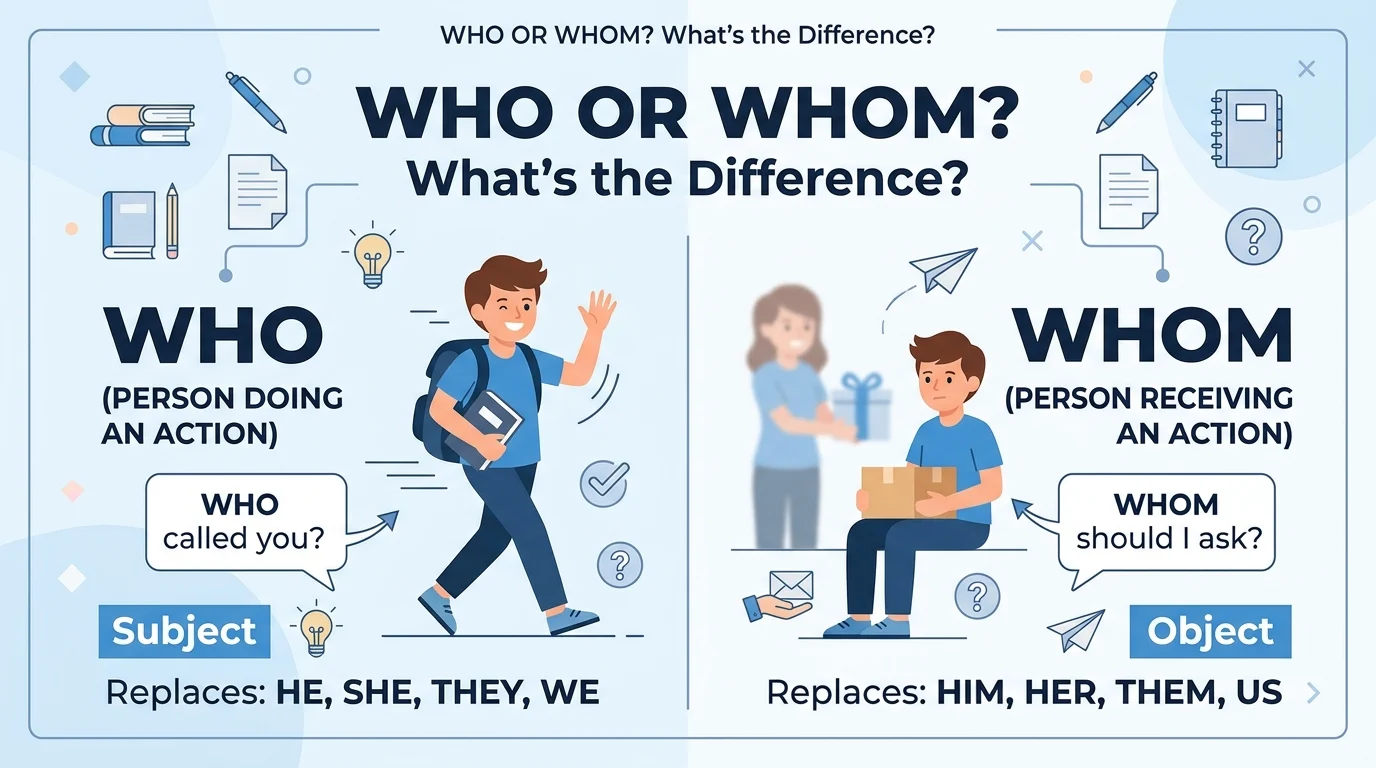
Quick Ans: Who and whom are both pronouns, but they have different roles. Use “who” when the person is doing the action and “whom” when the person receives the action. In modern English, who is more common in everyday speech, while whom is mainly used in formal writing.
Are you confused about whether to use who or whom? You’re not alone. These two words are among the most commonly confused English pronouns because they look similar and follow a grammar rule that many speakers find difficult.
The main difference is simple: who is a subject pronoun, while whom is an object pronoun. In other words, who performs an action, and whom receives an action.
For example, “Who called you?” is correct because the person calling performs the action. However, “Whom did you call?” is correct because the person receiving the call is the object.
Although traditional grammar keeps these two words separate, everyday English has become more flexible. Many native speakers use “who” in places where formal grammar suggests “whom.” Still, knowing the difference helps you write clearly in professional, academic, and formal situations.
Quick Answer and Key Takeaway
| Word | Use | Example |
|---|---|---|
| Who | Subject of a sentence | Who is coming to the meeting? |
| Whom | Object of a sentence | Whom did you invite? |
Easy rule: If you can replace the word with “he” or “she,” use who. If you can replace it with “him” or “her,” use whom.
Definition and Explanation
Who
“Who” is a pronoun used as the subject of a sentence or clause. It refers to the person performing the action.
Example: Who wrote this book?
Here, “who” performs the action of writing.
More examples:
- Who is your teacher?
- Who called last night?
- Who wants to join us?
Whom
“Whom” is also a pronoun, but it works as the object of a verb or preposition. It refers to the person receiving the action.
Example: Whom did you meet?
Here, “you” performed the action, and “whom” received it.
More examples:
- Whom should I contact?
- To whom did you send the email?
- Whom are you helping?
| Feature | Who | Whom |
|---|---|---|
| Grammar role | Subject | Object |
| Similar to | They | Them |
| Example | Who helped you? | Whom did you help? |
The main difference is based on the role of the person in the sentence. Who acts, while whom receives the action.
Is This a Grammar, Usage, or Vocabulary Issue?
This is mainly a grammar and usage issue.
The easiest way to decide is to use the he/him test.
If the answer would be “he” or “she,” choose who.
Example:
Who called you?
Answer: He called me.
Therefore, “who” is correct.
If the answer would be “him” or “her,” choose whom.
Example:
Whom did you call?
Answer: I called him.
Therefore, “whom” is correct.
However, modern English often uses “who” instead of “whom,” especially in casual conversations. In formal writing, knowing the traditional rule can make your writing more polished.
Real World Usage Examples
Workplace Examples
Who is leading the project?
The person leads the project, so who is correct.
Whom should I send the report to?
The person receives the report, so whom is traditionally correct.
Recap: Professional writing often benefits from choosing the correct subject or object form.
Academic Examples
Who discovered the theory?
The person performed the action of discovering.
Whom did the researcher interview?
The researcher performed the action, and the interviewee received it.
Recap: Academic writing usually follows traditional grammar rules.
Everyday Examples
Who are you talking to?
This is very common in everyday speech.
Whom are you talking to?
This is more formal but grammatically traditional.
Recap: Casual English often prefers who, while formal writing may use whom.
Regional or Global Usage Differences
Who and whom follow the same grammar rules in American, British, Canadian, and Australian English.
The main difference is frequency of use. Whom appears less often in everyday speech because many speakers prefer who.
In formal writing, such as academic papers, official documents, and professional communication, whom is still used when it functions as an object.
When NOT to Use It
Do not use whom just because a sentence sounds more formal.
Do not use who when the person clearly receives the action in formal writing.
Avoid choosing the word based only on position in the sentence.
Do not assume whom always comes after “to.” Check its role in the sentence.
Avoid replacing all instances of whom with who in academic or professional writing.
Common Mistakes and Corrections
| Correct Sentence | Incorrect Sentence | Why |
|---|---|---|
| Who is calling? | Whom is calling? | The person performs the action. |
| Whom did you invite? | Who did you invite? | The person receives the action. |
| To whom should I write? | To who should I write? | Whom follows a preposition in formal grammar. |
| Who wants coffee? | Whom wants coffee? | The person wanting coffee is the subject. |
Exercises With Answers
Choose who or whom.
- _____ called you yesterday?
- _____ did you invite to dinner?
- _____ is responsible for this task?
- To _____ should I send the letter?
- _____ wants to answer the question?
Answer Key
- Who
- Whom
- Who
- Whom
- Who
Related Concepts and Comparisons
Readers searching for who or whom may also want to learn about who vs whom grammar, whoever vs whomever, subject and object pronouns, personal pronouns, relative pronouns, he vs him, she vs her, and common grammar mistakes.
FAQs
What is the difference between who and whom?
Who is used for the subject of a sentence, while whom is used for the object. A simple he or him test can help you decide.
Is whom still used in modern English?
Yes. Whom is still correct, especially in formal writing. However, many speakers use who in casual conversations.
Should I say who or whom did you call?
The traditional grammar answer is “Whom did you call?” because the person receives the action of calling.
Is “Who are you talking to?” correct?
Yes. It is very common in everyday English. Formal grammar may prefer “To whom are you talking?”
How do I remember who vs whom?
Use the he or him test. If “he” fits, use who. If “him” fits, use whom.
Is who a subject pronoun?
Yes. Who acts as the subject and performs the action in a sentence.
Is whom an object pronoun?
Yes. Whom receives the action or follows a preposition.
Do Americans use whom?
Yes, but it is less common in everyday American speech. It appears more often in formal writing.
Conclusion
The difference between who or whom becomes easier when you focus on the role of the person in the sentence. Use who when the person performs the action. Use whom when the person receives the action.
For example, “Who called you?” is correct because the person made the call. “Whom did you call?” is correct because the person received the call.
Although everyday English often uses who more frequently, understanding whom is still valuable. It helps you write stronger emails, essays, reports, and formal documents.
The best way to remember the rule is to use the simple substitution test. Replace the word with he or him. If he works, choose who. If him works, choose whom.
Practical tip: Before choosing who or whom, ask yourself one question: “Is this person doing the action or receiving it?”
2 thoughts on “Who or Whom: What’s the Difference? Easy Rules, Examples & Tips”