
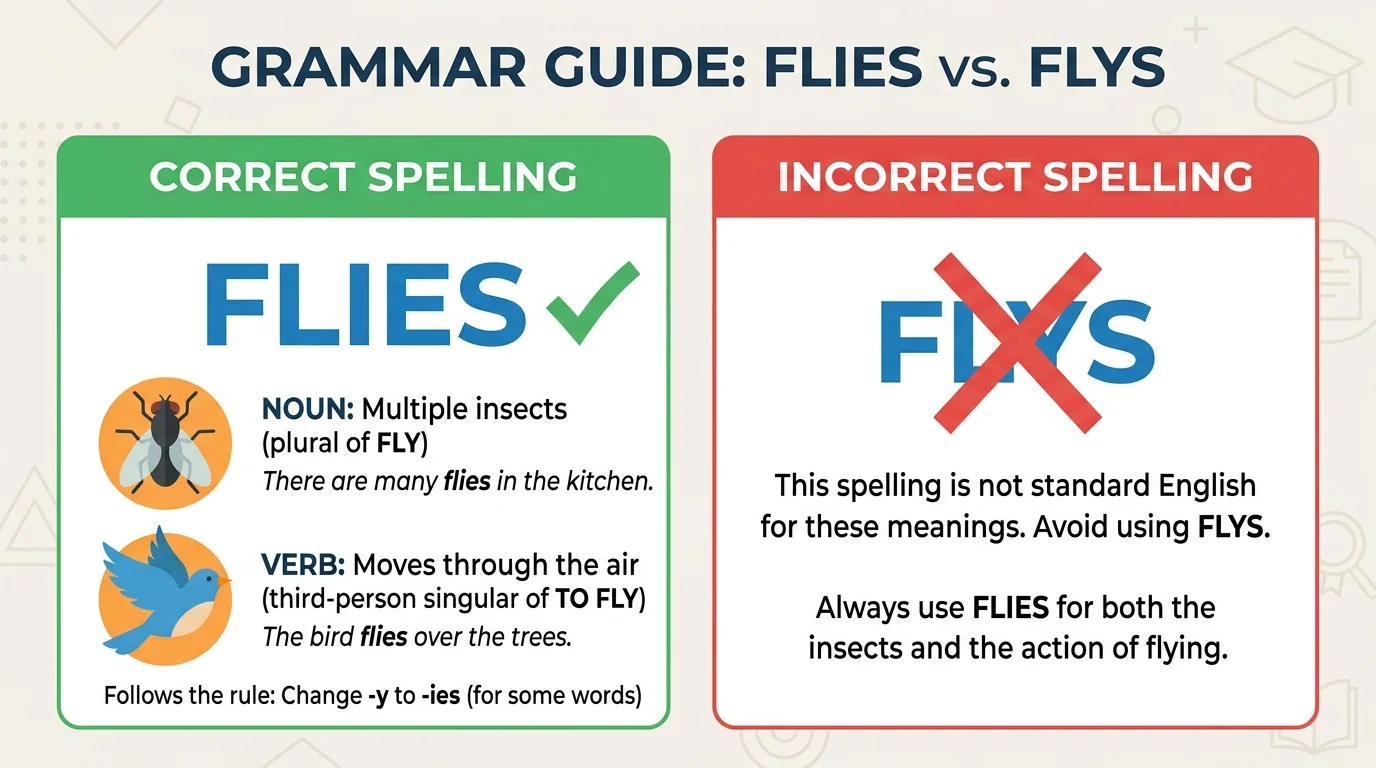
Quick Ans: “Flies or flys” is a common spelling question. Flies is the correct standard spelling, while flys is generally incorrect. Flies can be the plural of “fly” or the third person singular form of the verb “fly.” Knowing these simple rules will help you use the correct form in writing.
Flies or flys can be confusing because English has many words that change their spelling when they become plural or change form. If you’re unsure which spelling to use, the correct choice is almost always flies.
The word “flies” has two main uses. It can describe more than one insect, such as house flies. It can also be the verb form used with “he,” “she,” or “it,” as in “The bird flies over the trees.”
The spelling “flys” is not normally accepted in standard English. Understanding why “fly” changes to “flies” makes this spelling easier to remember.
In this guide, you’ll learn the difference between flies and flys, see practical examples, understand the spelling rule, and learn how to avoid common mistakes.
Quick Answer and Key Takeaway
Flies is the correct spelling in standard English. Flys is generally incorrect.
Use flies when:
- You mean more than one fly.
- You mean that someone or something travels through the air.
- You use “fly” with he, she, or it in the present tense.
Easy rule: When a word ending in consonant + y becomes plural or changes to the third person singular form, change y to ies.
Definition and Explanation
What Does Flies Mean?
Flies has two common meanings.
First, it is the plural form of fly, the insect.
There are several flies in the kitchen.
Second, “flies” is the third person singular form of the verb fly.
The eagle flies high above the mountains.
What Does Flys Mean?
Flys is generally considered an incorrect spelling in standard English.
Although you may see “flys” in informal writing, social media, usernames, or as a typo, it should not normally be used in formal or academic writing.
| Word | Correct? | Example |
|---|---|---|
| Flies | Yes | The bird flies away. |
| Flys | No | The bird flys away. |
Is This a Grammar, Usage, or Vocabulary Issue?
The difference between flies and flys is mainly a spelling and grammar issue.
The spelling changes because “fly” ends in a consonant followed by y.
When forming the plural of a noun, change y to ies:
fly → flies
The same pattern appears in words such as:
baby → babies
city → cities
party → parties
The same spelling pattern applies when forming the third person singular of certain verbs:
fly → flies
For example:
She flies to London every month.
Real World Usage Examples
Workplace
The company flies employees to different offices when necessary.
Several flies were found near the cafeteria.
Recap: Use “flies” for both the verb form and the plural noun.
Academic
The research explains how an insect flies through changing air currents.
Scientists studied how flies respond to different environments.
Recap: Academic writing also uses “flies” rather than “flys.”
Everyday
My dog chases flies around the house.
The bird flies over our garden every morning.
Recap: In everyday sentences, “flies” is the standard spelling.
Regional or Global Usage Differences
There is no major regional difference between standard English varieties regarding the spelling flies.
British English, American English, Canadian English, Australian English, and other major varieties use flies.
You may encounter “flys” online because of typing mistakes, informal writing, usernames, or brand names. However, these uses don’t make “flys” the standard spelling.
When NOT to Use Flies
Do not use flies in every sentence involving “fly.”
Use fly when the subject is I, you, we, or they.
I fly to New York tomorrow.
They fly every summer.
Use flies with he, she, or it.
She flies to New York tomorrow.
Also use fly after modal verbs and helping verbs:
Birds can fly.
The plane will fly tomorrow.
Does the bird fly?
Common Mistakes and Corrections
| Correct Sentence | Incorrect Sentence | Why |
|---|---|---|
| The bird flies south. | The bird flys south. | Change y to ies. |
| I fly every month. | I flies every month. | Use “fly” with I. |
| There are many flies outside. | There are many flys outside. | “Flies” is the plural noun. |
| She flies to Paris. | She flys to Paris. | Use “flies” with she. |
| Birds can fly. | Birds can flies. | Use the base verb after “can.” |
Easy Decision Rule
If the word is a plural noun or follows he, she, or it, use flies.
If the subject is I, you, we, or they, use fly.
Never use flys in standard English.
Exercises With Answers
Choose fly, flies, or flys.
- The airplane ___ over the city.
- I ___ to work every morning.
- Several ___ are near the window.
- She ___ to California twice a year.
- Birds can ___ long distances.
- The insects ___ around the food.
Answer Key
- flies
- fly
- flies
- flies
- fly
- flies
Related Concepts and Comparisons
The spelling rule for fly → flies is similar to several other English words.
| Base Word | Correct Form |
|---|---|
| fly | flies |
| baby | babies |
| city | cities |
| party | parties |
| study | studies |
However, words ending in a vowel + y usually keep the y:
boy → boys
toy → toys
key → keys
FAQs
Is flys a correct word?
No. “Flys” is generally not correct in standard English. The correct spelling is flies.
Is the plural of fly flies or flys?
The correct plural is flies. For example, “There are two flies in the room.”
Why does fly change to flies?
Because “fly” ends in a consonant followed by y. In this pattern, the y usually changes to ies when forming the plural or certain verb forms.
Is flies a verb or a noun?
It can be either. “Flies” is a noun when it means more than one insect, and it is a verb when it means that someone or something travels through the air.
Do you say a fly or a flies?
Use a fly for one insect. Use flies for more than one.
Does a plane fly or flies?
Use flies because “a plane” is singular. The correct sentence is, “A plane flies through the air.”
Do birds fly or flies?
Use fly because “birds” is plural. For example, “Birds fly south in winter.”
Is it flies away or flys away?
The correct phrase is flies away when the subject is singular, such as “The bird flies away.” “Flys away” is incorrect.
What is the past tense of fly?
The past tense of “fly” is flew. For example, “The bird flew across the garden.”
Conclusion
When choosing between flies or flys, always use flies in standard English. “Flys” is generally a spelling error and should be avoided in school, professional, academic, and formal writing.
Remember that flies has two common uses. It can be the plural of the noun “fly,” as in “There are flies in the kitchen.” It can also be the third person singular form of the verb “fly,” as in “The bird flies across the sky.”
The key spelling rule is simple: when a word ends in a consonant followed by y, the y often changes to ies when forming the plural or third person singular form. This gives us fly → flies.
A useful final tip is to check the subject of your sentence. Use flies with he, she, or it, but use fly with I, you, we, and they. With this rule, you’ll rarely confuse these forms again.
1 thought on “Flies or Flys: What’s the Difference? Easy Rules, Examples & Tips”