
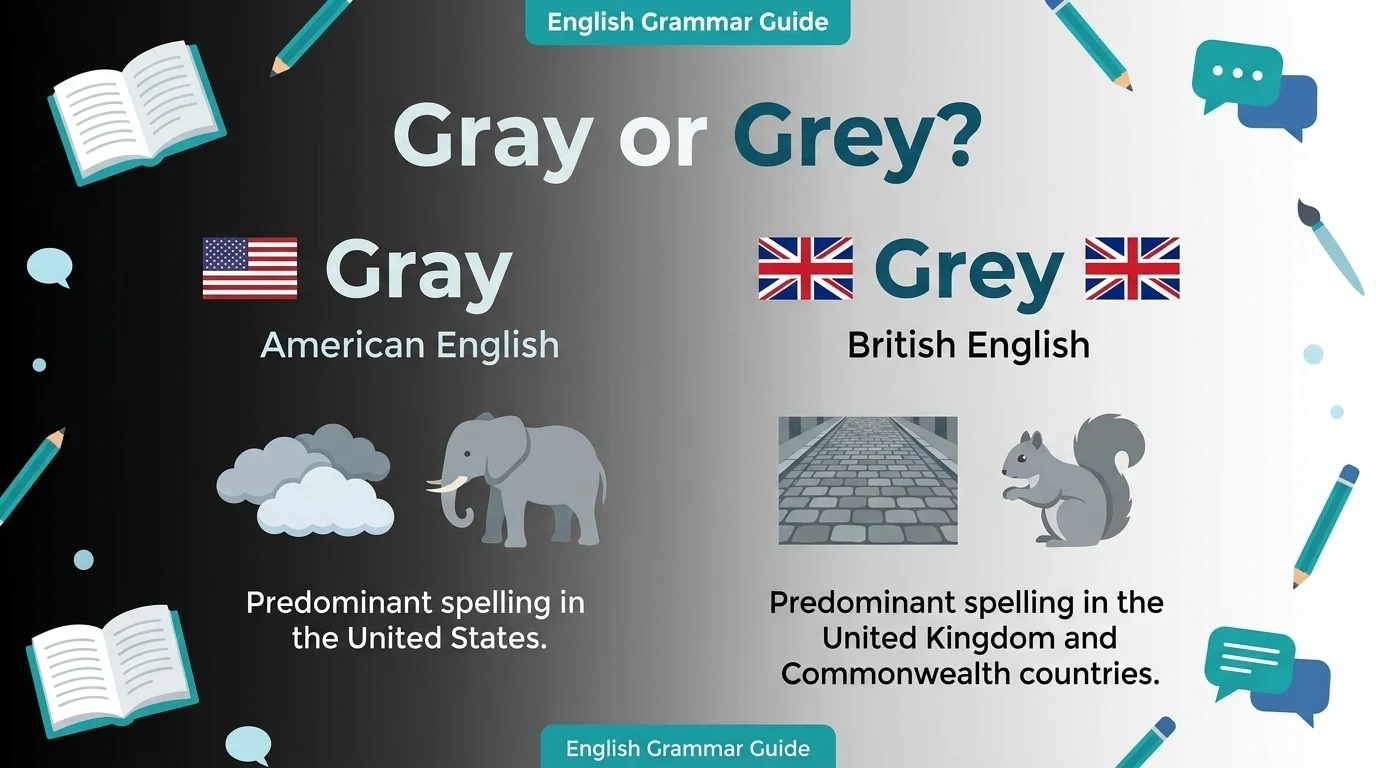
Quick Ans: Both “gray” and “grey” are correct spellings of the same color. “Gray” is more common in American English, while “grey” is more common in British English. The meaning and pronunciation are the same, so your choice usually depends on the variety of English you are using.
Are you confused about whether to write “gray or grey”? You may have seen both spellings in books, websites, schoolwork, and everyday writing.
The good news is that neither spelling is wrong. Both words describe the color between black and white. The main difference is regional preference. American English generally uses “gray,” while British English usually uses “grey.”
This difference can seem small, but consistency matters in professional and academic writing. If you are writing for an American audience, “gray” will usually look more natural. For British readers, “grey” is generally the preferred form.
The same difference appears in related words. For example, American English tends to use “grayish,” while British English often uses “greyish.” Some proper names and established terms may follow a particular spelling regardless of regional preference.
So, which one should you choose? Both are correct. The best choice depends on your audience and the style of English you are following.
Quick Answer and Key Takeaway
| Spelling | Common Usage | Example |
|---|---|---|
| Gray | American English | She wore a gray coat. |
| Grey | British English | She wore a grey coat. |
Both spellings have the same meaning and pronunciation.
Definition and Explanation
Gray
“Gray” is an adjective and noun.
As an adjective, it describes a color between black and white.
Example: He bought a gray shirt.
As a noun, it refers to the color itself.
Example: Gray is a neutral color.
“Gray” is the preferred spelling in American English.
Grey
“Grey” is also an adjective and noun with exactly the same basic meaning.
Example: She painted the wall grey.
“Grey” is the preferred spelling in British English and is also common in several other varieties of English.
| Feature | Gray | Grey |
|---|---|---|
| Meaning | Color between black and white | Color between black and white |
| American English | Preferred | Less common |
| British English | Less common | Preferred |
| Pronunciation | Same | Same |
| Part of speech | Adjective, noun | Adjective, noun |
In short, neither spelling is more correct in every situation. Choose the form that matches your English variety and keep it consistent.
Is This a Grammar, Usage, or Vocabulary Issue?
“Gray or grey” is mainly a spelling and usage difference, not a grammar issue.
Both forms are standard English. They are interchangeable when describing the color, although regional preference determines which spelling looks more natural.
For academic or professional writing, follow the style guide or regional variety required by your audience. If you are writing for an American publication, use “gray.” If your publication follows British English, use “grey.”
Consistency is more important than choosing one form as universally correct.
Real World Usage Examples
Workplace Example
“The new office will have gray walls and white furniture.”
This spelling is natural in American English.
Recap: Use “gray” for American English workplace writing.
Academic Example
“The researchers observed a grey area between the two categories.”
This spelling fits British English.
Recap: Academic writers should follow the English variety used by their institution or publication.
Everyday Example
“My favorite sweater is grey.”
This is natural in British English.
Recap: Both spellings work in everyday conversation and writing.
Regional or Global Usage Differences
The main difference is between American and British English.
American English generally prefers “gray.” British English generally prefers “grey.” Canadian English uses both, although “grey” is often common. Australian and New Zealand English generally prefer “grey.”
There are also exceptions in proper names. For example, a person’s surname or a company’s name may use “Gray” or “Grey regardless of the regional variety.
When NOT to Use It
Do not treat “gray” as the only correct spelling. “Grey” is standard English too.
Do not treat “grey” as an incorrect American spelling. American English normally prefers “gray.”
Avoid switching between “gray” and “grey” randomly in the same article.
Do not change a proper name from “Gray” to “Grey” or the other way around.
When following a specific style guide, use the spelling required by that guide.
Common Mistakes and Corrections
| Correct Sentence | Incorrect Sentence | Why |
|---|---|---|
| The sky looks gray. | The sky looks graey. | “Gray” is the American spelling. |
| She bought a grey dress. | She bought a greay dress. | “Grey” is the British spelling. |
| The walls are gray. | The walls are grey. | This is not always incorrect. Choose the spelling that matches your English variety. |
| His surname is Gray. | His surname is Grey. | Proper names should keep their official spelling. |
Decision Rule: Writing in American English? Choose “gray.” Writing in British English? Choose “grey.” Either way, stay consistent.
Exercises With Answers
Choose the best spelling for the stated variety.
- American English: The cat is _____.
- British English: The car is _____.
- American English: She bought a _____ sweater.
- British English: The wall is _____.
- Are “gray” and “grey” different colors?
- Which spelling does American English usually prefer?
Answer Key
- gray
- grey
- gray
- grey
- No
- Gray
Related Concepts and Comparisons
Readers may also search for color vs colour, gray vs grey meaning, American vs British English, spelling differences, canceled vs cancelled, traveled vs travelled, theater vs theatre, and favorite vs favourite.
FAQs
Is gray or grey correct?
Both “gray” and “grey” are correct spellings. American English usually prefers “gray,” while British English generally prefers “grey.”
Is grey British or American?
“Grey” is primarily associated with British English. If you are learning British English spelling, “grey” is the form you will normally see.
Is gray American English?
Yes. “Gray” is the standard preferred spelling in American English. For example, an American writer would normally write “a gray shirt.”
Do gray and grey mean the same thing?
Yes. The two spellings have the same meaning and pronunciation. The difference is mainly regional spelling preference.
Which spelling should I use in formal writing?
Use the spelling that matches your required English variety or style guide. For American English, use “gray,” while British English generally uses “grey.”
Is grey wrong in American English?
No. “Grey” is understood in American English, but “gray” is the more usual American spelling.
Why are gray and grey spelled differently?
The two spellings developed as regional spelling preferences. Over time, American English favored “gray,” while British English generally retained “grey.”
Does Canada use gray or grey?
Canadian English uses both forms, although “grey” is commonly preferred. Usage can vary depending on the writer and context.
Conclusion
When deciding between “gray or grey,” remember that both spellings are correct. They describe the same color and have the same pronunciation.
The main difference is regional. American English usually prefers “gray,” while British English generally prefers “grey.” Canadian English can use both, while Australian and New Zealand English commonly use “grey.”
Your choice matters most when you need to maintain a consistent style. If you are writing an American English article, choose “gray.” If you are following British English, choose “grey.” Also, keep official names unchanged because names may use either spelling.
There is no need to memorize one spelling as correct and the other as incorrect. Instead, connect each form with its common regional preference.
Practical tip: remember gray for American English and grey for British English. Then use the same spelling throughout your article, assignment, or document.
2 thoughts on “Gray or Grey: Which Spelling Is Correct?”