
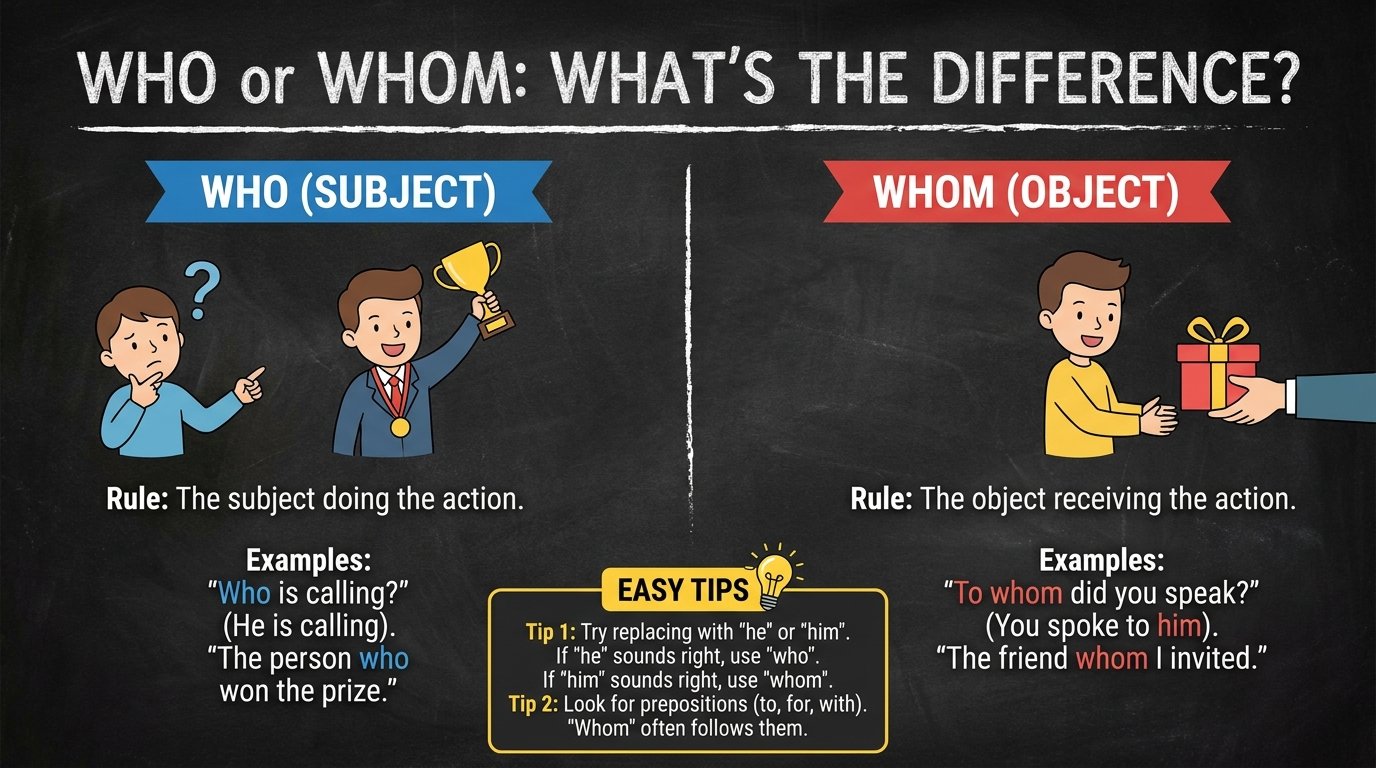
Quick Ans: Who and whom are both pronouns, but they have different roles in a sentence. Use who for the subject performing an action and whom for the object receiving the action. A simple trick is to replace the word with “he” or “him.” If “he” fits, use who. If “him” fits, use whom.
Are you unsure whether to use “who or whom” in a sentence? You’re not alone. These two words look similar, and even native speakers sometimes avoid “whom” in casual speech.
The main difference is grammatical. “Who” usually acts as the subject of a sentence, while “whom” usually acts as the object. For example, “Who called you?” asks about the person who performed the action. “Whom did you call?” asks about the person who received the action.
The good news is that you don’t need to memorize complicated grammar rules. A simple substitution test can usually give you the answer. Replace who or whom with “he” or “him.” If “he” sounds right, choose who. If “him” sounds right, choose whom.
In everyday conversation, “who” is much more common. However, “whom” still appears in formal writing, academic work, and after certain prepositions.
Quick Answer and Key Takeaway
| Word | Role | Example |
|---|---|---|
| Who | Subject | Who called you? |
| Whom | Object | Whom did you call? |
Easy rule: Who = he. Whom = him.
Definition and Explanation
Who
“Who” is a pronoun that usually refers to the person performing an action.
Example: Who wrote this letter?
The person who wrote the letter performs the action, so “who” is correct.
Another example is:
Who is coming to dinner?
Here, “who” refers to the person who will perform the action of coming.
Whom
“Whom” is a pronoun that usually refers to the person receiving an action.
Example: Whom did you invite?
The person receiving the action of being invited is the object, so “whom” is grammatically correct.
A useful comparison is:
| Question | Correct Word | Reason |
|---|---|---|
| Who called you? | Who | Who performs the action. |
| Whom did you call? | Whom | Whom receives the action. |
| Who helped her? | Who | Who performs the action. |
| Whom did she help? | Whom | Whom receives the action. |
Remember that who usually replaces “he” or “she,” while whom usually replaces “him” or “her.”
Is This a Grammar, Usage, or Vocabulary Issue?
The difference between who and whom is mainly a grammar issue involving subject and object pronouns.
In formal writing, the traditional rule remains useful. Use “whom” when the person functions as an object.
However, everyday English has changed. Many speakers use “who” instead of “whom,” especially in casual conversation.
For example, “Who did you invite?” is extremely common in everyday speech. Traditional grammar would prefer “Whom did you invite?”
After a preposition, “whom” often sounds more formal:
“To whom did you speak?”
In casual English, people usually say:
“Who did you speak to?”
Both forms are widely understood, but their level of formality differs.
Real World Usage Examples
Workplace Examples
“Who is responsible for this project?”
The person performs the role of being responsible, so “who” is correct.
“Whom should I contact about the issue?”
The person receives the action of being contacted, so “whom” is traditionally correct.
Recap: Use who for the person acting and whom for the person receiving the action.
Academic Examples
“Who conducted the research?”
The person conducted the research, so “who” is correct.
“The study identified the participants whom the researchers interviewed.”
The participants received the action of being interviewed, so “whom” is correct.
Recap: Academic writing often follows the traditional subject and object distinction.
Everyday Examples
“Who did you see at the store?”
“Who” is common in everyday conversation, even though “whom” would be traditionally preferred.
“Whom did you see at the store?” sounds more formal.
Recap: Casual English commonly uses who where formal grammar may use whom.
Regional or Global Usage Differences
Who and whom exist across major varieties of English. The main difference involves formality and frequency rather than meaning.
“Whom” appears more often in formal writing and careful speech. Meanwhile, “who” has become increasingly common in informal English.
As a result, “Who did you meet?” sounds natural to most speakers. “Whom did you meet?” is grammatically traditional but can sound formal or old fashioned in casual conversation.
When NOT to Use It
Don’t automatically use whom just because a sentence sounds formal.
Don’t use whom when it is the subject of the verb. Say “Who called?” rather than “Whom called?”
Avoid forcing whom into casual conversation if it makes the sentence sound unnatural.
Don’t confuse who with whose. “Whose” shows possession.
Don’t choose between who and whom based only on where the word appears in the sentence. Check its grammatical role instead.
Common Mistakes and Corrections
| Correct Sentence | Incorrect Sentence | Why |
|---|---|---|
| Who called you? | Whom called you? | Who performs the action. |
| Whom did you invite? | Who did you invite? | Whom receives the action in formal grammar. |
| Who is coming with us? | Whom is coming with us? | Who is the subject. |
| To whom did you speak? | To who did you speak? | Whom follows the preposition “to” in formal usage. |
Decision Rule: Replace the word with “he” or “him.” If “he” works, use who. If “him” works, use whom.
Exercises With Answers
Choose who or whom.
- _____ called you last night?
- _____ did you invite to the party?
- _____ is your teacher?
- _____ did she speak to?
- To _____ should I send the email?
- _____ helped you finish the work?
Answer Key
- Who
- Whom
- Who
- Whom
- Whom
- Who
Related Concepts and Comparisons
Readers who search for who or whom may also want to learn about who vs whose, subject vs object pronouns, whoever vs whomever, who vs that, reflexive pronouns, personal pronouns, possessive pronouns, and prepositions.
FAQs
What is the difference between who and whom?
Who usually acts as the subject, while whom usually acts as the object. For example, “Who called?” uses who because the person performs the action.
Is it who or whom did you call?
Traditional grammar recommends “Whom did you call?” because the person receives the action. However, “Who did you call?” is very common in everyday English.
Is who or whom correct after a preposition?
“Whom” is traditionally correct after a preposition. For example, formal writing uses “To whom did you speak?” while casual speech often uses “Who did you speak to?”
What is the easiest way to remember who vs whom?
Use the he or him test. If you could answer with “he,” use who; if you could answer with “him,” use whom.
Is whom still used in modern English?
Yes. Whom remains correct, especially in formal writing and after prepositions. However, everyday speakers often use who instead.
Who should I contact or whom should I contact?
“Whom should I contact?” follows traditional grammar because the person receives the action. “Who should I contact?” is also very common in modern conversational English.
Who did you meet or whom did you meet?
“Whom did you meet?” is the traditional grammatical form. However, “Who did you meet?” is natural and widely used in everyday English.
Can I use who instead of whom?
In informal English, often yes. Modern speakers frequently use who instead of whom, especially when the sentence sounds more natural that way.
Conclusion
The difference between who and whom becomes much easier when you focus on the person’s role in the sentence. Use who when the person performs the action. Use whom when the person receives the action.
For example, “Who called you?” is correct because the person performs the action of calling. “Whom did you call?” is traditionally correct because the person receives the action.
The he or him test is the easiest way to remember the rule. If “he” or “she” fits, choose who. If “him” or “her” fits, choose whom.
In casual English, many people use who instead of whom. Still, knowing the traditional rule helps you write confidently in formal, academic, and professional situations.
Practical tip: When you’re unsure, replace the word with he or him. Your choice will usually become clear immediately.
1 thought on “Who or Whom: What’s the Difference? Easy Rules, Examples & Tips”