
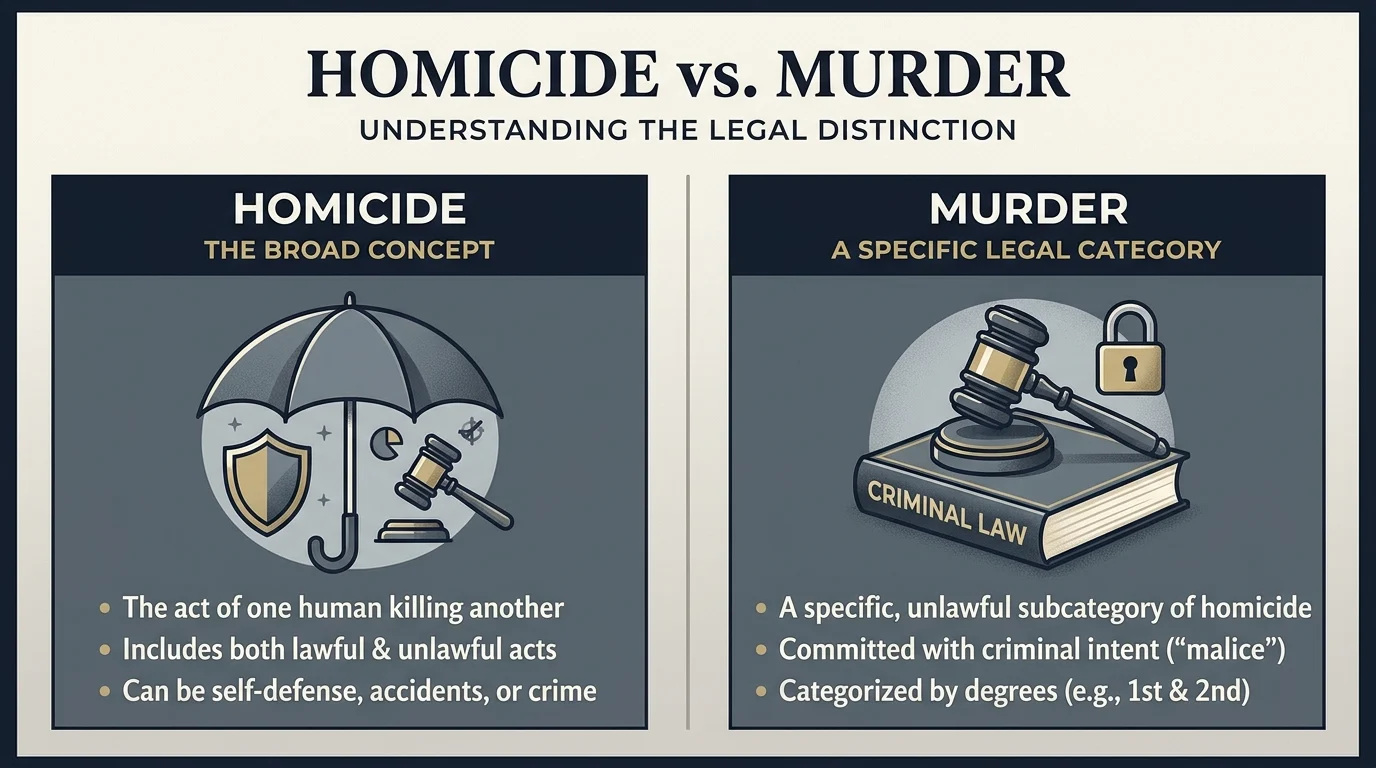
Quick Answer: Homicide vs murder: Homicide is the general term for one person causing the death of another person, while murder is a specific type of unlawful killing. Not every homicide is murder because some killings may be legally justified or classified as other offenses, such as manslaughter. The exact legal definitions depend on the jurisdiction.
The terms homicide and murder often appear in crime reports, police investigations, court cases, and news headlines. Many people use them interchangeably, assuming they mean exactly the same thing. However, there is an important difference between these two terms, especially in legal settings.
Homicide is a broad term that describes one person causing the death of another. Murder, on the other hand, refers to a particular category of unlawful killing under the applicable criminal law. The distinction matters because not every death caused by another person is automatically considered murder.
For example, a killing may occur in self defense under circumstances recognized by law, or it may result from conduct classified as manslaughter rather than murder. Investigators and courts examine the facts, the person’s actions, their state of mind, and the relevant legal rules before determining the appropriate classification.
In this guide, you will learn what homicide and murder mean, how they differ, and how to use both terms correctly in everyday writing.
Homicide vs Murder: Quick Answer
The main difference is that homicide is the broader category, while murder is one specific form of unlawful killing.
- Homicide: The act of one person causing another person’s death. Its legal classification depends on the circumstances.
- Murder: An unlawful killing that meets the legal requirements for murder in the relevant jurisdiction.
A homicide may be classified as murder, manslaughter, justifiable homicide, or another legal category, depending on the circumstances and applicable law.
What Does Homicide Mean?
Homicide refers generally to the killing of one human being by another. The term describes what happened without automatically determining whether the act was criminal.
Legal systems classify homicides differently based on factors such as intent, recklessness, self defense, and the circumstances surrounding the death.
Common categories include:
1. Criminal homicide
This involves a killing that violates criminal law. Depending on the jurisdiction and circumstances, it may be classified as murder, manslaughter, or another offense.
2. Justifiable homicide
In certain circumstances, a killing may be legally justified, such as qualifying acts of self defense. Whether the law recognizes the justification depends on the specific facts and legal requirements.
3. Accidental or noncriminal homicide
A death caused by another person may sometimes be determined not to constitute a criminal offense. However, an accidental death can still lead to criminal charges if the person’s conduct meets the legal requirements for an offense.
Examples:
- A person kills an attacker while meeting the legal requirements for self defense.
- A driver causes a fatal collision, and investigators examine whether criminal negligence occurred.
- A person intentionally kills another person under circumstances that may satisfy the legal definition of murder.
These examples show why the word homicide alone does not establish guilt or describe the final legal outcome.
What Does Murder Mean?
Murder is a form of unlawful killing that meets specific legal requirements. Depending on the jurisdiction, those requirements may involve intent, knowledge, malice, or other circumstances defined by law.
In many legal systems, murder is among the most serious criminal offenses because it involves an unlawful killing with a legally specified level of culpability.
However, the precise definition is not identical everywhere. Some jurisdictions distinguish different degrees of murder, while others use different classifications and terminology.
Examples:
- A person deliberately kills another person in circumstances that satisfy the legal requirements for murder.
- A court convicts someone of murder after examining the evidence and applying the relevant law.
- Investigators initially investigate a suspicious death as a possible murder, but the final classification depends on the evidence.
An important distinction is that an accusation of murder is not the same as a conviction. A person’s legal responsibility must be established through the applicable legal process.
Homicide vs Murder: Key Differences
| Feature | Homicide | Murder |
|---|---|---|
| Meaning | One person causing another person’s death | A specific category of unlawful killing |
| Scope | Broad term | Narrower legal category |
| Always a crime? | Not necessarily | Yes, under the applicable criminal law |
| Intent | Depends on the circumstances | Must meet the relevant legal requirements |
| Possible classifications | May include murder, manslaughter, or justified killing | A particular offense within the law |
| Legal consequences | Depend on the final classification | Can carry severe criminal penalties |
The table provides a general comparison. Exact classifications and penalties differ between countries and legal systems.
Homicide vs Murder vs Manslaughter
Manslaughter is another important term that often appears in discussions of homicide.
Homicide is the broad category describing a death caused by another person.
Murder generally involves an unlawful killing that satisfies the legal requirements for murder.
Manslaughter generally refers to a form of unlawful killing treated differently from murder. The distinction may depend on factors such as intent, recklessness, negligence, or legally recognized mitigating circumstances.
For example, a jurisdiction may classify a killing caused by criminal negligence as involuntary manslaughter. A different case involving the required mental state and circumstances may qualify as murder.
The precise terminology varies, so legal definitions should always be checked for the relevant jurisdiction.
Common Mistakes to Avoid
1. Assuming every homicide is murder
A homicide does not automatically mean murder. The circumstances and applicable law determine the classification.
2. Using homicide as a synonym for conviction
The term describes a type of event, not necessarily a proven crime or a court’s final decision.
3. Confusing murder with manslaughter
Both can involve unlawful killings, but they are distinct legal categories.
4. Assuming the definitions are identical worldwide
Different jurisdictions define and classify unlawful killings differently. Avoid applying one country’s legal definitions to another without checking.
Frequently Asked Questions
Is homicide the same as murder?
No. Homicide is the broader term for one person causing another person’s death. Murder is a specific category of unlawful killing.
Is every murder a homicide?
Generally, yes. Murder falls within the broader category of homicide.
Can homicide be legal?
Yes. Some killings may be legally justified under specific circumstances, such as qualifying self defense. The applicable law and facts determine whether a justification applies.
What is the difference between murder and manslaughter?
Murder and manslaughter are different legal categories of unlawful killing. Their precise definitions depend on the jurisdiction and the circumstances of the case.
Does homicide mean someone is guilty?
No. The term alone does not establish criminal guilt. Investigators and courts must determine the circumstances and legal classification.
Is attempted murder considered homicide?
Generally, no. Attempted murder involves an alleged or proven attempt to kill someone without the death occurring. It is a separate offense from a completed homicide.
Which term is more serious, homicide or murder?
The terms are not directly comparable in that way. Homicide is a broad category, while murder is a specific offense. The seriousness and penalties depend on the actual charge and applicable law.
Why do news reports use the word homicide?
News reports may use homicide while authorities investigate a death or before its legal classification is established. The word does not necessarily mean that murder has been proven.
Conclusion
Understanding homicide vs murder is important because the two terms have different meanings in legal and everyday contexts. Homicide is the broad term for one person causing another person’s death, while murder is a specific form of unlawful killing that meets the requirements established by law.
Not every homicide is murder. Depending on the circumstances, a death may be classified as murder, manslaughter, a justified killing, or another legal category. The person’s actions, state of mind, available evidence, and applicable legal rules all matter.
When reading crime reports or writing about criminal cases, use homicide when referring broadly to a killing and murder when the specific meaning is appropriate. Remember that an investigation, accusation, or arrest does not automatically establish guilt.
Although these general distinctions apply widely, legal definitions vary by jurisdiction. For a specific case, consult the relevant law or a qualified legal professional.