
Quick Answer: LASIK vs PRK compares two laser eye surgeries that correct vision problems such as nearsightedness, farsightedness, and astigmatism. LASIK usually offers faster visual recovery, while PRK avoids creating a corneal flap and may suit people with certain thin corneas or active lifestyles. The best option depends on your eye health, prescription, lifestyle, and surgeon’s assessment.
If you wear glasses or contact lenses, you may have considered laser eye surgery to improve your vision. Two common options are LASIK and PRK. Both procedures reshape the cornea, the clear front surface of the eye, so light focuses more accurately on the retina. However, they use different techniques and have different recovery experiences.
When comparing LASIK vs PRK, recovery time is often the first thing people consider. LASIK generally allows people to see clearly sooner, while PRK requires more time for the surface of the eye to heal. However, speed is not the only factor that matters.
Your corneal thickness, eye health, prescription, work requirements, and personal preferences can influence which procedure is appropriate. This guide explains the main differences, benefits, risks, and recovery expectations to help you understand your options before consulting an eye surgeon.
LASIK vs PRK: Quick Answer
LASIK and PRK both use laser technology to correct certain refractive errors, but they prepare the cornea differently.
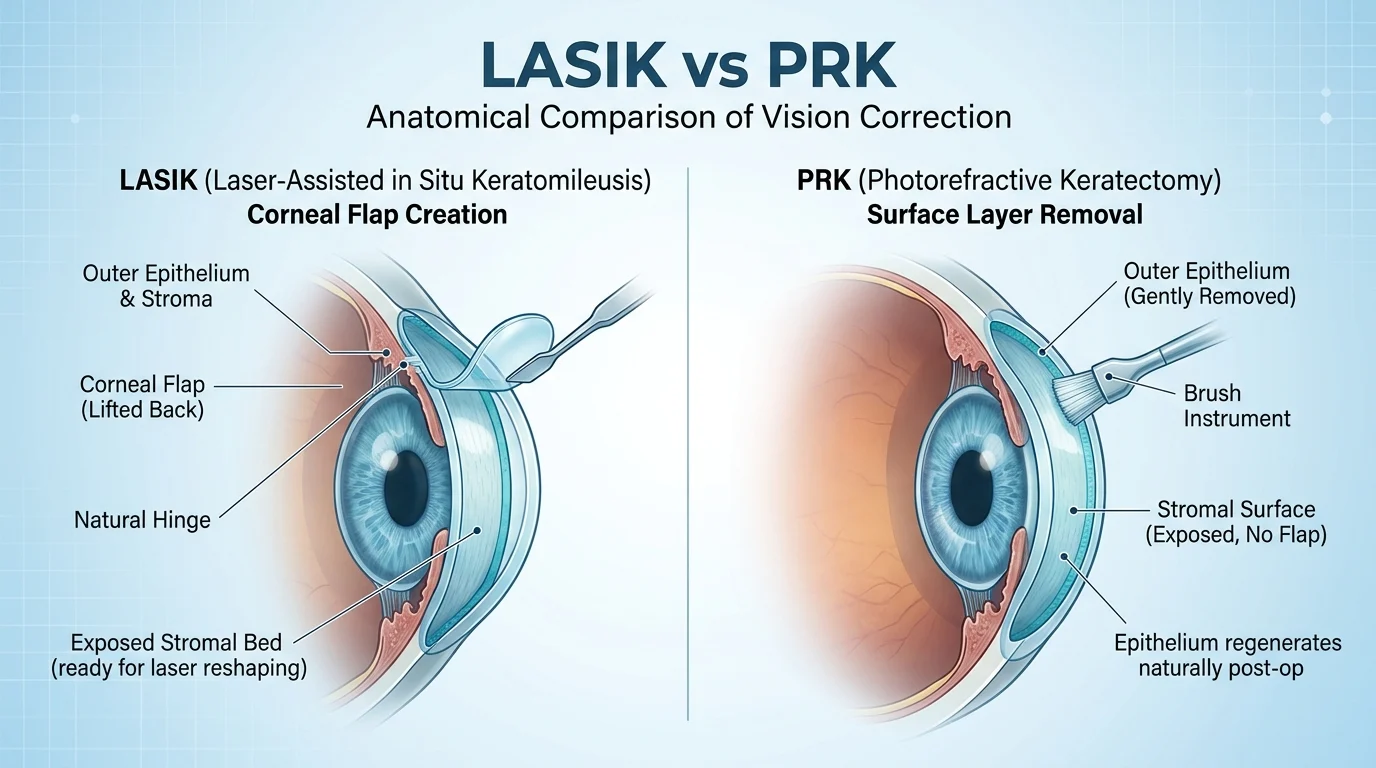
- LASIK: The surgeon creates a thin flap in the cornea, reshapes the underlying tissue with a laser, and returns the flap to its position.
- PRK: The surgeon removes the thin outer layer of the cornea before reshaping the underlying tissue. The surface layer then grows back during healing.
LASIK generally provides faster visual recovery and less initial discomfort. PRK avoids a corneal flap and may be suitable for some people who are not ideal LASIK candidates. Neither procedure is best for everyone.
What Is LASIK?
LASIK stands for laser assisted in situ keratomileusis. It is a refractive surgery designed to reduce dependence on glasses or contact lenses.
During the procedure, the surgeon creates a thin flap in the cornea. A laser then reshapes the tissue underneath to correct the focusing problem. The flap is repositioned after treatment and begins attaching naturally.
LASIK is commonly used to treat nearsightedness, farsightedness, and astigmatism in suitable candidates.
Potential advantages of LASIK include:
- Faster improvement in vision.
- Less initial discomfort for many patients.
- A relatively short recovery period.
- An earlier return to many everyday activities.
However, LASIK creates a permanent corneal flap. Dry eyes, glare, halos, undercorrection, overcorrection, and other complications are possible. Some patients may also experience flap related problems.
What Is PRK?
PRK stands for photorefractive keratectomy. It is another type of laser eye surgery that reshapes the cornea to improve how light enters the eye.
Unlike LASIK, PRK does not involve creating a corneal flap. Instead, the surgeon removes the surface layer of the cornea before using a laser to reshape the underlying tissue. The surface layer gradually regenerates during recovery.
PRK may be considered for people with certain thin corneas or those whose occupations and activities make avoiding a corneal flap especially important. However, suitability depends on detailed eye measurements and overall eye health.
Potential advantages of PRK include:
- No permanent corneal flap.
- A possible option for certain patients unsuitable for LASIK.
- Less concern about flap displacement from direct eye trauma.
PRK usually causes more discomfort during the initial healing period. Vision also takes longer to stabilize, and recovery requires careful adherence to postoperative instructions.
LASIK vs PRK: Key Differences
| Feature | LASIK | PRK |
|---|---|---|
| Surgical technique | Creates a corneal flap | Removes the surface layer |
| Visual recovery | Usually faster | Usually slower |
| Initial discomfort | Often milder | Often greater |
| Corneal flap | Yes | No |
| Thin corneas | May not be suitable | May suit some candidates |
| Return to activities | Often sooner | May require more time |
| Possible complications | Dry eye, glare, flap related issues | Dry eye, glare, corneal haze |
| Long term results | Often excellent in suitable candidates | Often excellent in suitable candidates |
Both procedures have potential benefits and risks. An eye examination is essential before choosing either option.
Recovery Time: Which Is Faster?
LASIK generally provides faster visual recovery than PRK.
After LASIK, many people notice substantial improvement within a day or two. However, vision can fluctuate, and dryness or light sensitivity may persist during healing.
PRK involves healing of the corneal surface. Vision may remain blurry during the first several days, and improvement typically continues over the following weeks. Some patients need a month or longer to reach their best vision.
Recovery varies from person to person. Your surgeon will advise when you can safely drive, return to work, exercise, swim, or resume contact sports.
Do not rush recovery simply because your vision seems clearer. Attend follow up appointments and use prescribed eye drops as directed.
Which Is Better for Thin Corneas or Active Lifestyles?
PRK may be an option for some people with thinner corneas because it avoids creating a LASIK flap. Nevertheless, thin corneas do not automatically make someone suitable for PRK. The surgeon must determine whether enough healthy corneal tissue remains after treatment.
PRK may also appeal to people involved in contact sports or work that carries a risk of eye trauma. Since there is no flap, flap displacement is not a concern.
LASIK may be more convenient for people who prioritize faster recovery and have suitable corneal measurements. Still, an active lifestyle alone does not determine the best procedure.
Risks and Side Effects
Both LASIK and PRK are surgical procedures, so neither is risk free.
Possible side effects include dry eyes, glare, halos around lights, light sensitivity, and temporary fluctuations in vision. Some patients experience undercorrection or overcorrection and may continue to need glasses or contact lenses.
PRK carries a risk of corneal haze or scarring. LASIK has additional flap related risks. Rarely, either procedure can cause serious complications, including reduced best corrected vision.
People with unstable prescriptions, certain corneal conditions, severe dry eye, or other eye health problems may not be suitable candidates. A comprehensive examination helps identify potential concerns.
Frequently Asked Questions
Is LASIK better than PRK?
Not for everyone. LASIK usually offers faster recovery, while PRK avoids a corneal flap. The better choice depends on your eyes and individual circumstances.
Which procedure is more painful?
PRK generally causes more discomfort during the first few days because the surface layer needs to heal. LASIK usually causes milder initial discomfort.
Do LASIK and PRK provide the same results?
Both can provide excellent vision correction in suitable candidates. Outcomes depend on the prescription, eye health, healing, and other individual factors.
Can thin corneas rule out LASIK?
Thin corneas may make LASIK unsuitable, but eligibility depends on detailed measurements. PRK may be considered in some cases.
How long does PRK recovery take?
Vision often improves over several days, but it may take weeks or longer to stabilize fully. Your surgeon will monitor your healing.
Can I still need glasses after surgery?
Yes. Some people still need glasses for certain activities or later develop age related near vision changes.
Conclusion
Choosing between LASIK vs PRK involves more than comparing recovery times. LASIK generally provides quicker visual improvement and less initial discomfort, while PRK avoids creating a corneal flap and may be suitable for certain patients with thinner corneas or higher risks of eye trauma.
Both procedures can offer excellent results when performed on appropriately selected candidates. However, each carries potential side effects and complications, and neither guarantees perfect vision without glasses.
Before making a decision, schedule a comprehensive examination with a qualified ophthalmologist. Discuss your prescription, corneal thickness, dry eye symptoms, lifestyle, work requirements, and expectations. The most suitable procedure is the one that offers an appropriate balance of safety and likely benefit for your individual eyes.