
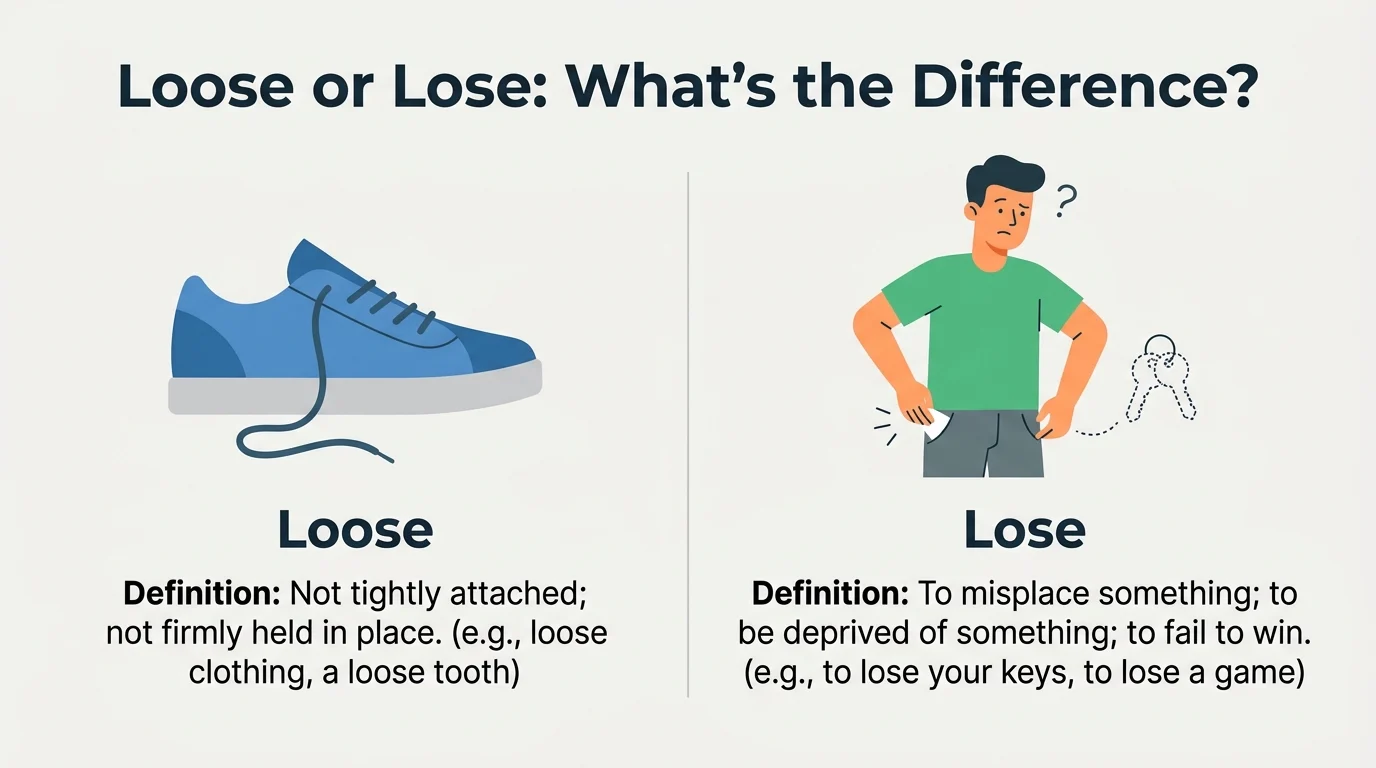
Quick Ans: Loose and lose are different words with different meanings. Loose usually means not tight, while lose means to misplace something, fail to win, or no longer have something. A simple way to remember the difference is: loose describes something that is not tight, while lose describes something you no longer have.
Loose or lose is one of the most common spelling and word choice confusions in English. The two words look and sound similar, but they have completely different meanings and grammatical functions. This makes the mistake easy to make, especially in fast writing, texting, and online communication.
Loose is usually an adjective that describes something that is not tight, firmly fixed, or closely attached. For example, you can have a loose shirt, a loose tooth, or a loose screw.
Lose is a verb. It can mean to misplace something, fail to win a game, or no longer have something. For example, you might lose your keys, lose a match, or lose interest.
Knowing the difference between these words can make your writing much clearer. Once you understand what each word means, choosing the correct spelling becomes simple.
Quick Answer and Key Takeaway
| Word | Meaning | Example |
|---|---|---|
| Loose | Not tight or firmly attached | My shoes are loose. |
| Lose | To misplace, fail to win, or no longer have | Don’t lose your keys. |
Key takeaway: Use loose when describing something that is not tight. Use lose when talking about misplacing something, failing to win, or no longer having something.
Definition and Explanation
What Does Loose Mean?
Loose is mainly an adjective. It describes something that is not tight, fixed, or firmly held.
Examples:
- This shirt is too loose.
- The dog broke loose from its leash.
- There is a loose screw on the chair.
- She prefers loose clothing.
The word can also describe something that is free or not controlled.
What Does Lose Mean?
Lose is a verb with several meanings.
It can mean to misplace something:
- I don’t want to lose my phone.
It can also mean to no longer have something:
- She lost her job last year.
Is This a Grammar, Usage, or Vocabulary Issue?
This is mainly a vocabulary and spelling issue because loose and lose have different meanings.
Their grammatical roles are also different.
| Word | Part of Speech | Example |
|---|---|---|
| Loose | Adjective | The rope is loose. |
| Lose | Verb | Don’t lose the rope. |
A useful rule is to look at the action or description in your sentence. If you are describing something as not tight, choose loose. If you are describing the act of misplacing, missing, or no longer having something, choose lose.
Real World Usage Examples
Workplace
Loose: The cable is loose and needs to be secured.
Lose: We could lose an important client.
Recap: Use loose for something that is not firmly attached and lose for something that may be lost or no longer retained.
Academic Writing
Loose: The paper contains a loose definition of the term.
Lose: Students may lose marks for incorrect answers.
Recap: The surrounding meaning tells you which word belongs in the sentence.
Everyday Writing
Loose: These pants are too loose.
Lose: Be careful not to lose your wallet.
Recap: Loose describes fit or attachment, while lose describes an action or outcome.
Regional or Global Usage Differences
There is no major regional spelling difference between these words. Loose and lose are standard spellings in both American and British English.
The confusion happens because the words look similar and have related pronunciation patterns.
| Word | Standard Spelling |
|---|---|
| Loose | Loose |
| Lose | Lose |
The difference is therefore about meaning and usage, not regional English.
When NOT to Use It
Avoid these common mistakes:
- Don’t use loose when you mean that you misplaced something.
- Don’t use lose to describe clothing that isn’t tight.
- Don’t write “loose weight” when you mean “lose weight.”
- Don’t write “I loose my keys” when you mean “I lose my keys.”
- Don’t write “loose the game” when you mean “lose the game.”
- Don’t assume the extra o in loose makes it the correct form for every situation.
- Don’t choose the spelling based only on how the word looks.
Common Mistakes and Corrections
| Correct Sentence | Incorrect Sentence | Why |
|---|---|---|
| I don’t want to lose my phone. | I don’t want to loose my phone. | Lose means to misplace something. |
| These shoes are loose. | These shoes are lose. | Loose describes something that is not tight. |
| She wants to lose weight. | She wants to loose weight. | Lose is the correct verb. |
| The bolt is loose. | The bolt is lose. | Loose describes something that isn’t firmly fixed. |
| They could lose the match. | They could loose the match. | Lose means fail to win. |
Simple Decision Rule
Loose = not tight. Lose = misplace, fail to win, or no longer have.
A quick memory trick is to associate the extra o in loose with something having “room” or being less tight.
Exercises With Answers
Choose loose or lose.
- Don’t ___ your passport.
- My jacket is too ___.
- We don’t want to ___ the game.
- The handle feels ___.
- She doesn’t want to ___ her opportunity.
- These jeans are very ___ around the waist.
Answers
- lose
- loose
- lose
- loose
- lose
- loose
Related Concepts and Comparisons
Loose and lose are not the only commonly confused words in English.
| Confused Words | Main Difference |
|---|---|
| Loose / Lose | Not tight / Misplace or fail to win |
| Choose / Chose | Present / Past |
| Advice / Advise | Noun / Verb |
| Affect / Effect | Usually verb / Usually noun |
| Then / Than | Time or sequence / Comparison |
Learning these pairs together can help you avoid common spelling and vocabulary mistakes.
FAQs
What is the difference between loose and lose?
Loose usually means not tight or not firmly attached. Lose means to misplace something, fail to win, or no longer have something.
Is it lose weight or loose weight?
The correct expression is lose weight. Lose is a verb meaning to reduce or no longer have something.
Is it loose or lose clothing?
Use loose when describing clothing that isn’t tight. For example, “I prefer loose clothing.”
How do you remember loose vs lose?
Remember that loose has two “o” letters and can describe something with extra room. Lose has one “o” and is the verb used for misplacing something or failing to win.
Is loose a verb or an adjective?
Loose is most commonly an adjective. It describes something that isn’t tight, fixed, or firmly attached.
Is lose a verb?
Yes. Lose is a verb. It can describe misplacing something, failing to win, or no longer having something.
Is loose the opposite of tight?
Yes. In many contexts, loose is the opposite of tight. For example, loose clothing isn’t tightly fitted.
Why do people confuse loose and lose?
The words have similar spellings and pronunciation patterns, which makes them easy to mix up. Their meanings, however, are different.
Is “loose the game” correct?
No. The correct expression is lose the game because lose means to fail to win.
Conclusion
Understanding loose or lose becomes much easier when you focus on meaning instead of spelling. Loose describes something that isn’t tight, firmly attached, or closely controlled. Lose is a verb that means to misplace something, fail to win, or no longer have something.
For example, you can have loose shoes, but you can lose your shoes. You can also lose a game, while a screw can become loose.
There is no major difference between American and British spelling for these two words. Both varieties use loose and lose in the same basic way.
When you’re unsure, ask yourself whether you’re describing something or talking about an action. If something isn’t tight, use loose. If something might be misplaced, missed, or no longer yours, use lose.
Practical tip: Remember this simple rule: Loose has two O’s because it has more room; lose has one O because something is gone.
1 thought on “Loose or Lose: What’s the Difference? Easy Rules, Examples & Tips”