
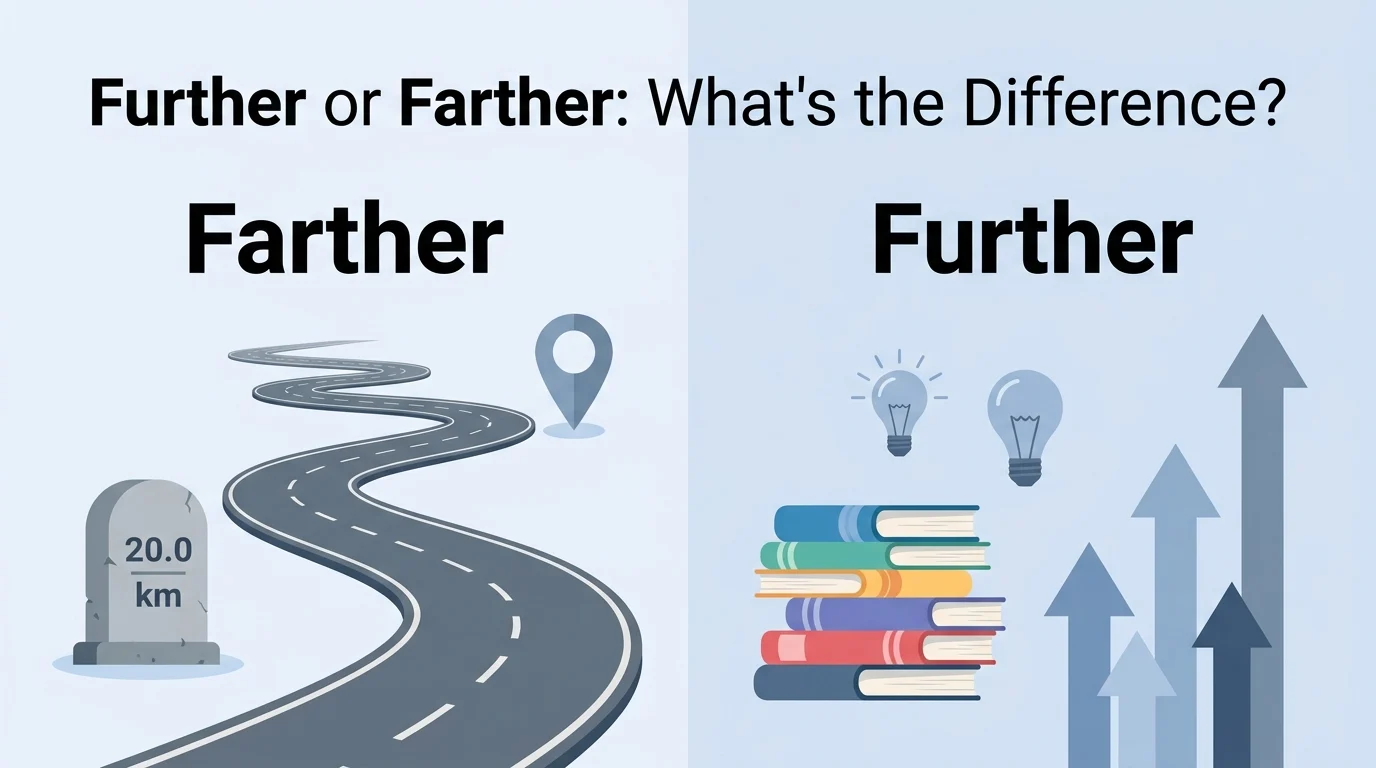
Quick Ans: Further and farther both describe distance, but they are used differently. Farther usually refers to physical distance, while further often refers to figurative distance, progress, or additional information. However, in modern English, further can also describe physical distance in some situations.
Are you confused about whether to use further or farther? These two words are often mixed up because they have similar meanings and both relate to distance.
The difference becomes clearer when you look at the type of distance being discussed. If you are talking about an actual physical distance, such as traveling to another city, farther is traditionally preferred. If you mean an idea, progress, discussion, or additional amount, further is usually the better choice.
For example, “The store is farther from my house” talks about physical space. On the other hand, “We need further discussion” refers to more discussion, not a measurable distance.
However, English usage has changed over time. Many speakers now use further for both physical and figurative meanings. Even so, understanding the traditional difference helps you write clearly in academic, professional, and formal situations.
Quick Answer and Key Takeaway
| Word | Main Use | Example |
|---|---|---|
| Further | Additional, more, or figurative distance | We need further information. |
| Farther | Physical distance | The park is farther away. |
Simple rule: Use farther for measurable distance and further for additional ideas, progress, or information.
Definition and Explanation
Further
“Further” can be an adjective, adverb, or verb.
It usually means more, additional, or to a greater extent.
Examples:
- We need further details.
- She continued further with her research.
It is common in formal writing, especially when discussing progress, development, or extra information.
Farther
“Farther” is mainly used as an adjective or adverb.
It traditionally refers to physical distance that can be measured.
Examples:
- The airport is farther than the station.
- How much farther do we need to walk?
| Word | Meaning | Example |
|---|---|---|
| Further | More, additional, or extended | We need further explanation. |
| Farther | Greater physical distance | The mountain is farther away. |
The main difference is simple. Farther focuses on actual space, while further often focuses on an idea, amount, or continuation.
Is This a Grammar, Usage, or Vocabulary Issue?
This is mainly a usage and vocabulary issue.
Both words are correct, but choosing the right one depends on context.
Traditional grammar guides suggest:
- Use farther for physical distance.
- Use further for abstract distance or additional meaning.
However, many modern dictionaries accept further for physical distance too.
For example:
- The house is farther down the road.
- The house is further down the road.
Both may be understood, but “farther” is often preferred when the distance is clearly measurable.
Real World Usage Examples
Workplace Examples
“We need further information before making a decision.”
Here, further means additional.
“The new office is farther from the city center.”
Here, farther refers to physical location.
Recap: Professional writing often uses further for additional information and farther for location.
Academic Examples
“The researcher conducted further analysis.”
Further means additional analysis.
“The second study site was farther away.”
Farther describes physical distance.
Recap: Academic writing often follows the traditional difference between the two words.
Everyday Examples
“Can you walk farther?”
The speaker means a greater physical distance.
“Let’s discuss this further.”
The speaker means continue the discussion.
Recap: Context determines which word sounds natural.
Regional or Global Usage Differences
Further and farther are used in American, British, Canadian, and Australian English.
The traditional distinction is understood across these varieties. However, many speakers use further for both physical and nonphysical distance.
In formal writing, especially academic and professional writing, keeping the traditional difference can make your meaning clearer.
When NOT to Use It
Do not use farther when you mean “additional” information.
Incorrect: Please provide farther details.
Correct: Please provide further details.
Do not use further when a clear physical measurement is the focus in formal writing.
Incorrect: The town is further than 20 miles away.
Better: The town is farther than 20 miles away.
Do not choose between them only because one sounds more formal. Meaning matters more than formality.
Avoid changing the word without checking the context.
Common Mistakes and Corrections
| Correct Sentence | Incorrect Sentence | Why |
|---|---|---|
| We need further explanation. | We need farther explanation. | Further means additional. |
| The lake is farther away. | The lake is further away. | Farther is traditional for physical distance. |
| Let’s discuss this further. | Let’s discuss this farther. | Further means continue. |
| She traveled farther than before. | She traveled further than before. | Farther clearly refers to distance. |
Decision Rule: Ask yourself: “Can I measure this distance?” If yes, use farther. If it means more, extra, or continued, use further.
Exercises With Answers
Choose further or farther.
- We need _____ information about the project.
- The hotel is _____ from the airport.
- Let’s explore this topic _____.
- How much _____ can we travel?
- The teacher gave _____ instructions.
Answer Key
- further
- farther
- further
- farther
- further
Related Concepts and Comparisons
Readers may also search for farther vs further, farther meaning, further meaning, affect vs effect, fewer vs less, then vs than, beside vs besides, and imply vs infer.
FAQs
What is the difference between further and farther?
Farther usually refers to physical distance, while further often refers to additional information, progress, or continuation. Both words can sometimes describe distance in modern English.
Is farther or further correct?
Both are correct. The best choice depends on the meaning you want to express. Farther focuses on measurable distance, while further often means more or additional.
Can further be used for physical distance?
Yes. Many modern speakers use further for physical distance. However, farther remains the traditional choice when talking about measurable space.
Is farther more formal than further?
No. Neither word is more formal. They simply have different traditional uses.
Should I say further information or farther information?
The correct phrase is “further information.” It means additional information.
Should I use farther or further in academic writing?
In academic writing, use further for additional research or explanation and farther for physical distance when possible.
What does further mean in a sentence?
Further can mean additional, more advanced, or continuing. For example, “We need further discussion” means we need more discussion.
What does farther mean in English?
Farther means at a greater physical distance. For example, “The school is farther from my home.”
Conclusion
The difference between further or farther becomes easier when you focus on meaning. Traditionally, farther refers to physical distance, while further refers to additional information, progress, or abstract ideas.
For example, “The airport is farther away” describes a measurable location. Meanwhile, “We need further details” means we need more information.
Although many people now use further for both meanings, the traditional rule remains useful. It helps make your writing clearer, especially in professional and academic settings.
Remember this simple trick: if you can measure the distance, choose farther. If you mean more, extra, or continued, choose further.
Practical tip: Before choosing the word, ask yourself whether you are talking about a place or an idea. That quick check will usually give you the correct answer.