
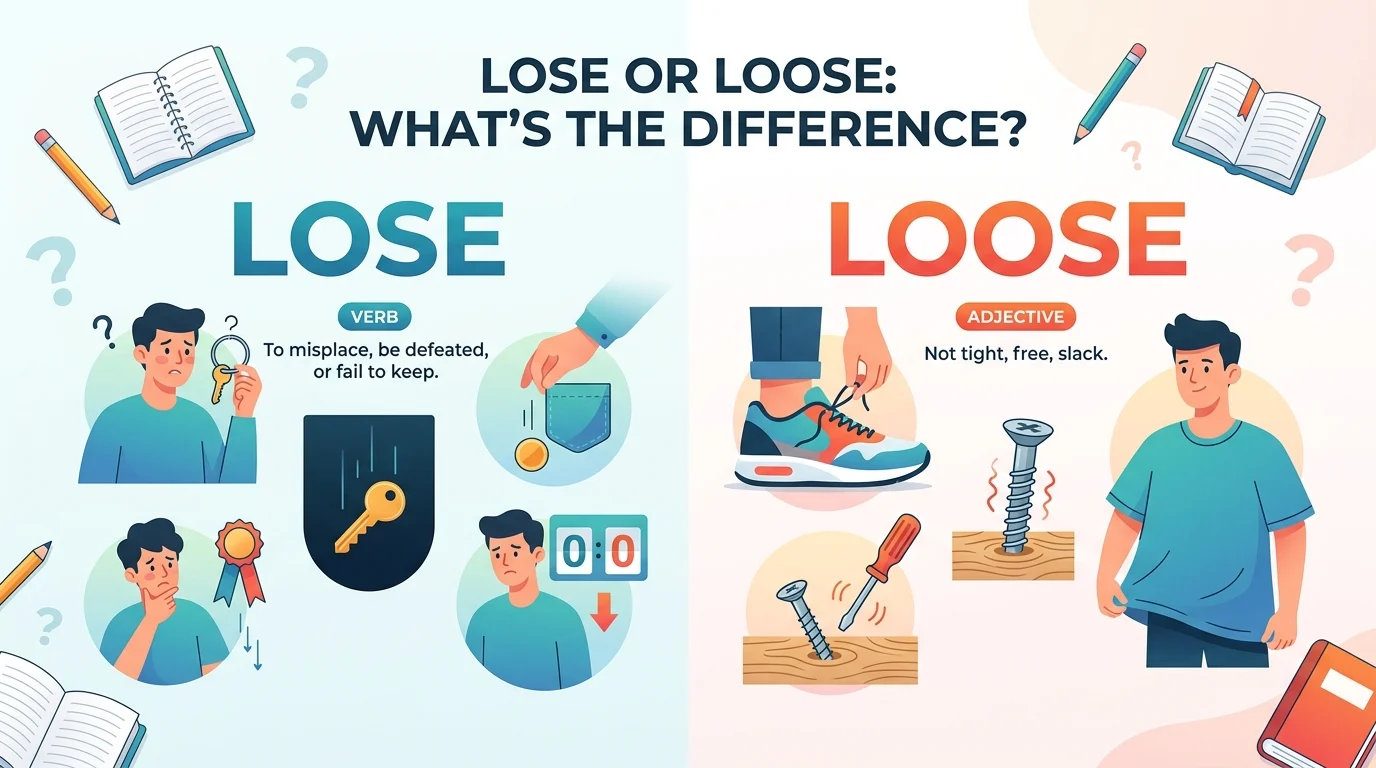
Quick Ans: Lose and loose have different meanings and pronunciations. Lose is a verb meaning to misplace something, fail to win, or no longer have something. Loose is usually an adjective meaning not tight or not firmly attached. Remember: you can lose your keys, but your shoes can be loose.
Lose or loose is a common spelling confusion because the two words look and sound somewhat similar. However, they have completely different meanings and grammatical roles. Using the wrong word can change the meaning of a sentence and make your writing look careless.
Lose is mainly a verb. You use it when something is misplaced, no longer possessed, or when someone fails to win. For example, you might lose your phone, lose a game, or lose your patience.
Loose is usually an adjective. It describes something that isn’t tight, fixed, or firmly attached. For example, you can have a loose shirt, a loose tooth, or a loose screw.
The good news is that this mistake is easy to avoid once you understand the difference. This guide explains lose or loose, their meanings, pronunciation, grammar, common mistakes, examples, and a simple rule to help you choose the correct word every time.
Quick Answer and Key Takeaway
Lose is a verb meaning to misplace something, fail to win, or no longer have something.
Loose is usually an adjective meaning not tight, not firmly fixed, or free from restriction.
| Word | Part of Speech | Meaning | Example |
|---|---|---|---|
| Lose | Verb | Misplace, fail to win, or no longer have | Don’t lose your keys. |
| Loose | Adjective | Not tight or firmly attached | My shirt is loose. |
Easy rule: If you mean “misplace” or “fail to win,” use lose. If you mean “not tight,” use loose.
Definition and Explanation
What Does Lose Mean?
Lose is a verb. It has several common meanings.
You can lose something when you cannot find it:
- I don’t want to lose my wallet.
- Our team may lose the match.
You can also lose something more abstract:
- She doesn’t want to lose her job.
- He lost his confidence.
What Does Loose Mean?
Loose is usually an adjective. It describes something that isn’t tight or securely attached.
- These shoes are too loose.
- The dog got loose from its leash.
- There is a loose button on my shirt.
Loose can also describe something that isn’t closely controlled or organized:
- The group followed a loose plan.
Is This a Grammar, Usage, or Vocabulary Issue?
The lose or loose confusion is mainly a spelling and vocabulary issue. The words have different meanings and usually serve different grammatical functions.
Lose is a verb.
- I might lose my keys.
Loose is usually an adjective.
- My keys are loose in my bag.
A useful pronunciation tip is that lose sounds like “looz,” while loose sounds like “loos.”
Real World Usage Examples
Workplace
- Be careful not to lose the client documents.
- The office door handle is loose.
- We could lose an important customer.
- The connection between the parts is loose.
Recap: Use lose for something that is misplaced or no longer retained. Use loose for something that isn’t tight or secure.
Academic
- Students can lose marks for incorrect answers.
- The pages became loose after repeated use.
- Don’t lose your focus during the exam.
- The professor gave us a loose outline.
Recap: Academic writing uses lose for loss or failure and loose for something that isn’t firmly arranged or attached.
Everyday
- I always lose my headphones.
- These jeans are too loose.
- Don’t lose your ticket.
- One of the buttons is loose.
Recap: Think lose = no longer have and loose = not tight.
Regional or Global Usage Differences
There is no major regional difference in the meanings of lose and loose. Both words are standard English and are used internationally.
The main difference is pronunciation. Lose has a voiced “z” sound, while loose has an unvoiced “s” sound.
When NOT to Use It
Avoid lose when you mean something isn’t tight.
Incorrect:
- My shoes are lose.
Correct:
- My shoes are loose.
Avoid loose when you mean misplacing something.
Incorrect:
- I don’t want to loose my phone.
Correct:
- I don’t want to lose my phone.
Other common situations include:
- Losing a game, not loosing a game.
- Losing weight, not loosing weight.
- A loose tooth, not a lose tooth.
- A loose screw, not a lose screw.
- Losing money, not loosing money.
Common Mistakes and Corrections
| Correct Sentence | Incorrect Sentence | Why |
|---|---|---|
| Don’t lose your phone. | Don’t loose your phone. | Lose means misplace. |
| This shirt is loose. | This shirt is lose. | Loose means not tight. |
| I lost the game. | I loosed the game. | Lose is the correct verb. |
| She wants to lose weight. | She wants to loose weight. | Lose means reduce or no longer have. |
| The screw is loose. | The screw is lose. | Loose means not firmly attached. |
Decision Rule
Ask yourself:
Do I mean “misplace, fail, or no longer have”? Use lose.
Do I mean “not tight or not firmly attached”? Use loose.
Exercises With Answers
Choose lose or loose.
- Don’t ___ your passport.
- These pants are too ___.
- Our team might ___ the game.
- The handle is ___.
- I don’t want to ___ my job.
- She needs a ___ jacket.
Answer Key
- lose
- loose
- lose
- loose
- lose
- loose
Related Concepts and Comparisons
The easiest comparison is:
Lose = verb = misplace, fail, or no longer have
Loose = adjective = not tight or not secure
You may also see lost, which is the past tense of lose.
- I lose my keys often.
- I lost my keys yesterday.
Loosen is different from both words. It is a verb meaning to make something less tight.
- Please loosen the knot.
FAQs
Is lose or loose correct?
Both are correct words, but they have different meanings. Use lose for misplacing something or failing to win, and loose for something that isn’t tight.
How do you remember lose vs loose?
Think of the extra “o” in loose as giving the word extra space. Loose things have extra space because they aren’t tight.
Is it lose weight or loose weight?
The correct phrase is lose weight. Lose is the verb used when talking about reducing body weight.
Is it lose a game or loose a game?
The correct phrase is lose a game. If you fail to win, you lose the game.
Is loose an adjective?
Yes. Loose is commonly an adjective that describes something that isn’t tight, fixed, or securely attached.
Is lose a verb?
Yes. Lose is a verb. It can mean misplace something, fail to win, or no longer have something.
Why do people confuse lose and loose?
They look very similar and are related in pronunciation, so writers often mix them up. Their meanings and grammatical uses are different.
What is the difference between lost and loose?
Lost is the past tense or past participle of lose. Loose describes something that isn’t tight or securely fixed.
What is the difference between loosen and lose?
Loosen means to make something less tight. Lose means to misplace something, fail to win, or no longer have something.
Conclusion
Understanding lose or loose becomes simple when you focus on meaning. Lose is a verb used for misplacing something, failing to win, or no longer having something. Loose is usually an adjective that describes something that isn’t tight, fixed, or secure.
Remember the basic distinction: lose = misplace or fail, while loose = not tight. You can lose your keys, lose a match, or lose your patience. You can have loose shoes, a loose button, or a loose screw.
When you’re unsure, replace the word mentally. If the sentence means “misplace,” “fail,” or “no longer have,” choose lose. If it means “not tight,” choose loose.
The best way to remember the difference is to use both words in your everyday writing. With a little practice, you’ll stop confusing lose or loose and choose the correct spelling naturally.