
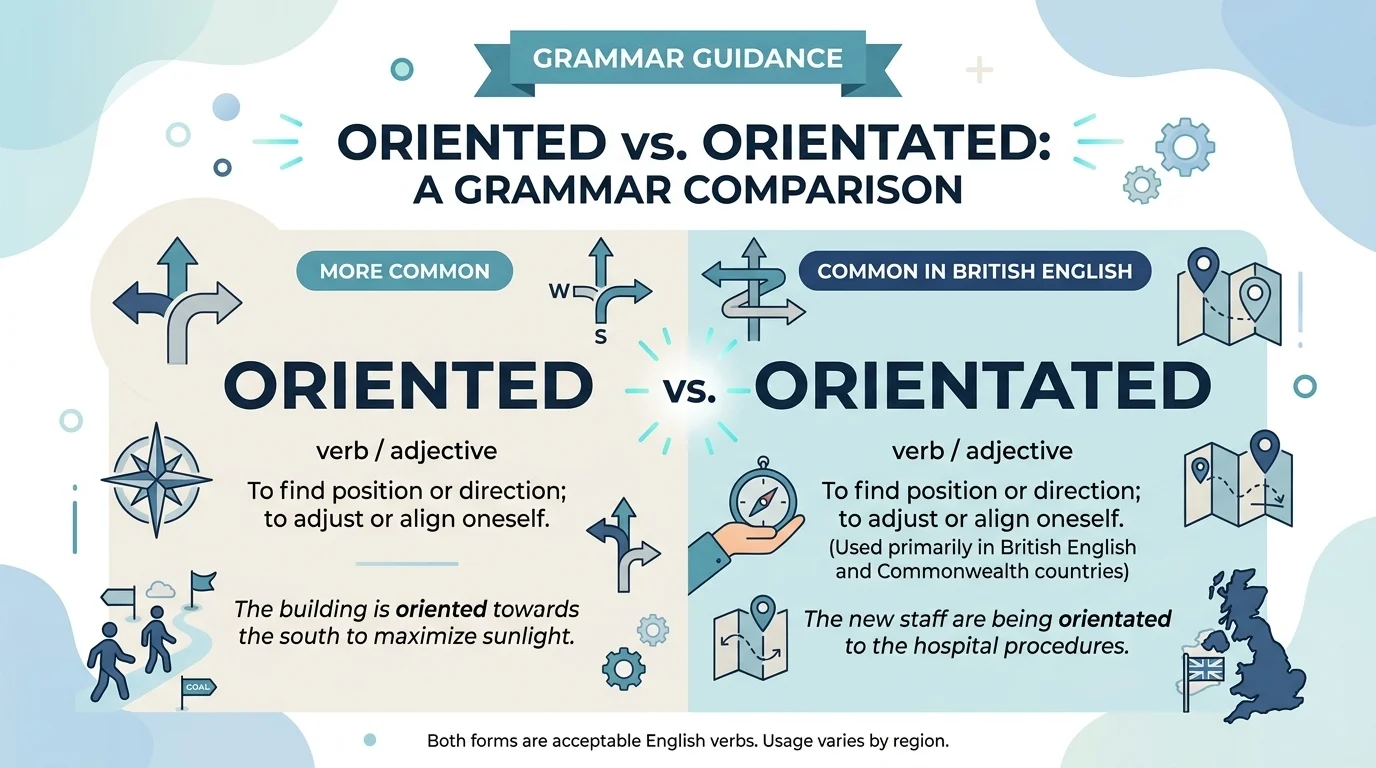
Quick Ans: Both “oriented” and “orientated” are correct English words. “Oriented” is more common, especially in American English, while “orientated” is also standard and appears more often in British English. In most situations, “oriented” is the safer and more widely understood choice.
Are you wondering whether to use “oriented or orientated”? Both forms are grammatically correct, so the choice can feel confusing.
The two words come from the verb “orient,” which means to position, direct, or help someone become familiar with something. For example, a company may provide a new employee with an orientation program.
In American English, “oriented” is much more common. British English also uses “oriented,” but “orientated” appears more often there than it does in American English.
The difference matters when you are writing for a specific audience. If you write for an international audience, “oriented” is usually the clearest choice because readers are more likely to recognize it immediately.
You may also see both forms in phrases such as “customer oriented” and “customer orientated.” Although both can be correct, style guides and regional preferences often favor “oriented.”
Quick Answer and Key Takeaway
| Word | Correct? | Common Usage |
|---|---|---|
| Oriented | Yes | More common, especially in American English |
| Orientated | Yes | More common in British English |
Both forms are correct. However, “oriented” is the more widely used form.
Definition and Explanation
Oriented
“Oriented” is the past tense and past participle of “orient.” It can mean directed toward something, positioned in a particular direction, or familiar with a situation.
Example: The training is customer oriented.
It can also describe someone who understands a new environment.
Example: The program helps students become oriented to university life.
Orientated
“Orientated” is also a past tense and past participle of “orient.” It has the same basic meaning as “oriented.”
Example: The course is career orientated.
The word is especially common in British English and some other varieties of English.
| Feature | Oriented | Orientated |
|---|---|---|
| Correct English | Yes | Yes |
| Meaning | Directed or familiarized | Directed or familiarized |
| American English | Very common | Less common |
| British English | Common | More common than in American English |
In practical writing, both forms can work. However, “oriented” usually gives you the safest choice for a broad audience.
Is This a Grammar, Usage, or Vocabulary Issue?
This is mainly a usage and regional preference issue. Neither word is grammatically wrong.
American writers generally prefer “oriented.” British writers may use either form, although “orientated” is more familiar in some British contexts.
The words are interchangeable in many sentences. However, consistency matters. If your article uses “oriented” in one section, there is usually no reason to switch to “orientated” later.
Real World Usage Examples
Workplace Example
“Our training program is customer oriented.”
This means the program focuses on customers and their needs.
Recap: “Customer oriented” is common in business writing.
Academic Example
“The course is research oriented.”
Here, the course focuses strongly on research.
Recap: “Oriented” is natural in academic and professional writing.
Everyday Example
“I’m still getting oriented to my new neighborhood.”
The speaker means they are becoming familiar with the new place.
Recap: “Oriented” commonly describes becoming familiar with something.
Regional or Global Usage Differences
American English strongly favors “oriented.” For example, American businesses commonly use phrases such as “customer oriented,” “goal oriented,” and “results oriented.”
British English also accepts “oriented,” but “orientated” appears more frequently in British usage.
Canadian, Australian, and other English varieties may use both forms. Therefore, your choice can depend on your audience and the style of publication.
If you are unsure which form to use for an international audience, “oriented” is generally the better option.
When NOT to Use It
Do not assume that “orientated” is incorrect simply because “oriented” sounds more familiar.
Do not change between “oriented” and “orientated” randomly within the same document.
Avoid using either form when a more precise verb would explain the action better.
Do not choose “orientated” simply to make your writing sound more formal.
If you are writing for an American audience, “oriented” will usually sound more natural.
Common Mistakes and Corrections
| Correct Sentence | Incorrect Sentence | Why |
|---|---|---|
| The company is customer oriented. | The company is customer orientated. | The second form is not wrong, but “oriented” is more common here. |
| The course is career oriented. | The course is career orientated. | “Oriented” is widely preferred, especially in American English. |
| New students become oriented to campus life. | New students become orientated to campus life. | Both forms can work, but “oriented” is more common internationally. |
| The team is results oriented. | The team is results orientated. | “Results oriented” is the more common form. |
Decision Rule: Both forms are correct, but choose “oriented” when you want the most widely accepted and familiar option.
Exercises With Answers
Choose the more common form for each sentence.
- The company is customer _____.
- The training is career _____.
- New students become _____ to university life.
- The team is results _____.
- Is “orientated” always incorrect?
- Which form is generally safer for an international audience?
Answer Key
- oriented
- oriented
- oriented
- oriented
- No
- oriented
Related Concepts and Comparisons
Readers may also search for orient vs orientate, orientation meaning, oriented meaning, customer oriented meaning, goal oriented meaning, results oriented meaning, American vs British English, and common British English differences.
FAQs
Is oriented or orientated correct?
Both “oriented” and “orientated” are correct. However, “oriented” is more common overall and is especially preferred in American English.
Is orientated British English?
“Orientated” is commonly associated with British English. However, British speakers also use “oriented,” so it is not exclusively British.
Is oriented American English?
“Oriented” is the strongly preferred form in American English. It is also widely used in British and international English.
Which is more common, oriented or orientated?
“Oriented” is more common overall. Therefore, it is usually the best choice for general and international writing.
Is customer oriented or customer orientated correct?
Both forms can be correct. “Customer oriented” is more common, particularly in American English and international business writing.
Is goal oriented or goal orientated correct?
Both expressions are acceptable. However, “goal oriented” is much more common and will usually sound more natural to a broad English speaking audience.
Can I use oriented and orientated interchangeably?
In many contexts, yes. Both forms can describe something directed toward a particular purpose or someone becoming familiar with something.
Should I use oriented in academic writing?
Yes. “Oriented” is completely appropriate for academic writing. It is also widely recognized, so it works well for an international audience.
Does orientated mean something different from oriented?
Usually, no. The two words have essentially the same meaning. The main difference involves regional preference and frequency of use.
Conclusion
The choice between “oriented or orientated” is easier once you know that both forms are correct. “Oriented” is the more common form, especially in American English, while “orientated” appears more often in British English.
Both words can describe something directed toward a particular goal or purpose. They can also describe someone becoming familiar with a new situation or environment.
For example, “The company is customer oriented” and “The company is customer orientated” can both be understood correctly. Still, “customer oriented” is more common and usually sounds more natural to an international audience.
Therefore, if you are unsure which form to choose, “oriented” is the safest option. It works well in academic writing, workplace communication, websites, and everyday English.
Practical tip: remember that “oriented” is the widely preferred form. Use “orientated” when it matches the regional style or audience you are writing for.
2 thoughts on “Oriented or Orientated: Which Is Correct?”