
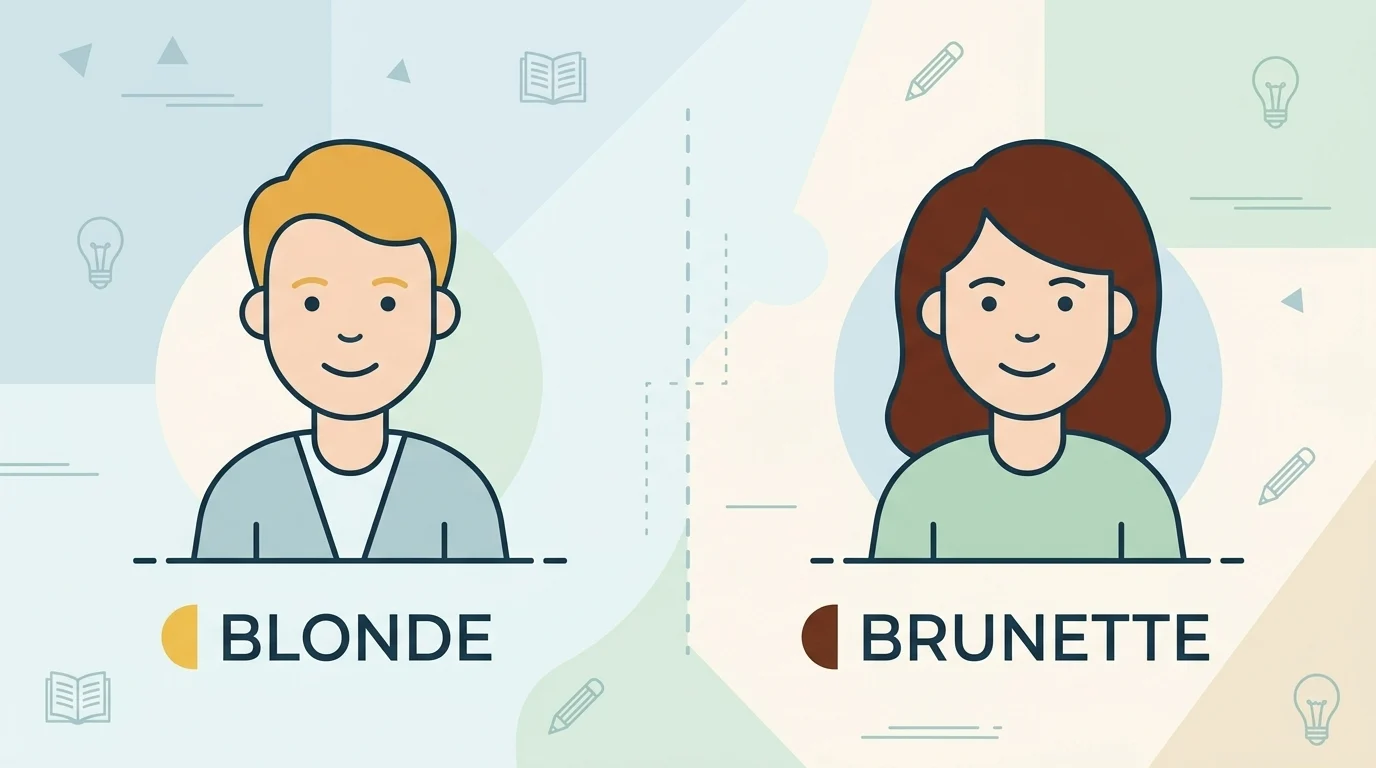
Quick Ans: “Blonde” and “brunette” are both words used to describe hair color. “Blonde” usually refers to light yellow, golden, or very light brown hair, while “brunette” usually refers to brown hair. The words can describe people, hair, or hair color, depending on the sentence and context.
Are you wondering about the difference between “blonde or brunette”? These words describe two common hair colors, but they can work differently in English.
“Blonde” usually describes someone with light colored hair. “Brunette” describes someone with brown hair. You may hear these words in everyday conversations, beauty articles, fashion writing, and descriptions of people.
The words also have an interesting history. “Blonde” can work as both a noun and an adjective, while “brunette” has traditionally been used as a noun for a woman or girl with brown hair. In modern English, however, many writers use “brunette” more broadly as an adjective too.
For English learners, the main challenge is not meaning. It is learning how these words fit naturally into sentences. Regional usage and modern style also affect which form sounds most natural.
Quick Answer and Key Takeaway
| Word | Meaning | Example |
|---|---|---|
| Blonde | A person with light colored hair or light hair color | She has blonde hair. |
| Brunette | A person with brown hair or brown hair color | She has brunette hair. |
The simplest rule is this: blonde means light hair, while brunette means brown hair.
Definition and Explanation
Blonde
“Blonde” can function as an adjective or noun.
As an adjective, it describes light colored hair.
Example: She has blonde hair.
As a noun, it can refer to a person with blonde hair.
Example: She is a blonde.
In modern English, many style guides prefer using “blonde” as an adjective because it keeps the focus on the hair rather than defining the person by appearance.
Brunette
“Brunette” traditionally works as a noun for a woman or girl with brown hair.
Example: She is a brunette.
It can also appear as an adjective, especially in phrases such as “brunette hair,” although “brown hair” often sounds more natural in everyday English.
Example: She has brown hair.
| Feature | Blonde | Brunette |
|---|---|---|
| Basic meaning | Light hair | Brown hair |
| Common adjective use | Very common | Less common |
| Common noun use | A person with blonde hair | A person with brown hair |
| Natural phrase | Blonde hair | Brown hair |
Both terms describe hair color. However, “brown hair” is often more natural than “brunette hair.”
Is This a Grammar, Usage, or Vocabulary Issue?
This is mainly a vocabulary and usage issue. Both words are correct, but their grammatical patterns can differ.
“Blonde” commonly works as an adjective before a noun, as in “blonde hair.” It can also work as a noun.
“Brunette” commonly appears as a noun, as in “She is a brunette.” When describing hair directly, “brown hair” usually sounds more natural.
Also, avoid treating these words as exact opposites in every sentence. “Blonde” describes a range of light hair shades, while “brunette” generally refers to brown hair.
Real World Usage Examples
Workplace Example
“The presenter has blonde hair.”
This neutral description works well when appearance is relevant.
Recap: Use “blonde hair” for a simple description of light hair.
Academic Example
“The researchers recorded participants’ natural hair colors.”
A formal context usually favors precise descriptions such as “light blonde” or “dark brown.”
Recap: Formal writing often benefits from specific color descriptions.
Everyday Example
“Is she the blonde or the brunette?”
This sentence uses both words as nouns. It is natural in casual conversation when identifying people by their hair color.
Recap: Both words can identify people in everyday speech.
Regional or Global Usage Differences
“Blonde” is widely used in American and British English. However, spelling conventions can differ when discussing gender.
Traditionally, “blond” has sometimes been used for men and “blonde” for women, especially in British and European usage. American English often uses “blond” as the general adjective.
For example, you may see “blond hair” and “a blond man” in American English. You may also see “blonde hair” and “a blonde woman.”
Modern English does not always follow the old gender distinction, so context and style guide preferences matter.
When NOT to Use It
Do not use “blonde” when you mean brown hair.
Do not assume every person with light brown hair is clearly blonde. Hair color exists on a spectrum.
Avoid using “brunette hair” when “brown hair” sounds more natural.
Do not describe someone by hair color when their appearance is irrelevant to the context.
Avoid assuming that “blonde” and “brunette” cover every possible hair color.
In formal writing, use precise color descriptions when the exact shade matters.
Common Mistakes and Corrections
| Correct Sentence | Incorrect Sentence | Why |
|---|---|---|
| She has blonde hair. | She has brunette hair. | “Blonde” describes light hair. |
| She has brown hair. | She has blonde hair. | “Brown” and “blonde” describe different hair colors. |
| She is a brunette. | She is a brown hair. | “Brunette” can function as a noun. |
| He has blond hair. | He has blonde hair. | “Blond” is a common general adjective, especially in American English. |
Decision Rule: Use “blonde” for light hair and “brunette” for a person with brown hair. When describing brown hair directly, “brown hair” usually sounds more natural.
Exercises With Answers
Choose the best word.
- She has _____ hair.
- He has dark _____ hair.
- She is a _____.
- The actress is known for her _____ hair.
- Which word usually describes brown hair?
- Which word usually describes light hair?
Answer Key
- blonde
- brown
- brunette
- blonde
- brunette
- blonde
Related Concepts and Comparisons
Readers may also search for blond vs blonde, brunette meaning, blonde hair meaning, blond hair vs blonde hair, brown hair vocabulary, hair color adjectives, blond or brunette, and American vs British English spelling.
FAQs
What is the difference between blonde and brunette?
“Blonde” generally describes light colored hair, while “brunette” refers to brown hair. For example, you can say “She has blonde hair” or “She is a brunette.”
Is blonde or brunette more common?
Neither word is automatically more common in every context. Their use depends on the hair color being described and the context.
Can you say brunette hair?
Yes, “brunette hair” can be understood, but “brown hair” usually sounds more natural. For example, “She has long brown hair” is a common expression.
What is the difference between blond and blonde?
Both words describe light colored hair. Traditionally, “blonde” referred to a woman and “blond” referred to a man, but modern English often uses “blond” as a general adjective.
Is brunette only used for women?
Traditionally, “brunette” was used mainly for women or girls. However, modern English sometimes uses it more broadly, although “brown haired” or “brown hair” can sound more neutral.
Is blonde a noun or an adjective?
“Blonde” can be both. In “blonde hair,” it works as an adjective. In “She is a blonde,” it works as a noun.
What does brunette mean in English?
“Brunette” generally means a person with brown hair. The word can also describe brown hair in some contexts, although “brown hair” is often more natural.
Which is correct, blonde hair or brunette hair?
“Blonde hair” is very natural. For brown hair, “brown hair” usually sounds more natural than “brunette hair,” although both may appear in English.
Conclusion
The difference between “blonde or brunette” is easy to understand once you focus on hair color. “Blonde” usually describes light colored hair, while “brunette” generally refers to someone with brown hair.
Both words appear frequently in everyday English, beauty writing, entertainment, and descriptions of people. However, they do not always work in exactly the same way. “Blonde” commonly works as both a noun and an adjective, while “brunette” traditionally works as a noun.
You may also encounter “blond,” especially in American English. Modern usage does not always follow the traditional distinction between “blond” for men and “blonde” for women.
When describing hair itself, “blonde hair” is natural, while “brown hair” is usually more natural than “brunette hair.”
Practical tip: remember the basic color rule first. Light hair is blonde, and brown hair is brunette. When describing the hair itself, choose the direct color term whenever it sounds clearer.