
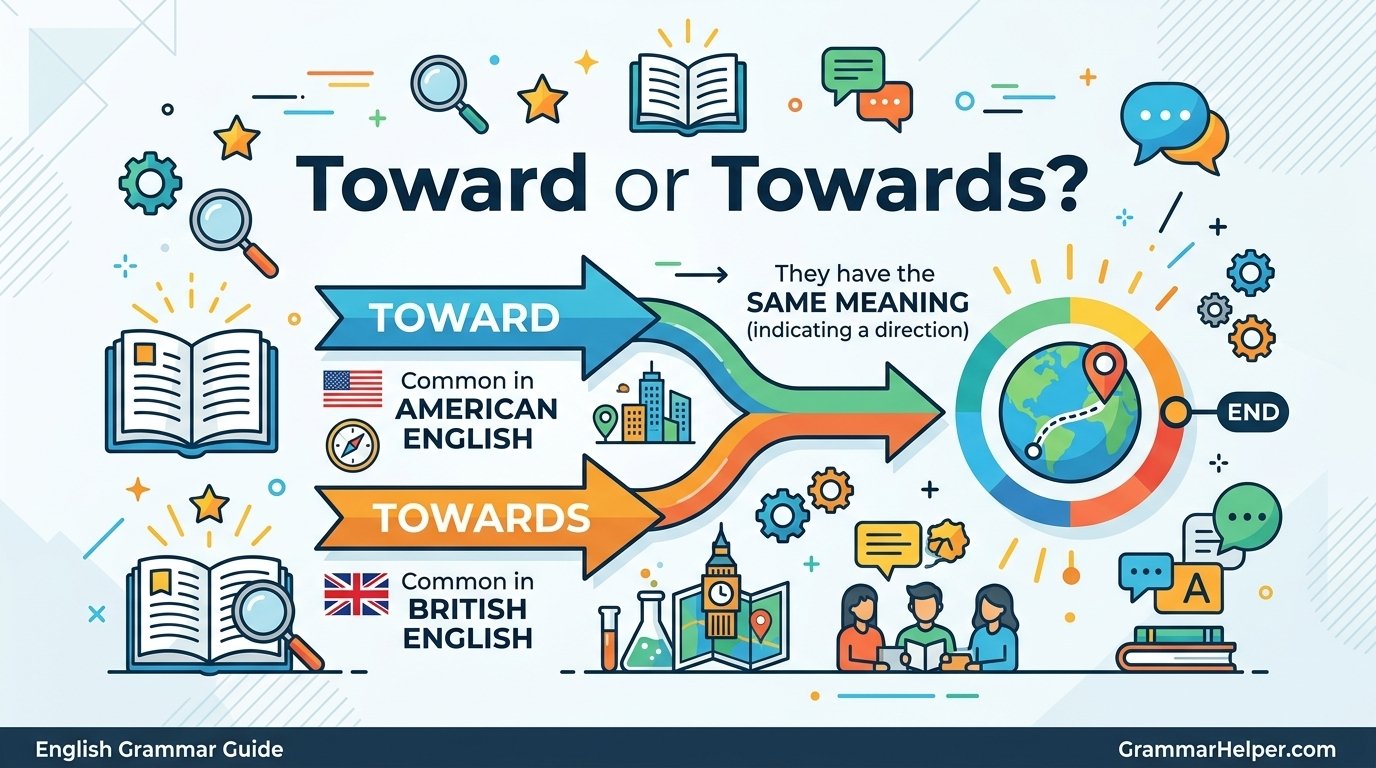
Quick Ans: Toward and towards have the same meaning and are both correct. They describe movement or direction toward a person, place, or goal. The main difference is regional preference. “Toward” is more common in American English, while “towards” is more common in British English. Both forms can be used in formal and informal writing.
Are you unsure whether to write toward or towards? Both forms are correct, so the choice can feel confusing.
The good news is that you don’t need to learn two different meanings. “Toward” and “towards” usually mean exactly the same thing. They can describe physical movement, such as “She walked toward the door,” or a change in attitude, such as “His feelings towards her changed.”
The main difference is usage preference. American writers often choose “toward,” while British writers commonly use “towards.” However, neither spelling is wrong.
You may also see both forms in academic writing, workplace communication, books, newspapers, and everyday conversation. As a result, knowing the difference can help you understand English from different regions.
If you’re writing for a specific audience, matching its usual style can make your writing feel more natural. Otherwise, you can generally choose either form and use it consistently.
Quick Answer and Key Takeaway
| Word | Meaning | Common Preference |
|---|---|---|
| Toward | In the direction of | More common in American English |
| Towards | In the direction of | More common in British English |
Both words are correct. The choice usually depends on regional writing style.
Definition and Explanation
Toward
“Toward” is a preposition. It means in the direction of someone or something.
Example: The child ran toward his mother.
It can also describe movement toward an aim, result, or condition.
Example: She is working toward her goal.
Towards
“Towards” is also a preposition and has the same basic meaning as “toward.”
Example: The child ran towards his mother.
It can describe physical direction, progress, attitude, or relationships.
Example: His attitude towards the project improved.
| Feature | Toward | Towards |
|---|---|---|
| Part of speech | Preposition | Preposition |
| Meaning | In the direction of | In the direction of |
| Meaning difference | None | None |
| Common regional preference | American English | British English |
In simple terms, “toward” and “towards” are different forms of the same word.
The extra “s” does not change the meaning.
Is This a Grammar, Usage, or Vocabulary Issue?
This is mainly a usage and regional preference issue. Both words are grammatically correct.
You can use either form to describe direction.
Example: He walked toward the park.
Example: He walked towards the park.
Both sentences mean the same thing.
The same rule applies when talking about goals or attitudes. You can say “working toward success” or “working towards success.”
However, consistency is helpful. If you’re following a particular style guide, use the form that the guide recommends.
Real World Usage Examples
Workplace Examples
“Our team is working toward a solution.”
“Our team is working towards a solution.”
Both sentences are correct and communicate the same idea.
Recap: Use either form when describing progress toward a workplace goal.
Academic Examples
“The research moves toward a better understanding of the disease.”
“The research moves towards a better understanding of the disease.”
Both versions are acceptable.
Recap: Both forms work naturally in academic writing.
Everyday Examples
“Walk toward the entrance.”
“Walk towards the entrance.”
Both instructions tell someone to move in the direction of the entrance.
Recap: In everyday English, the two forms are interchangeable.
Regional or Global Usage Differences
The biggest difference between “toward” and “towards” is regional preference.
American English generally favors “toward.” British English generally favors “towards.” Canadian, Australian, and other varieties may use both, depending on the writer and context.
Importantly, these preferences do not create a difference in meaning.
For example, “She moved toward the window” and “She moved towards the window” describe the same action.
When NOT to Use It
Don’t assume that “towards” is incorrect simply because you normally see “toward.”
Don’t treat “toward” as a more formal version. Both forms can appear in formal writing.
Avoid switching randomly between the two forms in the same document when consistency matters.
Don’t add an “s” because the sentence sounds more formal. Choose based on your preferred variety or style guide.
Don’t confuse “toward” with “through.” “Toward” describes direction, while “through” describes movement from one side or part to another.
Common Mistakes and Corrections
| Correct Sentence | Incorrect Sentence | Why |
|---|---|---|
| She walked toward the door. | She walked toward to the door. | “Toward” does not need “to” after it. |
| He moved towards the exit. | He moved toward the exit to. | The extra “to” is unnecessary. |
| We are working toward our goal. | We are working towards to our goal. | Use “toward” or “towards” directly before the noun. |
| His attitude towards me changed. | His attitude toward me changed. | This is not incorrect. Both forms are correct. |
Decision Rule: Use “toward” or “towards” according to your preferred regional or style convention. The meaning stays the same.
Exercises With Answers
Choose “toward” or “towards.”
- She walked _____ the car.
- We are working _____ a better solution.
- He moved _____ the window.
- Her attitude _____ the team changed.
- The dog ran _____ its owner.
- They are moving _____ their goal.
Answer Key
- toward or towards
- toward or towards
- toward or towards
- toward or towards
- toward or towards
- toward or towards
Related Concepts and Comparisons
Readers may also search for toward vs towards, toward or towards grammar, towards vs toward, toward meaning, towards meaning, among vs amongst, while vs whilst, forward vs forwards, and afterward vs afterwards.
FAQs
Is toward or towards correct?
Both “toward” and “towards” are correct. They have the same meaning and can describe direction, progress, or attitude.
What is the difference between toward and towards?
There is no significant difference in meaning. The main difference is regional preference, with “toward” more common in American writing and “towards” more common in British writing.
Is toward more correct than towards?
No. Neither form is more grammatically correct. Both are standard English words.
Should I use toward or towards in formal writing?
Either form is acceptable in formal writing. For consistency, follow the style guide or regional variety you are using.
Is towards more common in British English?
Yes. “Towards” is generally more common in British English. American writers tend to prefer “toward.”
Does toward mean direction?
Yes. “Toward” can describe movement in the direction of a person, place, object, or goal. For example, “She walked toward the station.”
Can I use toward for goals?
Yes. “Toward” commonly describes progress toward an objective or result. For example, “They are working toward a solution.”
Can toward and towards be used interchangeably?
Yes, in most situations. You can usually replace one with the other without changing the meaning of the sentence.
Conclusion
Toward and towards are both correct forms with the same basic meaning. They can describe movement in a particular direction, progress toward a goal, or a person’s attitude toward something.
The main difference comes from regional preference. American writers generally prefer “toward,” while British writers often prefer “towards.” Still, both forms are understood across English speaking countries.
You can therefore write “She walked toward the door” or “She walked towards the door.” Both sentences are grammatically correct. The same applies to phrases such as “working toward success” and “working towards success.”
The most useful rule is simple: don’t worry about choosing the supposedly “correct” form because both are standard. Instead, consider your audience, follow your preferred style, and stay consistent throughout your writing.
Practical tip: if you’re writing for a specific publication or website, check which form it normally uses. Then stick with that choice throughout the article.
2 thoughts on “Toward or Towards: What’s the Difference? Easy Rules, Examples & Tips”