
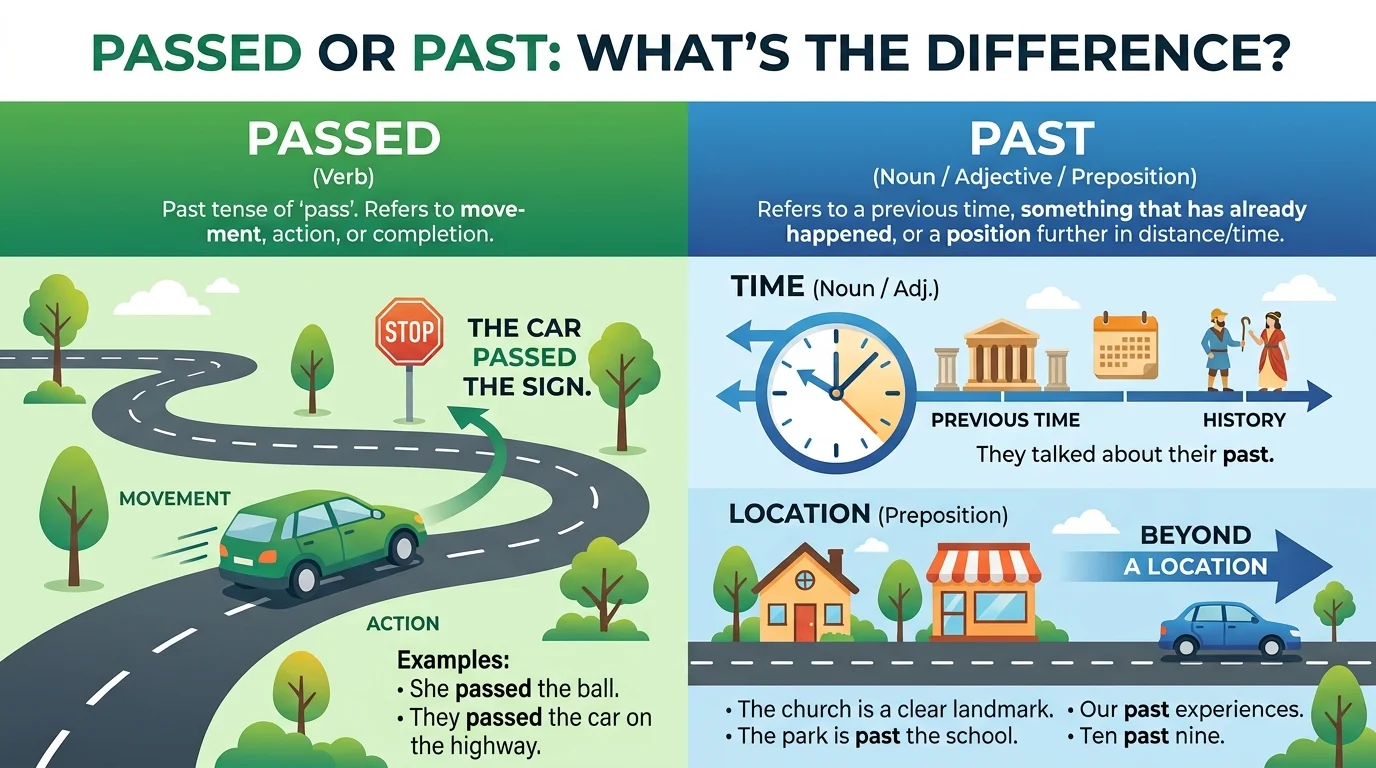
Quick Ans: Passed and past are different words with different grammatical roles. Passed is usually the past tense of the verb “pass,” while past can function as a noun, adjective, adverb, or preposition. Use passed for an action, such as “She passed the exam,” and past for time, location, or something that has already happened.
Passed or past is a common grammar question because the two words sound alike in many varieties of English. However, they don’t have the same meaning or function. Choosing the wrong word can change the meaning of a sentence.
Passed usually describes an action. It is the past tense and past participle of the verb pass. For example, “He passed the test” tells us that he successfully completed it.
Past, on the other hand, often refers to an earlier time, a previous period, or movement beyond a particular point. For example, “We walked past the store” describes movement beyond the store.
Therefore, learning a simple distinction can help you avoid this common mistake. When you mean an action performed by someone, passed may be the right choice. When you mean earlier time or beyond a point, past is usually correct.
Quick Answer and Key Takeaway
| Word | Main Function | Example |
|---|---|---|
| Passed | Verb | She passed the exam. |
| Past | Noun, adjective, adverb, or preposition | We walked past the school. |
Key takeaway: Use passed for the action of passing. Use past for time, previous events, or movement beyond something.
Definition and Explanation
What Does Passed Mean?
Passed is the past tense and past participle of pass.
It can describe several actions, including successfully completing something, moving beyond something, or handing something to another person.
Examples:
- She passed her driving test.
- The car passed us quickly.
- He passed the book to me.
In each example, passed describes an action.
What Does Past Mean?
Past can refer to an earlier time or something that has already happened. It can also describe movement beyond a particular place.
Examples:
- We talked about our past experiences.
- The train went past the station.
- It is half past five.
As a result, past has several grammatical uses, while passed functions as a verb.
Is This a Grammar, Usage, or Vocabulary Issue?
This is mainly a word choice and grammar issue. The words sound similar, but they perform different jobs in a sentence.
| Sentence | Correct Word | Reason |
|---|---|---|
| She ___ the exam. | passed | It describes an action. |
| We walked ___ the house. | past | It means beyond the house. |
| He has a difficult ___. | past | It refers to earlier experiences. |
| The bus ___ us. | passed | It describes movement. |
| It is ten minutes ___ six. | past | It refers to time. |
Real World Usage Examples
Workplace
Passed: The manager passed the report to her colleague.
Past: We discussed problems from the past year.
Recap: Use passed for an action and past for an earlier period or time.
Academic Writing
Passed: The student passed the final examination.
Past: Researchers examined data from the past decade.
Recap: Academic writing often uses both words, but their meanings remain different.
Everyday Writing
Passed: She passed me the salt.
Past: We drove past the restaurant.
Recap: Ask whether you mean an action or something earlier or beyond a point.
Regional or Global Usage Differences
Unlike words such as labeled and labelled, passed and past do not represent different regional spellings.
English speakers generally use both words in the same way. The difference comes from their meaning and grammatical function, not from regional spelling.
For example:
- He passed the store.
- He walked past the store.
The first sentence focuses on the action of passing. The second describes movement beyond the store.
When NOT to Use It
Avoid these common mistakes:
- Don’t use past when you need the verb passed.
- Don’t use passed to describe an earlier period of time.
- Don’t write “I past the test.” Use “I passed the test.”
- Don’t write “She passed the house” when you mean “She walked past the house.”
- Don’t confuse “past” in time expressions with the verb “passed.”
- Don’t assume that similar pronunciation means the words have the same function.
Common Mistakes and Corrections
| Correct Sentence | Incorrect Sentence | Why |
|---|---|---|
| I passed the exam. | I past the exam. | Passed is the verb describing the action. |
| We walked past the store. | We walked passed the store. | Past means beyond the store. |
| She passed me the phone. | She past me the phone. | Passed describes the action of handing something over. |
| He has a difficult past. | He has a difficult passed. | Past refers to earlier experiences. |
| It is five minutes past noon. | It is five minutes passed noon. | Past is used in this time expression. |
Simple Decision Rule
If you mean an action, use passed. If you mean earlier time, previous events, or beyond a place, use past.
Exercises With Answers
Choose passed or past.
- She ___ her driving test yesterday.
- We walked ___ the library.
- He has learned from his ___ mistakes.
- The car ___ the truck.
- It is twenty minutes ___ three.
- Please don’t ___ the opportunity to help.
Answers
- passed
- past
- past
- passed
- past
- pass
Related Concepts and Comparisons
Remember these useful patterns:
| Meaning | Example |
|---|---|
| Successful completion | She passed the test. |
| Movement beyond | She walked past the store. |
| Earlier time | We discussed the past. |
| Time expression | It is half past seven. |
| Handing something over | He passed me the paper. |
A useful trick is to replace past with beyond. If the sentence still makes sense, past may be correct.
For example, “We walked past the bank” becomes “We walked beyond the bank.”
FAQs
What is the difference between passed and past?
Passed usually acts as a verb and describes an action. Past can describe earlier time, previous events, or movement beyond a point.
Is it passed or past the store?
Use past when describing movement beyond the store: “We walked past the store.” However, “The car passed the store” is also correct when passed functions as the verb.
Is it passed or past tense?
The correct phrase is past tense. Here, past describes a grammatical tense referring to actions or states that happened earlier.
Is passed the past tense of pass?
Yes. Passed is the simple past and past participle form of the regular verb pass.
Should I say I passed or I past the test?
Say “I passed the test.” Passed is the correct verb because it describes successfully completing the test.
How do I remember passed vs past?
Think of passed as an action. Think of past as time, previous events, or something beyond a point.
Is it past or passed 5 o’clock?
Use past when telling the time. For example, “It is ten minutes past five.”
Can passed and past be used in the same sentence?
Yes. For example: “She passed the shop that she used to visit in the past.” Each word has a different function.
Conclusion
Understanding passed or past becomes much easier when you focus on meaning and grammatical function. Although the words sound similar, they don’t perform the same job.
Use passed when you describe the action of passing something, moving beyond something, handing something over, or successfully completing an activity. For example, you can say, “She passed the exam.”
Use past when you talk about earlier time, previous experiences, or movement beyond a particular point. For example, “We walked past the school” and “He has a difficult past.”
Unlike regional spelling pairs, this isn’t a difference between American and British usage. English speakers generally use both words according to the same grammatical rules.
Practical tip: When you’re unsure, ask yourself one question: Am I describing an action? If yes, passed may be right. If you’re talking about earlier time or something beyond a point, choose past.
1 thought on “Passed or Past: What’s the Difference? Easy Rules, Examples & Tips”