
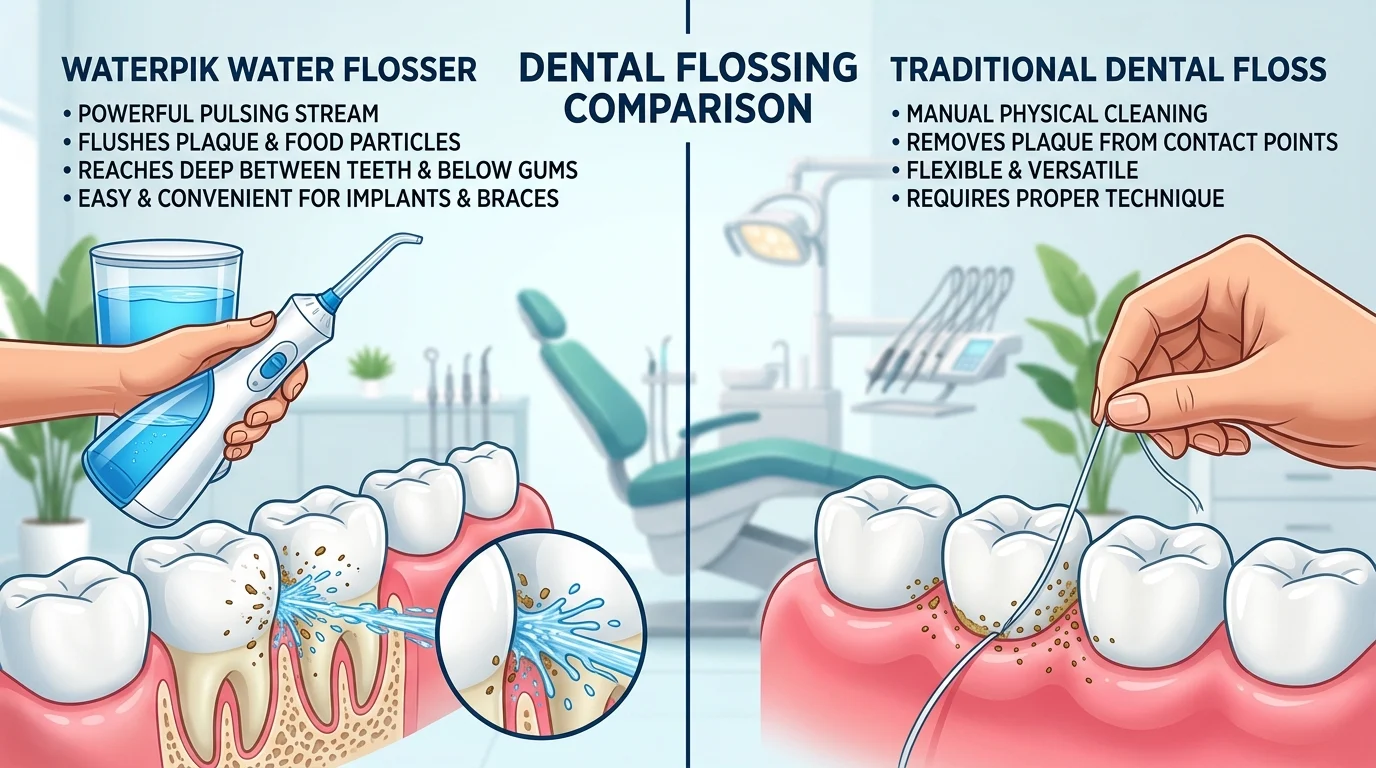
Quick Ans: Waterpik vs floss compares two ways to clean between teeth and along the gumline. Traditional floss uses a thin strand to physically clean tight spaces, while a Waterpik uses a stream of water. Both can support good oral hygiene, but they work differently and may suit different dental needs.
Waterpik vs floss is a common question for people who want a better way to clean between their teeth. Both methods help remove food particles and plaque from areas that a toothbrush cannot reach easily. However, they are not exactly the same.
Traditional dental floss uses a thin strand that slides between the teeth. You move it against the sides of the teeth to clean the spaces and gumline. A Waterpik, also called a water flosser, uses a controlled stream of water to clean between teeth and around the gums.
So, which one should you choose? The answer depends on your teeth, gums, dental work, comfort, and personal preference. Some people find traditional floss more effective for tight spaces, while others find a Waterpik easier and more comfortable to use consistently.
Understanding how each method works can help you choose the option that fits your daily oral care routine.
Quick Answer and Key Takeaway
If you are comparing Waterpik vs floss, neither method is automatically right for everyone.
| Feature | Waterpik | Traditional Floss |
|---|---|---|
| Cleaning method | Water stream | Floss strand |
| Removes food | Yes | Yes |
| Cleans between teeth | Yes | Yes |
| Gumline cleaning | Yes | Yes |
| Good for braces | Often convenient | Can be difficult |
| Tight spaces | Helpful | Often very effective |
| Ease of use | Usually easier for some people | Requires technique |
| Cost | Higher | Low |
Key takeaway: The best option is the one you can use correctly and consistently.
Waterpik Definition and Explanation
A Waterpik is a popular type of water flosser. It uses a motor and water reservoir to send a controlled stream of water through a small tip.
The water stream can reach between teeth and around the gumline. It can also be useful for people with braces, bridges, implants, or other dental appliances.
A Waterpik does not replace brushing. Instead, it works as an additional cleaning method.
Floss Definition and Explanation
Traditional dental floss is a thin strand designed to clean between teeth. When used correctly, it can remove plaque and food debris from areas that a toothbrush cannot reach.
You gently guide the floss between the teeth and curve it around each tooth. Avoid snapping the floss directly into the gums because this can cause irritation.
Floss is inexpensive, portable, and does not require electricity or water.
Is This a Grammar, Usage, or Vocabulary Issue?
No. Waterpik vs floss is a comparison between two oral hygiene methods.
Waterpik is commonly used as a brand name, although many people use it when referring generally to water flossers. Floss usually refers to traditional dental floss.
The terms describe different tools, so the main question is how each method works and which one fits your needs.
Real World Usage Examples
Workplace
Someone who travels for work may prefer traditional floss because it is compact and easy to carry.
Recap: Floss can be convenient when you need a simple portable option.
Academic
A student with braces may find a Waterpik easier to use around brackets and wires.
Recap: A water flosser can make cleaning around dental appliances more convenient.
Everyday
Someone with healthy teeth may use traditional floss every day as part of a regular brushing routine.
Recap: Traditional floss remains a simple option for daily cleaning between teeth.
Regional or Global Usage Differences
The term Waterpik is strongly associated with the Waterpik brand, while water flosser is a broader term for devices that clean with a stream of water.
The word floss generally refers to dental floss in everyday oral care discussions. Terminology can vary by country and brand, but the basic distinction remains the same: floss uses a strand, while a water flosser uses water.
When NOT to Use It
Do not treat either method as a replacement for brushing.
You should also avoid forcing floss into extremely tight spaces. If floss repeatedly gets stuck, tears, or causes significant discomfort, ask a dental professional for advice.
Similarly, do not use a water flosser at an unnecessarily high pressure if it causes pain or irritation. Follow the device instructions and use a comfortable setting.
If you have braces, implants, gum problems, or recent dental treatment, your dentist can recommend the most appropriate cleaning method.
Common Mistakes and Corrections
| Correct Approach | Incorrect Approach | Why |
|---|---|---|
| Gently move floss around each tooth | Snap floss into the gums | This can irritate the gums |
| Clean between every tooth | Only clean where food is visible | Plaque can remain in unseen areas |
| Use a comfortable Waterpik pressure | Always use maximum pressure | Higher pressure is not automatically better |
| Clean along the gumline | Focus only on tooth surfaces | The gumline also needs attention |
| Brush as well as floss | Use floss instead of brushing | Floss does not replace brushing |
Simple Decision Rule
Choose the method that allows you to clean between your teeth comfortably and consistently. If you can use traditional floss correctly, it is a practical option. If floss is difficult to manage, a water flosser may be easier to incorporate into your routine.
Exercises With Answers
1. Which tool uses a stream of water?
Answer: A Waterpik or water flosser.
2. Which method uses a thin strand?
Answer: Traditional dental floss.
3. Can a Waterpik replace brushing?
Answer: No.
4. Which option may be convenient for people with braces?
Answer: A Waterpik or water flosser can be particularly convenient.
5. What matters more than simply choosing one method?
Answer: Using the method correctly and consistently.
Related Concepts and Comparisons
Waterpik vs floss is related to several other oral hygiene comparisons.
Water flosser vs string floss: A water flosser uses water, while string floss uses a strand.
Floss vs interdental brush: An interdental brush uses a small brush designed for cleaning between teeth.
Water flosser vs interdental brush: Both can clean between teeth, but they use different mechanisms.
Your dentist may recommend one method or a combination depending on your oral health and dental work.
FAQs
Is a Waterpik better than floss?
A Waterpik is not automatically better for everyone. Both methods can help clean between teeth, and the best choice depends on your individual needs and how consistently you use it.
Can a Waterpik replace flossing?
A water flosser can be used as an alternative to traditional floss for some people. However, your dentist may recommend a specific method based on your teeth and gums.
Is Waterpik good for braces?
A Waterpik can be convenient for cleaning around braces, brackets, and wires. Always follow your orthodontist’s cleaning instructions.
Does floss remove more plaque than a Waterpik?
The effectiveness of either method depends on technique, consistency, and individual dental conditions. Proper use matters more than simply choosing one tool.
Can you use a Waterpik every day?
Many people use water flossers as part of their daily oral hygiene routine. Follow the manufacturer’s instructions and use a comfortable pressure.
Should I floss before or after brushing?
Either order can work as long as you clean thoroughly and consistently. Many people prefer cleaning between their teeth before brushing.
Is traditional floss cheaper than a Waterpik?
Yes. Traditional floss generally costs much less because it does not require an electronic device, water reservoir, or replacement tips.
Which is easier to use, Waterpik or floss?
Many people find a Waterpik easier, especially when they have braces or difficulty handling traditional floss. However, comfort and preference vary.
Conclusion
When comparing Waterpik vs floss, remember that both methods are designed to clean areas between the teeth and around the gumline. Traditional floss uses a strand and can be especially useful for cleaning tight spaces. A Waterpik uses a stream of water and may feel easier for people who struggle with traditional floss or have braces and other dental appliances.
The most important factor is not simply which tool you buy. It is whether you can use your chosen method correctly and make it part of your regular oral hygiene routine.
If you are unsure which option is appropriate for your teeth or gums, ask your dentist or dental hygienist for personalized advice. For a simple routine, choose the method you can use comfortably and consistently. Good oral care also includes regular brushing and professional dental checkups.