
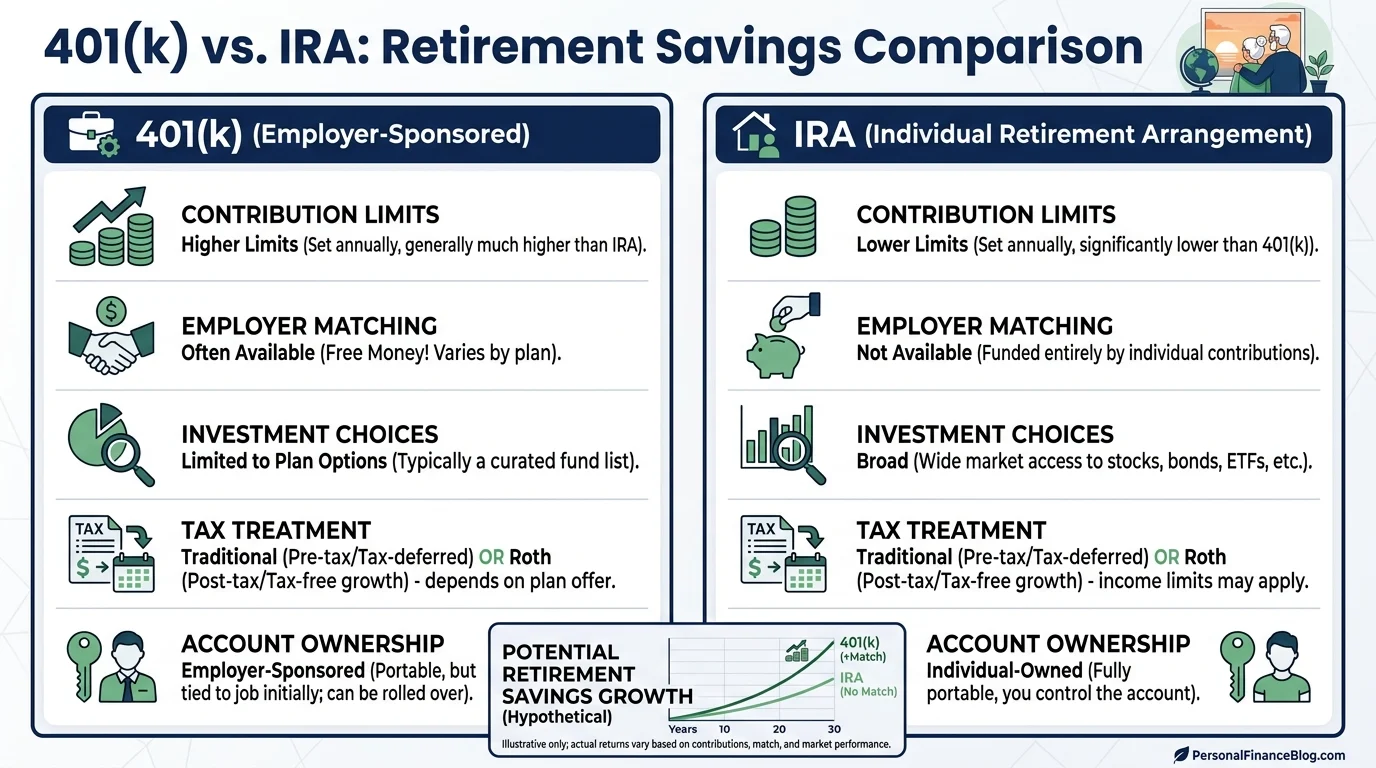
Quick Ans: A 401(k) is a workplace retirement plan that lets employees save through payroll deductions, while an IRA is an individual retirement account you open yourself. A 401(k) usually offers higher contribution limits and may include employer matching. An IRA typically provides more investment choices. Depending on your goals, you can use both to build retirement savings.
Planning for retirement can feel confusing, especially when you are choosing between a 401(k) and an Individual Retirement Account (IRA). Both accounts help you save for the future while offering valuable tax advantages. However, they differ in how you open them, how much you can contribute, and which investments you can choose.
For example, your employer may offer a 401(k) with matching contributions, while an IRA gives you more control over your retirement account. Therefore, understanding these differences can help you make a smarter financial decision.
The good news is that you do not always have to choose just one. Many people use a 401(k) and an IRA together to increase their retirement savings. In this guide, you will learn how each account works, compare their main features, and discover which option may suit your needs.
What Is a 401(k)?
A 401(k) is an employer-sponsored retirement savings plan. You contribute money directly from your paycheck, and your employer may add matching contributions.
There are two common types:
- Traditional 401(k): Contributions generally reduce your current federal taxable income, while withdrawals are usually taxable in retirement.
- Roth 401(k): You contribute after-tax money. Qualified withdrawals in retirement are generally tax-free.
Benefits of a 401(k)
- Higher annual contribution limits.
- Potential employer matching contributions.
- Convenient automatic payroll deductions.
- Traditional and Roth tax options may be available.
- Investment growth can receive tax advantages.
However, your employer’s plan determines which investments you can choose. Also, early withdrawals may trigger taxes and penalties, depending on the circumstances.
What Is an IRA?
An Individual Retirement Account, or IRA, is a retirement account you open independently through a bank, brokerage, or other eligible financial institution. Unlike a workplace 401(k), it does not require an employer to sponsor it.
The two main types are:
- Traditional IRA: Contributions may be tax-deductible, depending on your income and workplace retirement coverage. Withdrawals are generally taxable.
- Roth IRA: Contributions use after-tax money, but qualified withdrawals can be tax-free.
Benefits of an IRA
- Greater control over your account.
- Often a wider selection of investments.
- Traditional and Roth tax options.
- No employer is required to open an account.
- You can generally keep the account when changing jobs.
Nevertheless, IRAs have lower contribution limits. Roth IRA contributions also have income eligibility restrictions, while traditional IRA deductions may phase out at certain income levels.
401(k) vs. IRA: Key Differences
| Feature | 401(k) | IRA |
|---|---|---|
| Who opens it? | Employer provides the plan | You open it yourself |
| Contribution method | Usually payroll deductions | Contributions from your bank or brokerage account |
| 2026 contribution limit | $24,500 for employee contributions | $7,500 across traditional and Roth IRAs combined |
| Employer match | May be available | No employer match under a standard IRA |
| Investment choices | Limited to plan options | Often a wider selection |
| Roth option | Roth 401(k) may be available | Roth IRA is available if eligible |
| Income restrictions | Generally no income limit for standard employee contributions | Roth IRA income limits apply |
| Portability | Can generally be retained or rolled over after leaving a job | Generally remains yours when you change jobs |
Important: For 2026, people aged 50 or older may qualify for additional catch-up contributions. The standard 401(k) catch-up limit is $8,000, while the IRA catch-up limit is $1,100. Special rules apply to certain ages and plans.
401(k) vs. IRA: Which Is Better?
The better option depends on your financial situation, employer benefits, and retirement goals.
Choose a 401(k) if:
- Your employer offers matching contributions.
- You want to save more than an IRA’s annual limit allows.
- You prefer automatic contributions from your paycheck.
- Your workplace plan offers suitable, low-cost investments.
For instance, if your employer matches part of your contributions, contributing enough to receive the full available match can be a useful first step.
Choose an IRA if:
- You want more control over your investments.
- Your employer does not offer a 401(k).
- You want to explore a Roth IRA’s qualified tax-free withdrawals.
- You prefer to manage retirement savings independently.
However, check fees, investment options, and eligibility rules before opening an account.
Can You Have Both a 401(k) and an IRA?
Yes. Eligible individuals can contribute to both accounts in the same year. In fact, combining them can offer a practical way to save more for retirement.
For example, you could contribute enough to your workplace 401(k) to receive the full employer match. Then, you could contribute to a Roth IRA if you meet its eligibility requirements. After that, you could increase your 401(k) contributions as your budget allows.
Keep in mind that contributing to a workplace retirement plan may affect whether you can deduct traditional IRA contributions. Roth IRA contributions also depend on income and tax-filing status.
Common Mistakes to Avoid
- Ignoring an employer match: You may miss out on a valuable workplace benefit.
- Assuming all contributions are tax-free: Traditional and Roth accounts follow different tax rules.
- Overlooking fees: Investment expenses can reduce long-term returns.
- Exceeding contribution limits: Check the annual limits across your applicable accounts.
- Withdrawing money too early: Taxes and additional penalties may apply.
Frequently Asked Questions
1. Is a 401(k) safer than an IRA?
Neither account type is automatically safer. Your risk depends largely on the investments you choose, their costs, and your overall investment strategy.
2. Can I open an IRA without a job?
You generally need taxable compensation to contribute to an IRA. However, a married person filing jointly may qualify to contribute through a spousal IRA under specific rules.
3. Is a Roth IRA better than a traditional 401(k)?
Not necessarily. A Roth IRA may suit someone who wants qualified tax-free withdrawals and investment flexibility. A traditional 401(k) may suit someone who values current tax deductions and an employer match.
4. What happens to my 401(k) when I leave a job?
You may be able to leave it in your former employer’s plan, roll it into a new employer’s plan, or transfer it to an eligible IRA. Compare fees, investment choices, and tax consequences before deciding.
5. Can I contribute to a 401(k) and a Roth IRA at the same time?
Yes, provided you meet the applicable eligibility requirements and stay within each account’s contribution limits.
6. Which account has the higher contribution limit in 2026?
A standard 401(k) allows up to $24,500 in employee contributions in 2026, while the combined traditional and Roth IRA limit is $7,500. Catch-up rules can increase these amounts for eligible savers.
7. Do I need an employer to open an IRA?
No. You can generally open an IRA independently through an eligible financial institution.
8. Should beginners start with a 401(k) or an IRA?
If your employer offers a match, consider contributing enough to receive the full available match. After that, compare IRA options and your workplace plan’s fees before deciding where to direct additional savings.
Conclusion
When comparing a 401(k) vs. IRA, remember that each account serves a different purpose. A 401(k) offers higher contribution limits and may provide employer matching, while an IRA often gives you greater investment flexibility.
For many savers, using both accounts can be an effective approach. Ultimately, consider your income, tax situation, employer benefits, investment costs, and retirement goals before choosing a strategy. For personalized tax or investment advice, consult a qualified financial professional.