
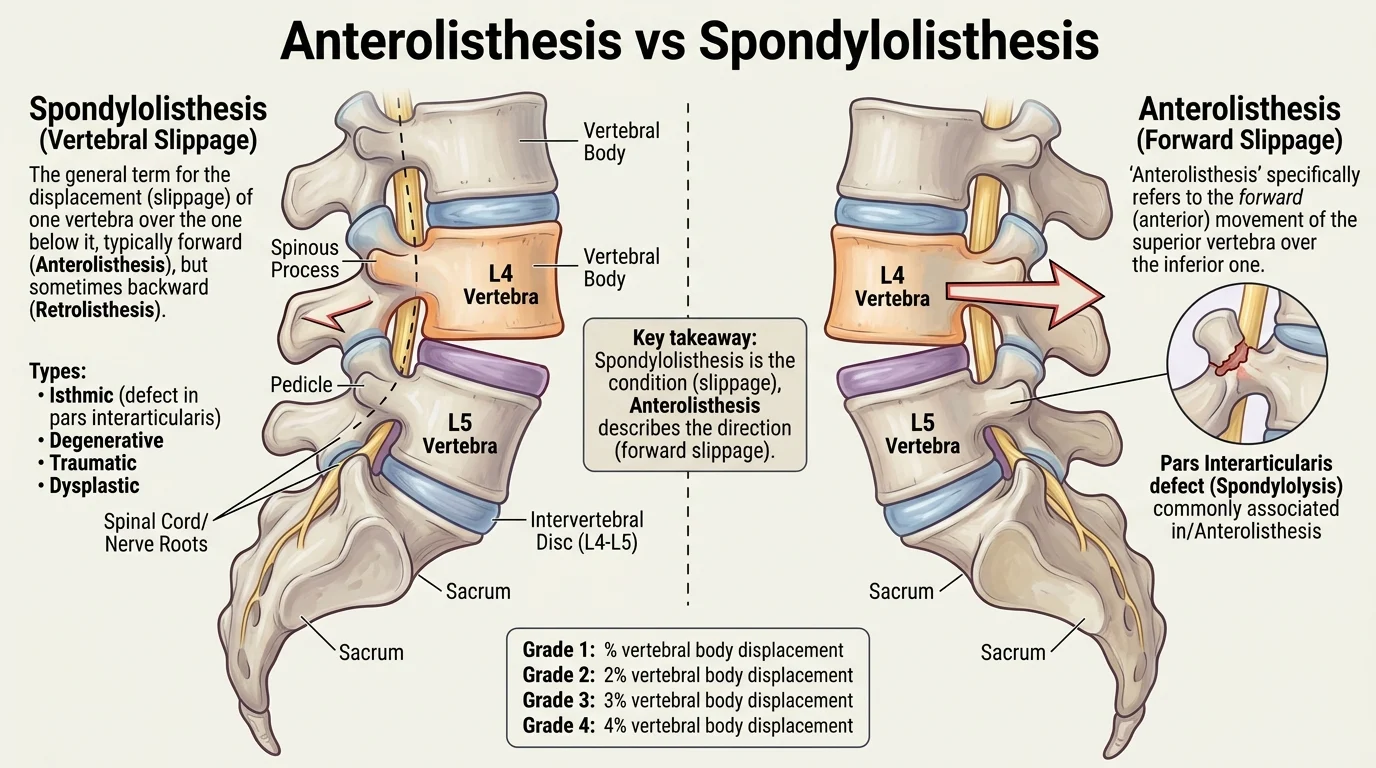
Quick Ans: Anterolisthesis and spondylolisthesis both describe vertebral slippage, but they are not exactly the same term. Spondylolisthesis is the broader term for one vertebra slipping out of its normal position. Anterolisthesis specifically describes forward slippage of one vertebra in relation to another. [Source: Cleveland Clinic and AANS]
Anterolisthesis vs spondylolisthesis can be confusing because the two terms describe closely related changes in the spine. They may appear on an X ray or MRI report, especially when a healthcare professional is evaluating back pain or other spinal symptoms.
The easiest way to understand the difference is to think of spondylolisthesis as the broader condition and anterolisthesis as a description of the direction of the slip. Spondylolisthesis refers to a vertebra moving out of its normal alignment. Anterolisthesis means that the vertebra has moved forward relative to the vertebra below it.
The terms can sometimes appear together in medical reports. However, the exact meaning of a finding depends on its location, severity, cause, and whether it is causing symptoms.
This guide explains the difference in simple language so you can better understand these commonly confused spinal terms.
Quick Answer and Key Takeaway
Spondylolisthesis is a general term for one vertebra slipping out of its normal position relative to another vertebra. Anterolisthesis specifically means that one vertebra has shifted forward relative to the vertebra below it.
In simple terms:
Spondylolisthesis = vertebral slippage
Anterolisthesis = forward vertebral slippage
Spondylolisthesis can have different forms and causes, while anterolisthesis describes the direction of movement.
Anterolisthesis vs Spondylolisthesis: Definition and Explanation
What Is Spondylolisthesis?
Spondylolisthesis occurs when one vertebra slips out of its usual alignment relative to another vertebra. It most commonly affects the lower back, although it can occur in other areas of the spine.
Different types can have different causes. These include degenerative changes, congenital differences, injuries, and problems involving the pars interarticularis. Some people have no symptoms, while others may experience back pain, stiffness, leg pain, numbness, or weakness.
What Is Anterolisthesis?
Anterolisthesis describes forward displacement of one vertebra relative to another.
For example, if a report says that L4 has anterolisthesis over L5, it means that L4 has shifted forward relative to L5.
Anterolisthesis is therefore a directional description rather than a completely separate spinal condition.
Is This a Grammar, Usage, or Vocabulary Issue?
Anterolisthesis vs spondylolisthesis is a medical terminology comparison.
The words are often confused because they describe related spinal findings. The distinction is important because one term describes the broader type of vertebral slippage, while the other specifies forward movement.
A medical report may use both terms because they provide different information about the same spinal finding.
What Is the Main Difference?
| Feature | Anterolisthesis | Spondylolisthesis |
|---|---|---|
| Meaning | Forward displacement of a vertebra | Slippage or displacement of one vertebra relative to another |
| Scope | More specific | Broader term |
| Direction | Specifically forward | The term itself does not provide the directional detail |
| Common location | Often discussed in the lumbar spine | Can occur in different spinal regions |
| Symptoms | May or may not cause symptoms | May or may not cause symptoms |
| Diagnosis | Often identified through imaging | Usually evaluated through examination and imaging |
The American Association of Neurological Surgeons defines spondylolisthesis as forward displacement of one vertebra on another. In clinical usage, anterolisthesis is commonly used to specify forward vertebral displacement. [Source: AANS]
Real World Usage Examples
Medical Report
The imaging report shows anterolisthesis of L4 over L5.
This describes forward movement of L4 relative to L5.
Recap: Anterolisthesis tells you the direction of the vertebral displacement.
Doctor Discussion
The doctor explained that the patient has spondylolisthesis in the lower spine.
Here, spondylolisthesis refers to the broader condition involving vertebral slippage.
Recap: Spondylolisthesis identifies the spinal displacement, while additional terminology can describe its direction and cause.
Everyday Explanation
Instead of saying:
My vertebra is moving forward.
A person might explain a medical report by saying:
My report mentions anterolisthesis.
Recap: Medical terminology provides a more precise description of the spinal finding.
Causes and Associated Conditions
Spondylolisthesis can develop for several reasons. Cleveland Clinic lists degenerative changes, congenital differences, stress injuries, trauma, and other causes among the possible types and causes.
Degenerative spondylolisthesis can occur when age related changes affect spinal discs and facet joints. Isthmic spondylolisthesis can be associated with a defect or fracture involving the pars interarticularis.
Anterolisthesis itself describes the direction of the displacement. Therefore, knowing that a vertebra has moved forward does not by itself explain why the movement occurred.
Symptoms
Some people with spondylolisthesis have no symptoms. Others may experience:
- Lower back pain
- Back stiffness
- Pain that travels into the legs
- Numbness or tingling
- Weakness
- Difficulty standing or walking for long periods
Symptoms depend on the individual and whether the spinal displacement affects nearby nerves or other structures. [Source: Cleveland Clinic]
When NOT to Confuse the Terms
Do not assume that anterolisthesis and spondylolisthesis always mean exactly the same thing.
Avoid these assumptions:
- Anterolisthesis does not automatically identify the cause of the slippage.
- Spondylolisthesis does not always mean severe symptoms.
- A finding on an imaging report does not automatically explain every symptom.
- The degree of vertebral displacement matters.
- Different types of spondylolisthesis have different causes.
- Treatment depends on the individual diagnosis rather than the word alone.
Common Mistakes and Corrections
| Correct Understanding | Incorrect Assumption | Why |
|---|---|---|
| Anterolisthesis describes forward movement | Anterolisthesis means any spinal movement | The term specifically describes forward displacement |
| Spondylolisthesis describes vertebral slippage | Spondylolisthesis always means severe disease | Severity varies |
| Both terms can appear in reports | They always describe completely different conditions | They can describe related aspects of the same finding |
| Causes can vary | Every case has the same cause | Different types have different causes |
Easy Decision Rule
Remember:
Spondylolisthesis tells you that a vertebra has slipped.
Anterolisthesis tells you that the vertebra has slipped forward.
This is the simplest way to remember the relationship between the two terms.
Exercises With Answers
Complete each sentence with anterolisthesis or spondylolisthesis.
- A general term for vertebral slippage is ______.
- Forward displacement of one vertebra is called ______.
- A report describing forward movement may use the term ______.
- The broader condition involving vertebral slippage is ______.
- ______ provides information about the direction of displacement.
Answers
- spondylolisthesis
- anterolisthesis
- anterolisthesis
- spondylolisthesis
- anterolisthesis
Related Concepts and Comparisons
Anterolisthesis vs Retrolisthesis
Anterolisthesis describes forward displacement, while retrolisthesis describes backward displacement. Both terms describe the direction in which a vertebra has shifted.
Spondylolisthesis vs Spondylolysis
These are different terms. Spondylolysis refers to a stress fracture or defect involving the pars interarticularis. Spondylolisthesis refers to vertebral slippage. Spondylolysis can contribute to a type of spondylolisthesis. [Source: Cleveland Clinic]
Anterolisthesis vs Spondylosis
Spondylosis generally refers to degenerative changes in the spine. It should not be confused with anterolisthesis, which describes forward vertebral displacement.
FAQs
Is anterolisthesis the same as spondylolisthesis?
Not exactly. Spondylolisthesis is the broader term for vertebral slippage, while anterolisthesis specifically describes forward displacement.
Is anterolisthesis a type of spondylolisthesis?
The terms can overlap in clinical descriptions. Anterolisthesis identifies forward displacement, while spondylolisthesis describes the broader phenomenon of vertebral slippage.
What does anterolisthesis mean on an MRI?
Anterolisthesis on an imaging report generally means that one vertebra has shifted forward relative to another vertebra. The significance depends on the location and degree of displacement and the person’s symptoms.
What does Grade 1 anterolisthesis mean?
A grade indicates the extent of vertebral slippage. The grading system commonly used for spondylolisthesis divides displacement into grades based on how much one vertebra has shifted relative to the vertebra below it. A healthcare professional should interpret the grade together with the imaging findings and symptoms.
Can spondylolisthesis cause back pain?
Yes. Spondylolisthesis can cause lower back pain and stiffness, although some people have no symptoms. It can also cause leg symptoms when nerves are affected. [Source: Cleveland Clinic]
Is anterolisthesis always serious?
No. The significance varies from person to person. The amount of displacement, underlying cause, symptoms, and possible nerve involvement all matter.
Which is worse, anterolisthesis or spondylolisthesis?
These terms should not be treated as two separate conditions that can simply be ranked by severity. Anterolisthesis describes direction, while spondylolisthesis describes vertebral slippage more broadly.
Can anterolisthesis get worse?
Vertebral slippage can sometimes progress, but progression varies according to the underlying cause and individual circumstances. Follow up with a healthcare professional if an imaging report shows a spinal alignment change.
Conclusion
Anterolisthesis vs spondylolisthesis is easier to understand when you separate the condition from the direction of movement. Spondylolisthesis is the broader term used for a vertebra slipping out of its normal alignment. Anterolisthesis specifically describes forward displacement of one vertebra relative to another.
These terms may appear together in medical reports because they provide related but different information. Anterolisthesis tells you that the movement is forward, while the broader diagnosis and its cause require additional clinical information.
Symptoms can vary widely. Some people have no symptoms, while others may experience back pain, stiffness, leg pain, numbness, or weakness. Imaging findings should therefore be interpreted in the context of the person’s symptoms and clinical examination.
The easiest rule to remember is: spondylolisthesis means vertebral slippage, while anterolisthesis means forward vertebral slippage. If these terms appear in an imaging report, discuss the exact finding with a qualified healthcare professional rather than interpreting the terminology alone.