
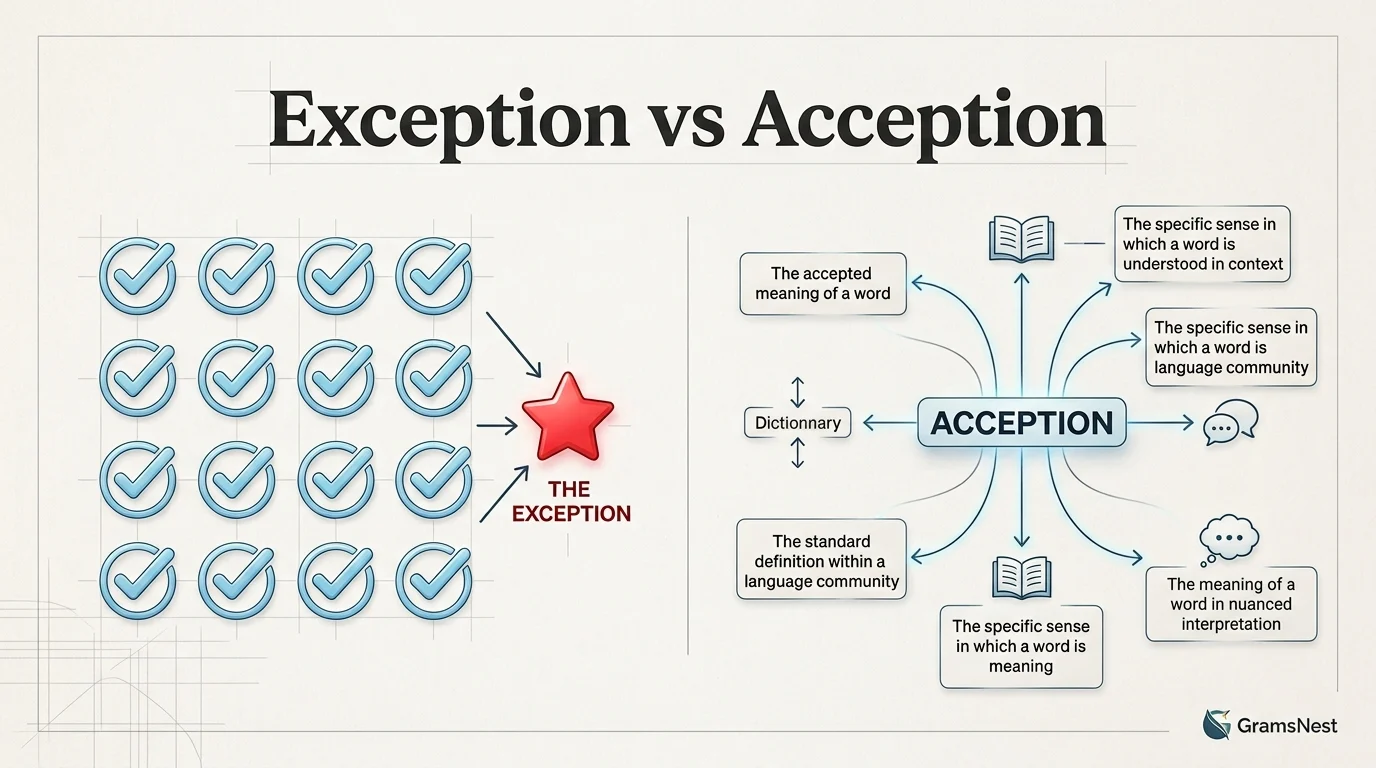
Quick Ans: Exception and acception are not interchangeable words. Exception is a common English noun meaning something that does not follow a general rule. Acception is a rare term related to the meaning or acceptance of a word or expression. In everyday English, exception is almost always the word you need.
Exception vs acception can be confusing because the two words look and sound similar. However, they have very different meanings and levels of use.
The word exception is common in modern English. It describes a person, thing, or situation that does not follow a general rule. For example, if a rule applies to everyone except one person, that person is an exception.
Acception, in contrast, is a very uncommon word. It has historical and specialized uses related to the meaning, interpretation, or acceptance of a word or expression. Most English speakers will rarely, if ever, need it in everyday writing.
This difference matters because acception is often mistakenly used when the writer actually means exception. Understanding the meaning, pronunciation, and usage of each word can help you avoid this common spelling and vocabulary mistake.
Quick Answer and Key Takeaway
Exception is the correct word when you mean something that does not follow a general rule or condition.
Acception is a rare word referring to a particular meaning or interpretation of a word or expression. In normal everyday English, use exception, not acception, unless you are discussing its specialized meaning.
Exception vs Acception: Definition and Explanation
What Does Exception Mean?
Exception is a noun that refers to something or someone excluded from a general rule, statement, or condition.
Examples:
Everyone must attend, with one exception.
This rule has several exceptions.
The word can also describe something unusual that does not fit a general pattern.
The company usually closes at six, but today is an exception.
What Does Acception Mean?
Acception is a rare noun with historical and specialized uses. It can refer to a particular sense, meaning, or interpretation of a word or expression.
For example, in specialized linguistic or philosophical writing, a writer may discuss the different acceptions of a term.
However, acception is not a normal replacement for exception.
If you want to say that something does not follow a rule, the correct word is exception.
Is This a Grammar, Usage, or Vocabulary Issue?
This is mainly a vocabulary and spelling issue.
Both words exist, but they do not have the same meaning. The confusion usually happens because they share several letters and have similar pronunciation.
The important distinction is:
Exception = something excluded from a rule
Acception = a particular meaning or interpretation, usually in specialized usage
Real World Usage Examples
Everyday Usage
Everyone received a ticket, with one exception.
Children under five are an exception to the rule.
Recap: Use exception when something does not follow a general rule.
Academic Usage
The researcher discussed the different acceptions of the term.
Here, acceptions refers to different meanings or interpretations of a term.
Recap: Acception can appear in specialized academic or linguistic contexts, but it is uncommon.
Workplace Usage
Employees are expected to follow the policy without exception.
This means there are no special cases excluded from the policy.
Recap: Exception is the natural choice in professional communication.
Exception vs Acception: Key Differences
| Feature | Exception | Acception |
|---|---|---|
| Common in modern English | Yes | No |
| Part of speech | Noun | Noun |
| Main meaning | Something excluded from a rule | A particular meaning or interpretation |
| Everyday use | Very common | Very rare |
| Common phrase | Without exception | Different acceptions |
| Suitable for general writing | Yes | Usually no |
Regional or Global Usage Differences
The word exception is widely used across varieties of English, including British, American, Canadian, and Australian English.
Acception is much less common internationally. Its specialized use is not generally part of everyday vocabulary.
Therefore, the distinction is not mainly regional. It is primarily about meaning and frequency of use.
When NOT to Use Acception
Do not use acception when you mean:
- An unusual case
- Something excluded from a rule
- A person who does not follow a general condition
- A special case
- Something that differs from the usual pattern
- An exemption from a rule
In all these situations, exception is normally the correct word.
Common Mistakes and Corrections
| Correct Sentence | Incorrect Sentence | Why |
|---|---|---|
| There is one exception to the rule. | There is one acception to the rule. | Exception means a special case excluded from a rule. |
| Everyone attended without exception. | Everyone attended without acception. | The standard expression is without exception. |
| This case is an exception. | This case is an acception. | The meaning is a special or unusual case. |
| The rule has several exceptions. | The rule has several acceptions. | Exceptions are cases that do not follow the rule. |
Easy Decision Rule
Ask yourself:
Am I talking about something that does not follow a rule?
If yes, use exception.
If you are discussing the specific meaning or interpretation of a word in specialized writing, acception may be appropriate.
Exercises With Answers
Choose exception or acception.
- There is no ______ to this rule.
- The professor explained the different ______ of the term.
- Everyone must follow the policy without ______.
- This situation is an unusual ______.
- The rule has several ______.
Answers
- exception
- acceptions
- exception
- exception
- exceptions
Related Concepts and Comparisons
Exception vs Exemption
An exception is something that does not follow a general rule. An exemption is a formal release from a requirement, duty, or rule.
Exception vs Exclusion
An exception is a special case outside a general rule. Exclusion focuses on keeping someone or something out.
Exception vs Acceptance
Do not confuse exception with acceptance either. Acceptance means agreeing to or receiving something, while exception refers to a special case that does not follow a general rule.
FAQs
Is acception a real word?
Yes. Acception is a real but rare word. It has specialized or historical meanings related to a particular sense or interpretation of a word or expression.
Is exception or acception correct?
Both words exist, but they have different meanings. If you mean a special case that does not follow a rule, exception is correct.
What is the difference between exception and acception?
Exception refers to something excluded from a general rule. Acception refers to a particular meaning or interpretation of a word or expression and is rarely used in everyday English.
Is acception commonly used in English?
No. Acception is uncommon in modern everyday English. Most people will encounter exception much more frequently.
Can I say acception to the rule?
No, not when you mean a special case that does not follow a rule. The correct expression is exception to the rule.
What does exception mean in simple words?
Exception means something that is different from or excluded from a general rule. For example, “There is one exception to the rule.”
What does acception mean in linguistics?
In specialized linguistic usage, acception can refer to a particular meaning or sense assigned to a word or expression.
Is “without exception” correct?
Yes. Without exception is a standard English expression meaning that something applies to everyone or everything without any special cases.
Conclusion
Understanding exception vs acception is easier once you focus on their meanings. Exception is the common word used for something that does not follow a general rule or condition. It appears frequently in everyday conversations, academic writing, workplace communication, and formal documents.
Acception is a real word, but it is rare and specialized. It can refer to a particular meaning or interpretation of a word or expression. Because of its limited use, most people will not need it in ordinary English.
The most important rule is simple: if you mean a special case or something excluded from a general rule, choose exception. For example, “There is an exception to every rule” is correct.
Before using acception, check whether you are actually discussing the meaning or interpretation of a term. In most everyday situations, exception will be the word you need.
1 thought on “Exception vs Acception: What’s the Difference? Meaning & Examples”