
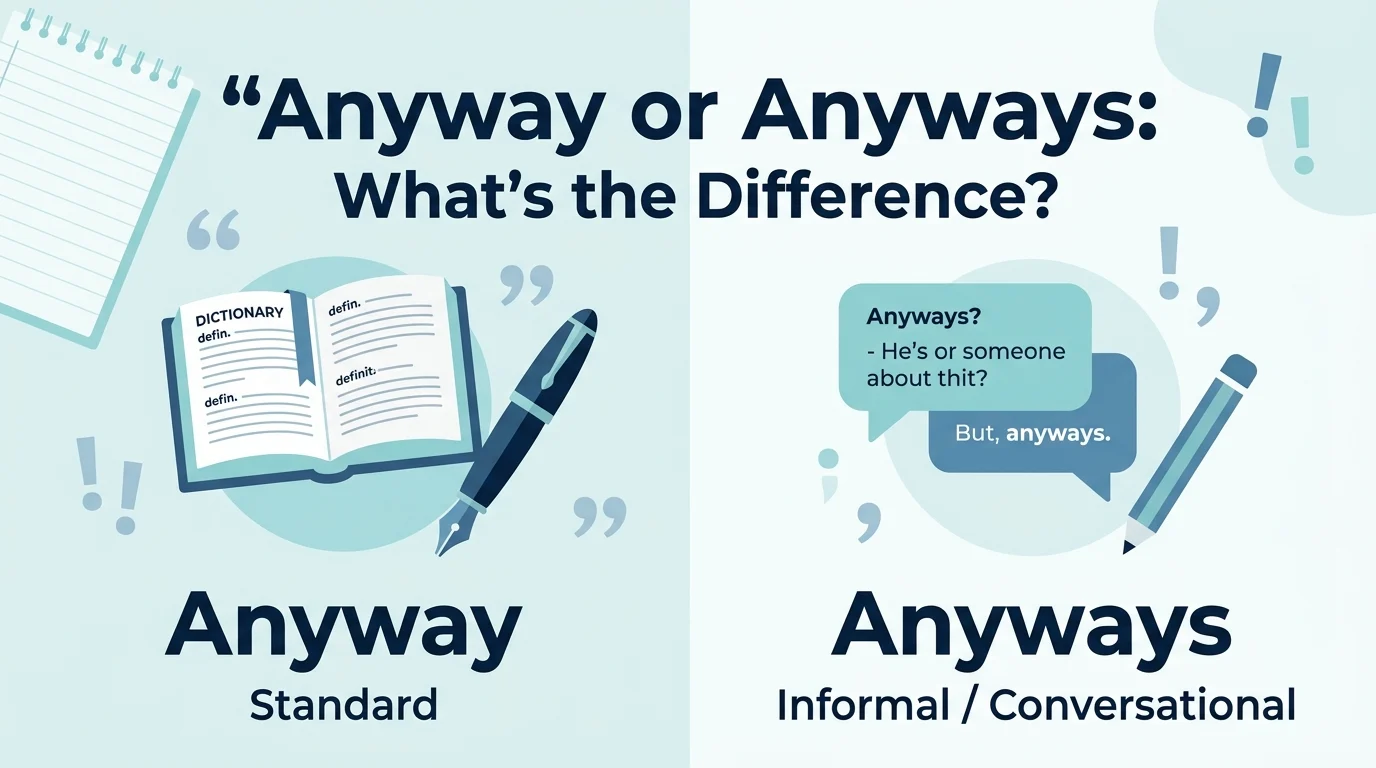
Quick Ans: Anyway and anyways can both appear in English, but they differ in usage and style. Anyway is the standard form and works in formal and informal writing. Anyways is mainly used in informal speech and casual writing. For professional, academic, and polished writing, anyway is usually the safer choice.
Anyway or anyways is a common grammar and usage question. You may hear both forms in everyday conversations, but that doesn’t mean they are equally suitable in every situation.
Anyway is the traditional and widely accepted form. It can mean “in spite of that,” “regardless,” or “moving to another point.” It works naturally in both formal and informal writing.
Anyways is also used by native speakers, especially in casual conversation. However, many style guides and speakers consider it informal or nonstandard in formal writing. It is often used to create a conversational tone.
Knowing the difference can help you choose the right word for your audience. If you’re writing an email, essay, article, or professional document, anyway is generally the better choice.
Quick Answer and Key Takeaway
| Word | Usage | Example |
|---|---|---|
| Anyway | Standard and widely accepted | Anyway, let’s continue with the meeting. |
| Anyways | Informal and conversational | Anyways, what were you saying? |
Key takeaway: Use anyway in formal and informal writing. Use anyways mainly when you intentionally want a casual, conversational style.
Definition and Explanation
What Does Anyway Mean?
Anyway is an adverb with several related meanings.
It can mean regardless:
It was raining, but we went anyway.
It can also introduce a new subject or return to an earlier point:
Anyway, let’s get back to the main topic.
Another use emphasizes that something happened despite a reason against it:
I didn’t really want to go, but I went anyway.
What Does Anyways Mean?
Anyways has essentially the same meaning as anyway, but it is more informal.
For example:
Anyways, I’ll call you tomorrow.
This sounds conversational and may be perfectly natural in speech. However, anyway is usually preferred in formal writing.
Is This a Grammar, Usage, or Vocabulary Issue?
This is mainly a usage and style issue.
Anyway is the standard form and has long been established in English. Anyways is commonly heard in informal speech, but many formal writing contexts prefer anyway.
The choice often depends on your audience and the tone you want.
| Situation | Better Choice |
|---|---|
| Academic essay | anyway |
| Business email | anyway |
| Formal article | anyway |
| Casual text | anyway or anyways |
| Friendly conversation | anyway or anyways |
| Deliberately conversational writing | anyways can work |
Real World Usage Examples
Workplace
Preferred: Anyway, let’s review the final report.
Casual: Anyways, I’ll send you the report later.
Recap: Use anyway for professional communication.
Academic Writing
Preferred: The results were unexpected. Anyway, the findings require further analysis.
In highly formal academic writing, however, you may want to replace conversational transitions with a more precise phrase.
Recap: Anyway is acceptable, but formal alternatives may sometimes be more suitable.
Everyday Conversation
Anyways, what are you doing tonight?
This sounds casual and conversational.
Anyway, what are you doing tonight?
This is also natural and is more widely accepted in standard written English.
Recap: Both can appear in casual conversation, but anyway is the safer general choice.
Regional or Global Usage Differences
Anyway is widely used across English speaking regions and is the standard form in formal writing.
Anyways is also heard in several varieties of English, particularly in informal speech. Its frequency and acceptance can vary by region and social context.
The important point is that anyways does not create a different meaning. The difference is mainly one of style and usage.
When NOT to Use It
Avoid anyways when:
- You’re writing a formal academic essay.
- You’re preparing a professional report.
- You’re writing formal business correspondence.
- Your employer or publication follows a strict formal style.
- You want your writing to sound neutral and standard.
- You’re unsure which form your audience expects.
In these situations, anyway is the safer choice.
Common Mistakes and Corrections
| Correct Sentence | Incorrect or Less Suitable Sentence | Why |
|---|---|---|
| Anyway, let’s begin. | Anyways, let’s begin. | Anyway is preferred in formal writing. |
| I didn’t like it, but I went anyway. | I didn’t like it, but I went anyways. | Anyways is more conversational. |
| Anyway, what happened next? | Anyways, what happened next? | Anyway is the standard form. |
| She continued anyway. | She continued anyways. | Anyway is more appropriate for neutral writing. |
| Anyway, I’ll contact you tomorrow. | Anyways, I’ll contact you tomorrow. | Professional writing generally favors anyway. |
Simple Decision Rule
Use anyway when you want the standard, neutral choice. Use anyways only when a casual or conversational tone is appropriate.
Exercises With Answers
Choose anyway or anyways.
- I was tired, but I went ___.
- ___, let’s move on to the next topic.
- The weather was bad, but they continued ___.
- ___, what did you decide?
- Choose the better form for a formal email: anyway or anyways?
Answers
- anyway
- anyway
- anyway
- anyway
- anyway
Related Concepts and Comparisons
Don’t confuse anyway with any way.
Anyway is usually an adverb:
Anyway, let’s continue.
Any way refers to any method or manner:
Is there any way to solve this problem?
The meaning changes when the words are separated, so context matters.
FAQs
Is anyway or anyways correct?
Both forms are used, but anyway is the standard choice for formal and neutral writing. Anyways is mainly informal and conversational.
Is anyways grammatically correct?
Anyways is widely used in informal speech and casual writing. However, many formal writing contexts prefer the standard form anyway.
Should I use anyway or anyways in an essay?
Use anyway if you need one of these words in an essay. For very formal academic writing, consider whether a more precise transition would work better.
Why do people say anyways instead of anyway?
Anyways is a conversational variant that has become common in informal speech. Some speakers use it naturally as part of their everyday style.
Is anyway more formal than anyways?
Generally, yes. Anyway is neutral and suitable for formal writing, while anyways has a more casual and conversational tone.
Can I use anyways in a text message?
Yes. Text messages are usually informal, so anyways can fit a casual conversational style.
What is the difference between anyway and any way?
Anyway is an adverb meaning something like “regardless” or “moving on.” Any way refers to any possible method or manner.
Is anyway or anyways better for professional writing?
Anyway is generally the safer choice for professional writing because it is standard and neutral.
Conclusion
The choice between anyway or anyways is mostly about usage and tone rather than meaning. Anyway is the standard form and works well in formal, professional, academic, and everyday writing. Anyways is commonly used in casual speech and informal writing, where a conversational tone is appropriate.
If you’re writing something important and you’re unsure which form to choose, anyway is the safest option. It is widely accepted and doesn’t make your writing sound overly casual.
Also remember that anyway and any way are different. The first usually functions as an adverb, while the second refers to a method or possibility.
Practical tip: When in doubt, choose anyway. Save anyways for situations where you deliberately want your writing to sound relaxed and conversational.