
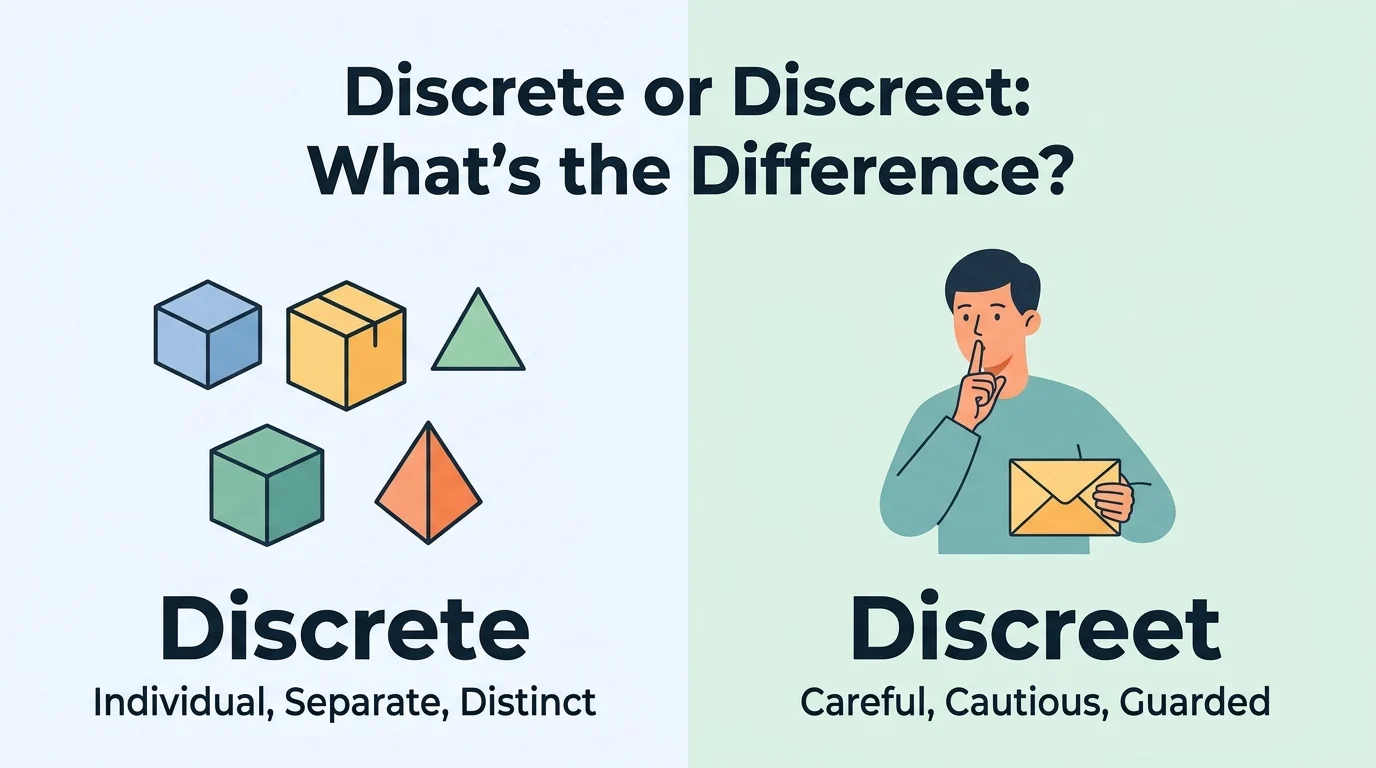
Quick Ans: Discrete and discreet are different words with different meanings. Discrete means separate, distinct, or individually different. Discreet means careful, tactful, and not likely to attract attention. A simple way to remember them is that discrete is about things being separate, while discreet is about behaving carefully or privately.
Discrete or discreet can be confusing because the two words look and sound very similar. However, they have different meanings and are used in different situations.
Discrete usually describes things that are separate, distinct, or individually identifiable. For example, a researcher may divide information into discrete categories.
Discreet, on the other hand, describes someone or something that shows careful judgment and avoids attracting unnecessary attention. For example, a discreet employee may handle private information carefully.
The spelling difference is only one letter, but choosing the wrong word can change the meaning of a sentence. This matters in academic writing, business communication, professional emails, and everyday conversations.
Once you understand what each word means, the distinction becomes much easier. This guide explains the difference between discrete and discreet, provides practical examples, and gives you a simple memory trick to choose the right word.
Quick Answer and Key Takeaway
| Word | Meaning | Example |
|---|---|---|
| Discrete | Separate, distinct, or individual | The study examined three discrete groups. |
| Discreet | Careful, tactful, or private | She was discreet about the confidential information. |
Key takeaway: Use discrete for separate things. Use discreet for careful or private behavior.
Definition and Explanation
What Does Discrete Mean?
Discrete means separate, distinct, or individually considered.
It is often used when talking about objects, categories, groups, numbers, or pieces of information that can be clearly separated.
Examples:
- The data were divided into discrete categories.
- The machine has five discrete settings.
- The experiment included four discrete stages.
In mathematics and science, discrete has a more specific meaning. Discrete values are separate and countable rather than continuous.
What Does Discreet Mean?
Discreet means careful, tactful, or intentionally unobtrusive.
It often describes a person who knows how to handle sensitive information without drawing attention to it.
Examples:
- Please be discreet about the meeting.
- The receptionist was discreet when discussing the customer’s issue.
- He made a discreet inquiry about the available position.
A discreet person uses good judgment, especially when privacy or sensitive information is involved.
Is This a Grammar, Usage, or Vocabulary Issue?
This is mainly a vocabulary and word choice issue.
The two words are not interchangeable because their meanings differ.
| Situation | Correct Word |
|---|---|
| Separate groups | discrete |
| Different categories | discrete |
| Individual units | discrete |
| Careful behavior | discreet |
| Protecting privacy | discreet |
| Avoiding attention | discreet |
The key is to look at what you’re describing. If you mean separate, choose discrete. If you mean careful or private, choose discreet.
Real World Usage Examples
Workplace
Discrete: The company operates through several discrete departments.
Discreet: She was discreet when discussing the employee’s personal situation.
Recap: Use discrete for separate departments and discreet for careful handling of sensitive matters.
Academic Writing
Discrete: The researchers identified three discrete variables.
Discreet: The researcher made a discreet inquiry before publishing the information.
Recap: Academic writing can use both words, but they serve completely different purposes.
Everyday Writing
Discrete: The product is available in three discrete sizes.
Discreet: He gave me a discreet signal to leave.
Recap: Remember that discrete describes separation, while discreet describes careful behavior.
Regional or Global Usage Differences
There is no major regional difference between discrete and discreet. Both words are widely used with the same basic meanings in major varieties of English.
The confusion comes from their similar spelling and pronunciation rather than regional usage.
However, discrete appears frequently in technical, scientific, mathematical, and academic contexts, while discreet often appears in professional, social, and personal contexts.
When NOT to Use It
Avoid these common mistakes:
- Don’t use discreet when you mean separate or distinct.
- Don’t use discrete when describing someone’s careful or private behavior.
- Don’t describe separate categories as discreet.
- Don’t call someone discrete when you mean they are tactful.
- Don’t assume the two spellings are interchangeable.
- Don’t confuse discreet with the related word discretion.
- Don’t rely only on pronunciation because the words sound very similar.
Common Mistakes and Corrections
| Correct Sentence | Incorrect Sentence | Why |
|---|---|---|
| The data contain several discrete groups. | The data contain several discreet groups. | The groups are separate. |
| Please be discreet about the news. | Please be discrete about the news. | The person should be careful and private. |
| The machine has discrete settings. | The machine has discreet settings. | The settings are separate options. |
| She was discreet during the conversation. | She was discrete during the conversation. | She behaved carefully and tactfully. |
| The experiment used discrete categories. | The experiment used discreet categories. | The categories are distinct from one another. |
Simple Decision Rule
Discrete = separate. Discreet = careful and private.
A useful memory trick is to connect the ee in discreet with elegant and careful behavior. If you’re talking about keeping something quiet or avoiding attention, choose discreet.
Exercises With Answers
Choose discrete or discreet.
- The survey divided participants into five ___ groups.
- Please be ___ when discussing the confidential report.
- The device has several ___ operating modes.
- She gave him a ___ warning.
- The experiment measured three ___ outcomes.
- He tried to be ___ when asking about the sensitive issue.
Answers
- discrete
- discreet
- discrete
- discreet
- discrete
- discreet
Related Concepts and Comparisons
Discrete and discreet are often confused with discretion.
Discretion means the ability to make careful decisions, especially when dealing with sensitive matters.
For example:
- She handled the situation with discretion.
- Please use discretion when sharing this information.
So the connection is:
Discrete = separate
Discreet = careful and private
Discretion = careful judgment
FAQs
What is the difference between discrete and discreet?
Discrete means separate, distinct, or individual. Discreet means careful, tactful, or private.
Is it discrete or discreet information?
Usually, discreet is correct when you mean information should be handled privately or carefully. Discrete would mean the information consists of separate or distinct units.
Is discreet a synonym for private?
It can be used in situations involving privacy. Someone who is discreet avoids revealing sensitive information or attracting unnecessary attention.
What is an example of discrete?
“The experiment contained three discrete stages.” Here, discrete means that the stages are separate and distinct.
What is an example of discreet?
“She was discreet about the confidential conversation.” Here, discreet means careful about keeping the matter private.
How can I remember discrete vs discreet?
Think of discrete as meaning separate. Think of discreet as describing someone who is careful and avoids attention.
Are discrete and discreet pronounced the same?
They are commonly pronounced very similarly, which is one reason they are frequently confused. Their meanings and spellings are different.
Is discrete or discreet used in mathematics?
Discrete is the correct word in mathematics. It describes separate or countable values, as in discrete mathematics or discrete data.
What does discreet mean in a sentence?
Discreet means careful, tactful, or unobtrusive. For example, “He made a discreet request” means he made the request without attracting unnecessary attention.
Conclusion
Understanding discrete or discreet becomes simple when you focus on their meanings. Discrete describes things that are separate, distinct, or individually identifiable. Discreet describes careful, tactful, or private behavior.
For example, you can have discrete categories in a research study, but you should be discreet when discussing confidential information. The two words are similar in spelling and sound, but they cannot normally replace each other.
The easiest memory rule is discrete = separate and discreet = careful or private. This distinction works in everyday writing as well as academic, scientific, and professional contexts.
Practical tip: Before choosing the word, ask yourself what you mean. If you mean “separate,” use discrete. If you mean “careful, tactful, or private,” use discreet.