
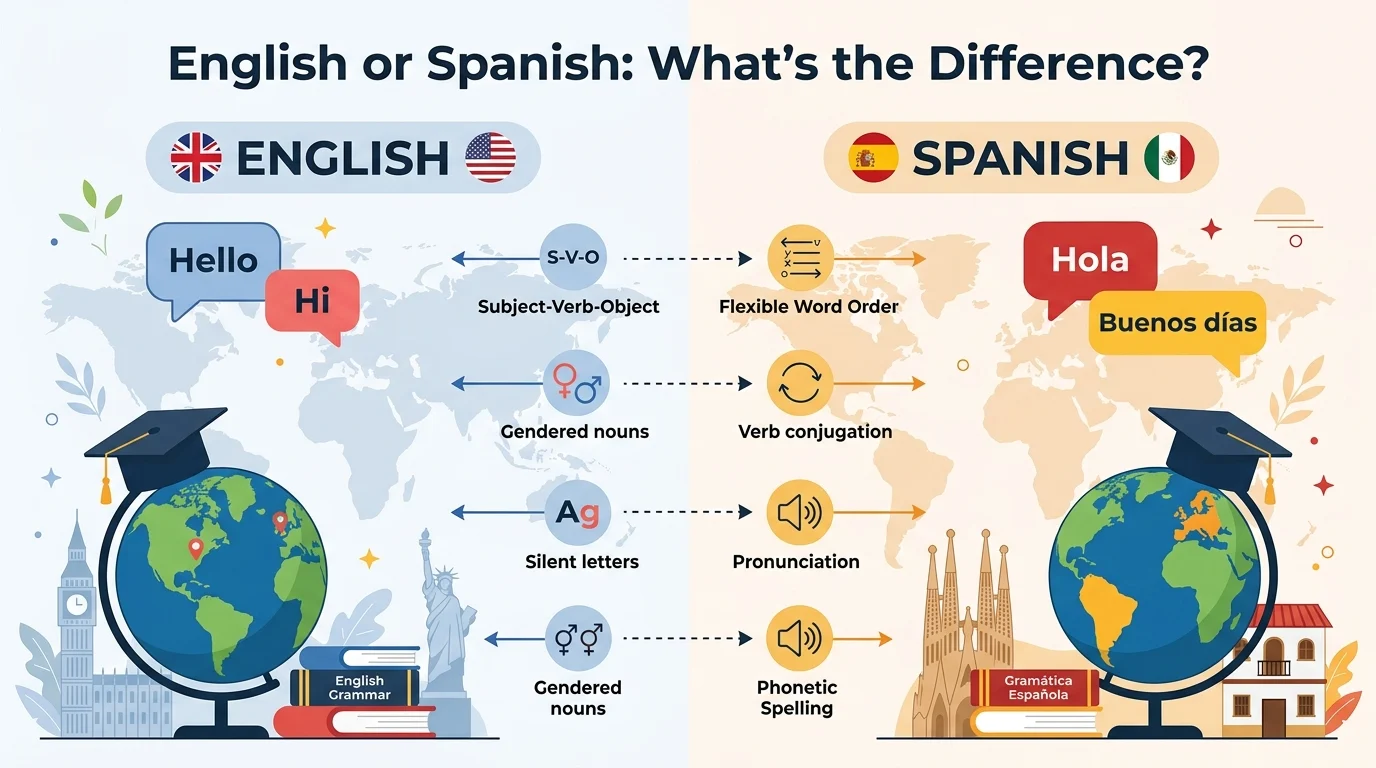
Quick Ans: English and Spanish are two of the most widely spoken languages in the world. English is a Germanic language mainly associated with countries like the United States and the United Kingdom, while Spanish is a Romance language that developed from Latin and is widely spoken in Spain and Latin America.
English or Spanish is a common comparison for language learners, travelers, and people interested in communication. Both languages have millions of speakers worldwide, and each one has its own history, grammar rules, pronunciation patterns, and cultural influence.
English is often used as a global language for business, technology, science, and international communication. On the other hand, Spanish plays a major role in many countries across Europe, North America, and South America.
Understanding the differences between English and Spanish can help learners choose the right language to study. It can also make it easier to recognize how sentence structure, vocabulary, and pronunciation change between languages.
Although these languages are different, they also share some similarities. For example, both use the Latin alphabet and contain many words influenced by historical language contact.
Quick Answer and Key Takeaway
| Feature | English | Spanish |
|---|---|---|
| Language family | Germanic | Romance |
| Main origin | Old English | Latin |
| Writing system | Latin alphabet | Latin alphabet |
| Common regions | US, UK, Canada, Australia | Spain, Mexico, Central and South America |
Key takeaway: English and Spanish are different languages with unique grammar, pronunciation, and vocabulary systems.
Definition and Explanation
English
English is a global language that developed from Germanic languages. Over time, it gained vocabulary from Latin, French, Greek, and many other languages.
Examples:
- I am learning English.
- She speaks English at work.
English sentence structure usually follows a subject, verb, and object pattern.
Example:
I eat apples.
Spanish
Spanish is a Romance language that developed from Latin. It is spoken by millions of people around the world, especially in Spain and Latin America.
Examples:
- Estoy aprendiendo español.
- Ella habla español en el trabajo.
Spanish also follows a subject, verb, and object structure in many sentences, but its grammar includes features that differ from English.
Example:
Yo como manzanas.
Grammar Differences Between English and Spanish
English and Spanish grammar share some basic ideas, but they work differently.
| Grammar Feature | English | Spanish |
|---|---|---|
| Nouns | Usually no gender | Nouns have masculine or feminine gender |
| Adjectives | Usually come before nouns | Often come after nouns |
| Verbs | Fewer verb endings | Many verb changes |
| Articles | a, an, the | el, la, los, las |
For example:
English: a red car
Spanish: un carro rojo
The adjective changes position and form in Spanish.
Pronunciation Differences
Pronunciation is one of the biggest differences between English and Spanish.
English has many vowel sounds and irregular spelling patterns. Therefore, the same letters can sometimes create different sounds.
Spanish pronunciation is usually more consistent. Most letters have predictable sounds.
For example:
- English: “read” can have different pronunciations.
- Spanish: Words are generally pronounced as they are written.
Vocabulary Differences and Similarities
English and Spanish have many different words, but they also share some vocabulary because of historical connections.
Examples of similar words:
| English | Spanish |
|---|---|
| Animal | Animal |
| Hospital | Hospital |
| Important | Importante |
| Family | Familia |
However, many everyday words look completely different.
Examples:
English: House
Spanish: Casa
English: Water
Spanish: Agua
Learning English or Spanish
The best language to learn depends on your personal goals.
English can be useful for international communication, education, technology, and business.
Spanish can be valuable for travel, cultural understanding, and communication across many Spanish speaking countries.
Additionally, learning either language can improve memory, listening skills, and cultural awareness.
Common Mistakes When Comparing English and Spanish
| Correct Understanding | Common Mistake | Why |
|---|---|---|
| English and Spanish are different languages | They are the same language | They have different grammar and vocabulary |
| Spanish has gendered nouns | All languages work the same way | Spanish assigns gender to nouns |
| English spelling can be irregular | English words always sound as written | Many English words have unusual pronunciation |
| Both languages have shared words | Every word has the same meaning | Similar words can sometimes differ |
Exercises With Answers
Choose the correct answer.
- Spanish developed from which language?
- Which language is mainly a Germanic language?
- Does Spanish use the Latin alphabet?
- Which language uses gendered nouns?
Answers
- Latin
- English
- Yes
- Spanish
Related Concepts and Comparisons
Readers interested in English and Spanish may also search for English vs Spanish grammar, Spanish vs English vocabulary, learning English, learning Spanish, Spanish pronunciation, English pronunciation, bilingual learning, and language differences.
FAQs
Is English or Spanish easier to learn?
The difficulty depends on the learner’s background and goals. Some learners find Spanish pronunciation easier, while others find English vocabulary more familiar.
What is the main difference between English and Spanish?
The biggest differences involve grammar, pronunciation, and vocabulary. Spanish uses gendered nouns and more verb changes, while English has simpler noun rules but more irregular spelling.
Which language is spoken more, English or Spanish?
Both languages have hundreds of millions of speakers worldwide. English has a larger global role in international communication, while Spanish has a large speaker population across multiple continents.
Can English speakers learn Spanish easily?
Many English speakers can learn Spanish successfully. Shared vocabulary and the Latin alphabet can make some parts easier.
Is Spanish grammar harder than English grammar?
Spanish grammar has more verb forms and gender rules. However, English also has challenges, especially with pronunciation and irregular spelling.
Are English and Spanish similar languages?
They are different language families, but they share some vocabulary because of historical influence and borrowed words.
Should I learn English or Spanish first?
Your goals should guide your choice. English may help with global communication, while Spanish may help with communication in many Spanish speaking communities.
Do English and Spanish use the same alphabet?
Yes. Both languages use the Latin alphabet, although Spanish includes additional marks such as the ñ character.
Conclusion
English and Spanish are two influential languages with different histories, grammar systems, and pronunciation patterns. English developed from Germanic roots, while Spanish developed from Latin. As a result, each language has its own unique structure.
English is widely used in global communication, business, science, and education. Meanwhile, Spanish connects people across Spain, Latin America, and many multicultural communities.
Neither language is simply better than the other. The right choice depends on your goals, interests, and reasons for learning.
If you want to communicate internationally, English may be useful. If you want to explore Spanish speaking cultures or communities, Spanish may be a great choice.
Practical tip: Choose a language based on where you want to use it most, then practice a little every day to build strong skills.
2 thoughts on “English or Spanish: What’s the Difference? Easy Guide, Examples & Tips”