
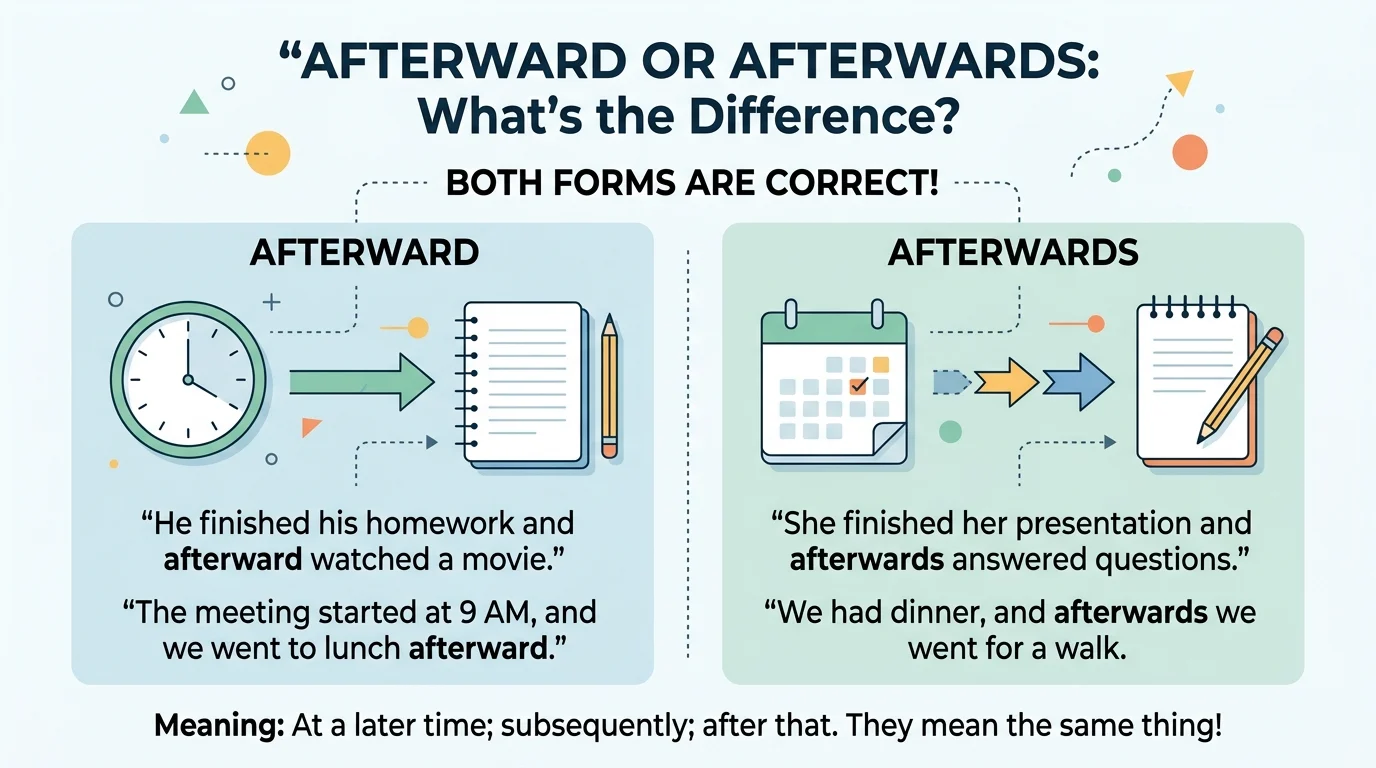
Quick Ans: Afterward and afterwards are both correct adverbs meaning “at a later time” or “later.” Afterward is more common in American English, while afterwards is more common in British English and other varieties. The two words have the same meaning and can usually be used interchangeably. Choose one based on your preferred style and keep it consistent.
Afterward or afterwards is a common spelling and usage question. Both words describe something that happens later or following another event. For example, you can say, “We went home afterward” or “We went home afterwards.” Both sentences are grammatically correct.
The main difference is regional preference. Afterward is more common in American writing, while afterwards is widely preferred in British writing. However, both forms can appear in many varieties of English.
This small difference can sometimes cause confusion for students, writers, and English learners. You might see one spelling in a book and the other on a website and wonder whether one is incorrect.
The good news is simple: neither spelling is wrong. The choice usually depends on your preferred variety of English or the style guide you’re following.
Quick Answer and Key Takeaway
| Word | Common Usage | Example |
|---|---|---|
| Afterward | American English | We had dinner afterward. |
| Afterwards | British English and other varieties | We had dinner afterwards. |
Key takeaway: Both words mean “later.” Use afterward or afterwards according to your preferred English style.
Definition and Explanation
Afterward means at a later time or after something has happened.
Afterwards has exactly the same meaning.
For example:
- She finished her work and went home afterward.
- She finished her work and went home afterwards.
There is no meaningful difference in the time described. Both sentences say that she went home after finishing her work.
The difference mainly comes from spelling and regional usage.
Is This a Grammar, Usage, or Vocabulary Issue?
This is mainly a usage and regional spelling issue.
Both words function as adverbs. They can describe when an action happens.
| Word | Part of Speech | Meaning |
|---|---|---|
| afterward | Adverb | later; after that |
| afterwards | Adverb | later; after that |
You don’t need to change the sentence structure when switching between them.
Example:
“We went shopping afterward.”
“We went shopping afterwards.”
Both are grammatically correct.
Real World Usage Examples
Workplace
Afterward: We discussed the proposal afterward.
Afterwards: We discussed the proposal afterwards.
Recap: Both forms work in professional writing. Follow your organization’s preferred style.
Academic Writing
Afterward: The participants completed a questionnaire afterward.
Afterwards: The participants completed a questionnaire afterwards.
Recap: Choose the form that matches your academic style guide.
Everyday Writing
Afterward: I’ll call you afterward.
Afterwards: I’ll call you afterwards.
Recap: Both forms sound natural in everyday communication.
Regional or Global Usage Differences
The most noticeable difference is regional preference.
Afterward is particularly common in American English.
Afterwards is particularly common in British English and is also widely used in other varieties.
| Style | Common Form |
|---|---|
| American English | afterward |
| British English | afterwards |
| International English | Either |
| Formal writing | Follow the required style |
Neither form should automatically be treated as a spelling error.
When NOT to Use It
Avoid these common mistakes:
- Don’t write afterwards as though it has a different meaning from afterward.
- Don’t assume afterward is incorrect simply because you normally see afterwards.
- Don’t assume afterwards is wrong because your preferred dictionary uses afterward.
- Don’t switch between both forms unnecessarily within the same formal document.
- Don’t use either word when you need the noun aftermath, which has a different meaning.
- Don’t confuse afterward with afterword, which means a concluding section of a book.
- Don’t add an unnecessary extra word when afterward already clearly expresses the intended meaning.
Common Mistakes and Corrections
| Correct Sentence | Incorrect Sentence | Why |
|---|---|---|
| We went home afterward. | We went home afterword. | Afterword is a different word. |
| She called me afterwards. | She called me after wards. | Afterwards is written as one word. |
| I’ll explain it afterward. | I’ll explain it afterward later. | Afterward already means later. |
| They talked afterwards. | They talked afterwords. | Afterwords is not the standard spelling. |
| He apologized afterward. | He apologized after ward. | Afterward is written as one word. |
Simple Decision Rule
Use afterward and afterwards with the same meaning. Choose afterward for American style and afterwards for British style, then stay consistent.
Exercises With Answers
Choose the form that matches the requested style.
- American style: We went for coffee ___.
- British style: She apologized ___.
- American style: I’ll finish the report ___.
- British style: They discussed the issue ___.
- American style: He left shortly ___.
Answers
- afterward
- afterwards
- afterward
- afterwards
- afterward
Related Concepts and Comparisons
Some similar words are easy to confuse with afterward or afterwards.
| Word | Meaning |
|---|---|
| afterward | later; after that |
| afterwards | later; after that |
| afterword | a concluding section of a book |
| afterwardly | uncommon and generally unnecessary |
The most important distinction is between afterward and afterword. The first describes time, while the second refers to part of a book.
FAQs
Is afterward or afterwards correct?
Both are correct. Afterward is more common in American English, while afterwards is more common in British English.
Is afterward American English?
Yes. Afterward is widely preferred in American English, although afterwards is also understood and used.
Is afterwards British English?
Yes. Afterwards is commonly used in British English and several other English varieties.
Do afterward and afterwards mean the same thing?
Yes. Both words mean “later” or “after that.” They can usually replace each other without changing the meaning.
Which is more formal, afterward or afterwards?
Neither is inherently more formal. The choice mainly depends on regional preference and the style you’re following.
Can I use afterward in British English?
Yes. British readers understand afterward, although afterwards is generally more common in British usage.
Can I use afterwards in American English?
Yes. American readers will understand afterwards, although afterward is generally more common in American usage.
What is the difference between afterward and afterword?
Afterward is an adverb meaning later. An afterword is a concluding section added to a book or other written work.
Should I use afterward or afterwards in academic writing?
Either can be correct. Check your institution or required style guide and use the preferred form consistently.
Conclusion
The choice between afterward or afterwards is much simpler than it may first appear. Both words are correct, and both mean “later” or “after that.” The main difference is regional preference rather than meaning or grammar.
Use afterward when following American spelling and usage conventions. Use afterwards when following British conventions. In international writing, either form can work, but consistency is important.
Remember that afterword is different. It refers to a concluding section of a book, not something that happens later.
For everyday messages, essays, professional documents, and online content, you can confidently use either form. Just consider your audience and follow the style expected by your publication, school, workplace, or client.
Practical tip: If you’re unsure, check the English style you’re using first. Then choose one form and use it consistently throughout your writing.