
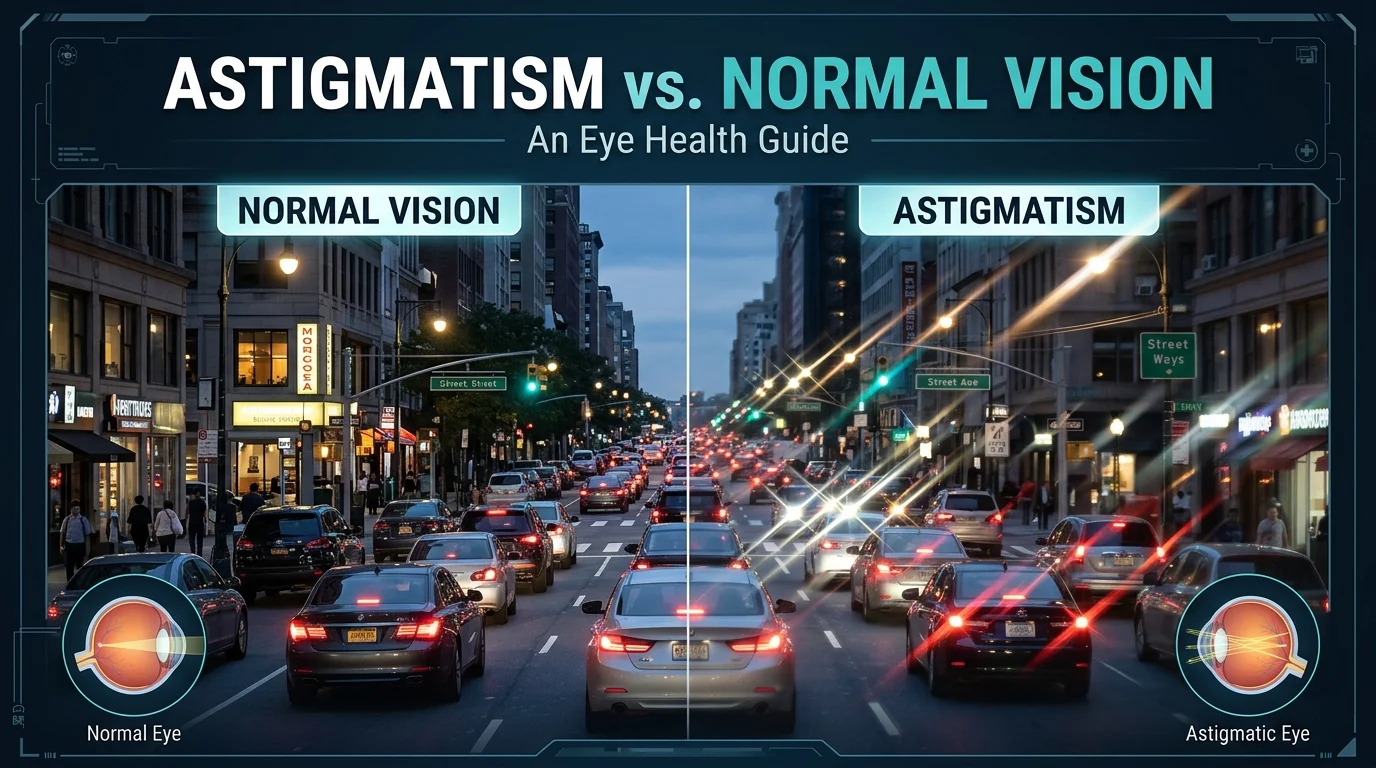
Quick Answer: Astigmatism vs normal vision comes down to how the eye focuses light. Normal vision occurs when light focuses clearly on the retina, while astigmatism happens when the cornea or lens has an irregular curvature. This can make objects look blurry or distorted at near and far distances. Glasses, contact lenses, or certain surgical procedures can help correct astigmatism.
Have you ever wondered why some people see sharp images while others experience blurry text, distorted shapes, or streaks around lights? One possible explanation is astigmatism, a common vision condition that affects how the eye focuses light.
When comparing astigmatism vs normal vision, the main difference is the shape of the eye’s cornea or lens. In an eye without significant refractive errors, light focuses clearly on the retina, the light sensitive layer at the back of the eye. With astigmatism, an irregular curve can prevent light from focusing evenly, which may cause blurred or distorted vision.
Astigmatism can affect children and adults. Some people have mild astigmatism and barely notice it, while others experience headaches, eye strain, and difficulty seeing clearly at night.
In this guide, you will learn how astigmatism differs from normal vision, what symptoms to look for, how eye specialists diagnose it, and which treatments can help improve vision.
Astigmatism vs Normal Vision: Quick Answer
Normal vision allows the eyes to focus light clearly onto the retina. Astigmatism occurs when the cornea or lens has an irregular curvature, causing light to focus unevenly.
The difference can affect how clearly a person sees:
- Normal vision: Objects generally appear sharp when no significant refractive error is present.
- Astigmatism: Objects may appear blurry, stretched, or distorted at near and far distances.
- Night vision: People with astigmatism may notice glare, streaks, or halos around lights.
- Correction: Glasses and contact lenses can improve vision, and some people may be candidates for surgery.
A person’s symptoms depend on the degree of astigmatism and whether other vision conditions are present.
What Is Normal Vision?
Normal vision, in this context, means that the eyes focus light appropriately and do not have a significant refractive error affecting clarity.
The cornea is the clear front surface of the eye, while the lens sits inside the eye and helps focus light. Together, they direct incoming light toward the retina. The retina then converts light into signals that travel to the brain.
When the focusing system works effectively, objects appear clear rather than blurred or distorted.
However, having no astigmatism does not automatically guarantee perfect eyesight. Other conditions, including nearsightedness, farsightedness, and age related changes in the lens, can also affect vision.
What Is Astigmatism?
Astigmatism is a common refractive error that occurs when the cornea or lens has an uneven curvature. Instead of focusing light evenly, the eye focuses it differently in different directions.
Imagine a basketball compared with an American football. A basketball is relatively round, while a football has a more elongated shape. This comparison helps explain why the shape of the eye’s focusing surface matters.
Astigmatism may be present from birth or develop during childhood or adulthood. It can also occur after an eye injury or surgery. In some cases, it occurs alongside nearsightedness or farsightedness.
Mild astigmatism may cause few noticeable symptoms. More pronounced astigmatism can make reading, driving, and recognizing distant objects difficult.
Astigmatism vs Normal Vision: Key Differences
| Feature | Normal Vision | Astigmatism |
|---|---|---|
| Cornea or lens | No significant irregular curvature affecting focus | Irregular curvature affects focus |
| Image clarity | Generally clear without refractive correction | May appear blurry or distorted |
| Near vision | Clear if no other vision problem exists | May be blurry |
| Distance vision | Clear if no other vision problem exists | May be blurry |
| Night vision | Usually no astigmatism related distortion | Glare or streaks around lights may occur |
| Eye strain | Not necessarily present | May occur |
| Correction | May not require refractive correction | Glasses, contacts, or selected procedures may help |
These are general patterns. Not everyone with astigmatism experiences noticeable symptoms.
What Does Astigmatism Look Like?
People often describe astigmatism as blurred, stretched, or slightly distorted vision. For example, letters on a screen may look unclear, and streetlights may appear to have streaks or halos around them.
Common symptoms include:
- Blurry or distorted vision
- Difficulty seeing clearly at night
- Headaches
- Eye strain after reading or screen use
- Squinting to focus
- Trouble seeing details clearly
Symptoms alone cannot confirm astigmatism. Other eye conditions can cause similar problems, so an eye examination is the best way to identify the cause.
What Causes Astigmatism?
Astigmatism develops when the cornea or lens has a shape that affects how light enters and focuses inside the eye.
Possible factors include inherited characteristics, normal eye development, eye injury, and certain eye conditions. Some people have astigmatism from childhood, while others develop changes later in life.
Reading in dim light or sitting too close to a television is not considered a cause of astigmatism.
How Is Astigmatism Diagnosed?
An optometrist or ophthalmologist can check for astigmatism during a comprehensive eye examination.
The examination may include a visual acuity test, which measures how clearly you can read letters at different distances. The eye specialist may also use instruments to measure the curvature of the cornea and determine the appropriate lens prescription.
An eye prescription may include a cylinder value and an axis measurement. The cylinder indicates the amount of astigmatism correction needed, while the axis describes its orientation.
You should arrange an eye examination if you experience persistent blurry vision, headaches, or difficulty seeing at night.
Can Astigmatism Be Corrected?
Yes. Several options can improve vision for people with astigmatism.
Glasses: Prescription glasses are a common and straightforward way to correct astigmatism.
Contact lenses: Specially designed lenses, including toric contact lenses, can correct many cases of astigmatism. Proper fitting and cleaning are important to reduce the risk of infection.
Refractive surgery: Some people may qualify for procedures that change the shape of the cornea. An eye specialist can explain the benefits, risks, and suitability of these options.
Mild astigmatism does not always require treatment. The appropriate choice depends on the prescription, symptoms, eye health, and personal needs.
Frequently Asked Questions
Is astigmatism worse than normal vision?
Astigmatism can reduce visual clarity, but its impact varies. Mild cases may cause few symptoms, while stronger cases may interfere with everyday activities.
Can you have astigmatism and still see clearly?
Yes. Mild astigmatism may not cause noticeable symptoms. Some people also see clearly with the help of prescribed glasses or contact lenses.
Does astigmatism affect near and far vision?
It can affect both. Unlike some other refractive errors, astigmatism may cause blurry or distorted vision at different distances.
Can astigmatism cause headaches?
Yes. Astigmatism can contribute to headaches and eye strain, particularly when the eyes work harder to focus.
Can astigmatism get worse over time?
Astigmatism can change as the eyes develop or age. Regular eye examinations help identify changes and determine whether a new prescription is needed.
Is astigmatism permanent?
It can persist over time, but its effects can often be corrected with glasses, contact lenses, or suitable surgical procedures.
Can astigmatism cause night vision problems?
Yes. Some people notice glare, halos, or streaks around lights at night, which can make driving more difficult.
How can I tell if I have astigmatism?
Blurry vision, squinting, headaches, and night vision difficulties may suggest a problem, but only an eye examination can determine whether astigmatism is present.
Conclusion
The difference between astigmatism vs normal vision lies in how effectively the eye focuses light. Normal vision generally produces clear images when no significant refractive error is present. Astigmatism occurs when the cornea or lens has an irregular curvature, which can make objects appear blurry or distorted.
Some people experience only mild symptoms, while others notice headaches, eye strain, or difficulty seeing clearly at night. Fortunately, glasses and contact lenses can correct many cases, and selected patients may benefit from refractive surgery.
If you regularly experience blurry vision or other changes in eyesight, schedule a comprehensive eye examination instead of trying to diagnose the problem yourself. Early identification can help you find the right treatment and maintain clear, comfortable vision.