
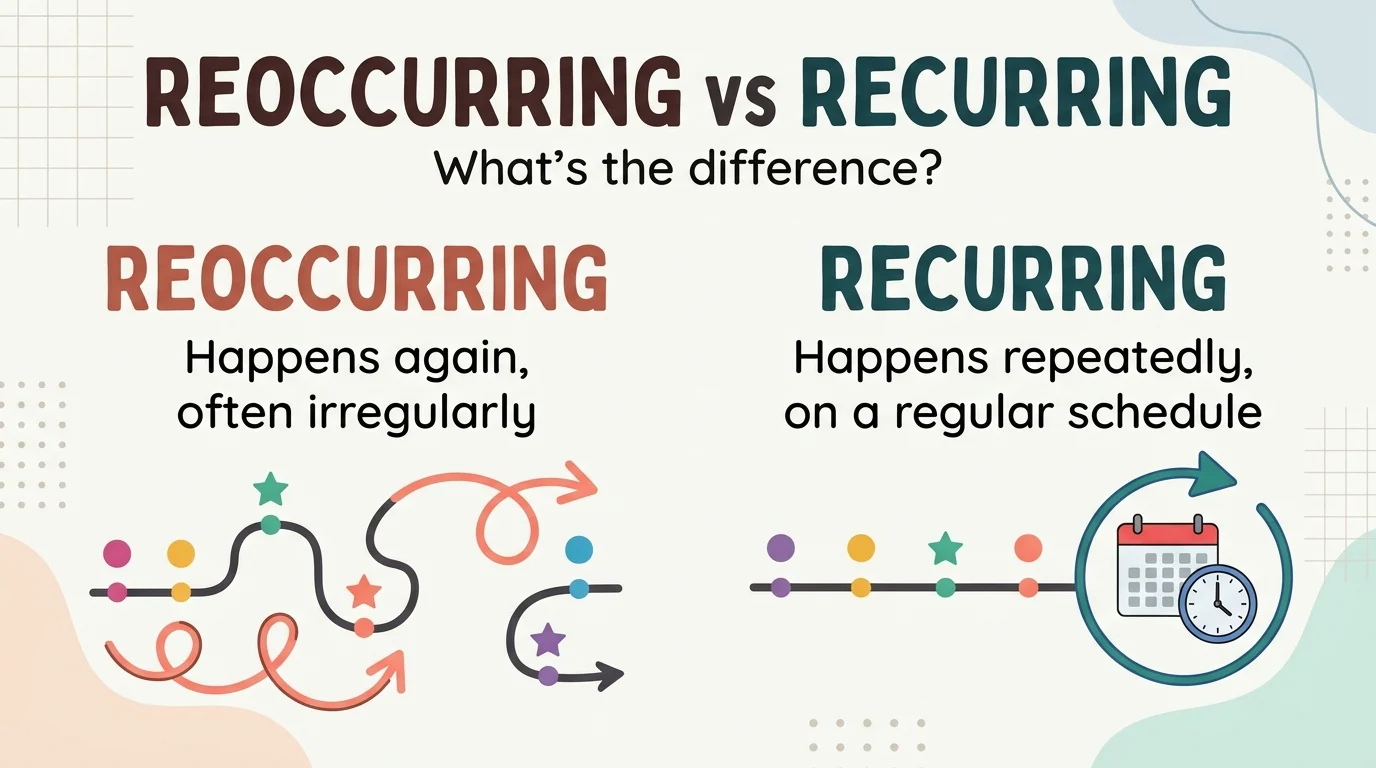
Quick Answer: Recurring means happening repeatedly or at regular intervals. Reoccurring also means happening again, but it does not necessarily suggest a regular pattern. Although both words are correct, recurring is usually the better choice when describing repeated events, payments, meetings, or problems that happen regularly.
Have you ever wondered whether to write reoccurring or recurring? The two words look almost identical, and people often use them interchangeably. However, there is a small difference in their meanings that can help you choose the right word for your sentence.
Both words describe something that happens again. The main distinction is that recurring often suggests a repeated or regular pattern, while reoccurring emphasizes that something happens again. In everyday English, their meanings can overlap, so context plays an important role.
Choosing the right word can make your writing clearer, especially when discussing monthly bills, scheduled meetings, repeated symptoms, or problems that keep appearing. If you are writing for a website, preparing a report, or improving your English vocabulary, understanding this difference can help you express your meaning more precisely.
In this guide, you will learn the meanings of recurring and reoccurring, see practical examples, and discover when each word works best.
Reoccurring vs Recurring: Quick Answer
Recurring describes something that happens repeatedly, often following a pattern or schedule. For example, a recurring payment is charged repeatedly, such as every month.
Reoccurring describes something that happens again after it has happened before. It may happen regularly, but the word does not necessarily emphasize a predictable schedule.
Examples:
- Recurring: She has a recurring meeting every Monday.
- Reoccurring: The same technical problem is reoccurring after each update.
Both words are correct. However, recurring is generally more suitable when you want to emphasize repetition or an established pattern.
What Does Recurring Mean?
Recurring is an adjective formed from the verb recur. It describes something that happens repeatedly, returns, or appears again over time.
The word often suggests a pattern, although the repetition does not always have to follow a strict schedule.
Examples of recurring:
- I have a recurring appointment every Friday.
- The company charges a recurring monthly fee.
- She experiences recurring headaches.
- The team holds recurring progress meetings.
- The business faces recurring supply problems.
In these examples, the events or situations return more than once. Some follow a clear schedule, while others repeat over time without a fixed timetable.
The word is particularly common in business, finance, healthcare, and everyday communication. For example, a recurring subscription usually means that a customer is charged repeatedly according to an agreed billing schedule.
What Does Reoccurring Mean?
Reoccurring comes from the verb reoccur, which means to occur again. It emphasizes that an event or situation has happened before and is happening another time.
Unlike recurring, it does not necessarily suggest a regular or predictable pattern.
Examples of reoccurring:
- The error is reoccurring after every system restart.
- A similar issue is reoccurring in several departments.
- The problem keeps reoccurring despite our efforts to fix it.
- The unusual noise is reoccurring whenever the machine starts.
- The same disagreement is reoccurring during team discussions.
These examples focus on an event happening again. In many of these sentences, recurring would also work, but reoccurring can emphasize the return of a particular incident.
Reoccurring vs Recurring: Key Differences
| Feature | Recurring | Reoccurring |
|---|---|---|
| Basic meaning | Happening repeatedly | Happening again |
| Main emphasis | Repetition or a pattern | Another occurrence |
| Regular schedule | Often associated with one | Not necessarily implied |
| Common uses | Payments, meetings, events, symptoms | Returning errors, incidents, and problems |
| Correct spelling | Yes | Yes |
The distinction is useful, but it is not an absolute grammatical rule. English speakers sometimes use both words for the same situation.
When Should You Use Recurring?
Use recurring when you want to describe something that repeats, especially when it forms a recognizable pattern or happens according to a schedule.
This word is often the clearest choice in professional and formal writing.
Common examples include:
Recurring payments: A customer pays a subscription fee every month.
Recurring meetings: A team meets every Tuesday to discuss progress.
Recurring problems: A company repeatedly experiences the same delivery delays.
Recurring symptoms: A person experiences symptoms that return over time.
Recurring events: A festival takes place every year.
If you are unsure which word to choose, recurring is usually a safe option for general repetition.
When Should You Use Reoccurring?
Use reoccurring when you want to emphasize that something has happened before and is happening again, particularly when the return of an incident is important.
For example:
- The software error is reoccurring after the latest update.
- The same complaint is reoccurring despite the new policy.
- A strange smell is reoccurring in the kitchen.
These sentences focus on the return of a problem or event. Still, recurring would also be correct in each example.
Remember that reoccurring does not mean an event can happen only once or that it must be unpredictable. It simply places more emphasis on another occurrence.
Common Mistakes to Avoid
1. Assuming reoccurring is incorrect
Both words are accepted English words. The difference lies mainly in emphasis and usage.
2. Using recurring only for scheduled events
Recurring can describe unscheduled situations, such as recurring headaches or recurring technical problems.
3. Treating the distinction as absolute
The meanings overlap. In many sentences, either word is grammatically acceptable.
4. Confusing recurring with occasional
Recurring means something happens again and again. It does not necessarily mean that it happens frequently or at perfectly regular intervals.
Frequently Asked Questions
Is recurring or reoccurring correct?
Both are correct. Recurring is generally preferred for repeated events or patterns, while reoccurring emphasizes that something happens again.
What is the main difference between recurring and reoccurring?
Recurring often highlights repetition or a pattern. Reoccurring emphasizes another occurrence. However, their meanings frequently overlap.
Is reoccurring a real word?
Yes. Reoccurring is the present participle of reoccur, meaning to happen again.
Is recurring more common than reoccurring?
Recurring is widely used in everyday, professional, and technical writing, especially for repeated payments, meetings, events, and symptoms.
Should I write recurring payment or reoccurring payment?
Recurring payment is the more natural and widely used expression because it commonly refers to payments made repeatedly according to a billing arrangement.
Can a problem be recurring and reoccurring?
Yes. Both words can describe a problem that returns. Recurring may emphasize the repeated pattern, while reoccurring may emphasize another instance of the problem.
Does recurring always mean regular?
No. Recurring often suggests a pattern, but an event can recur without following a fixed schedule.
What is the noun form of recurring?
The noun is recurrence. It describes the act or instance of something happening again.
Conclusion
Understanding reoccurring vs recurring is easier when you focus on the emphasis of each word. Both describe something happening again, but recurring is generally the more common choice for repeated events, established patterns, and regular arrangements. Reoccurring emphasizes that an event or situation has happened before and is happening again.
For example, a recurring payment is a charge that happens repeatedly, often according to a schedule. A reoccurring error emphasizes that the error has appeared again, although recurring error would also be correct.
Neither word is inherently wrong, and their meanings often overlap. When you need to choose quickly, use recurring for most situations involving repetition. Reserve reoccurring for cases where you want to emphasize another occurrence. Above all, consider the context and aim for clear, natural wording.