
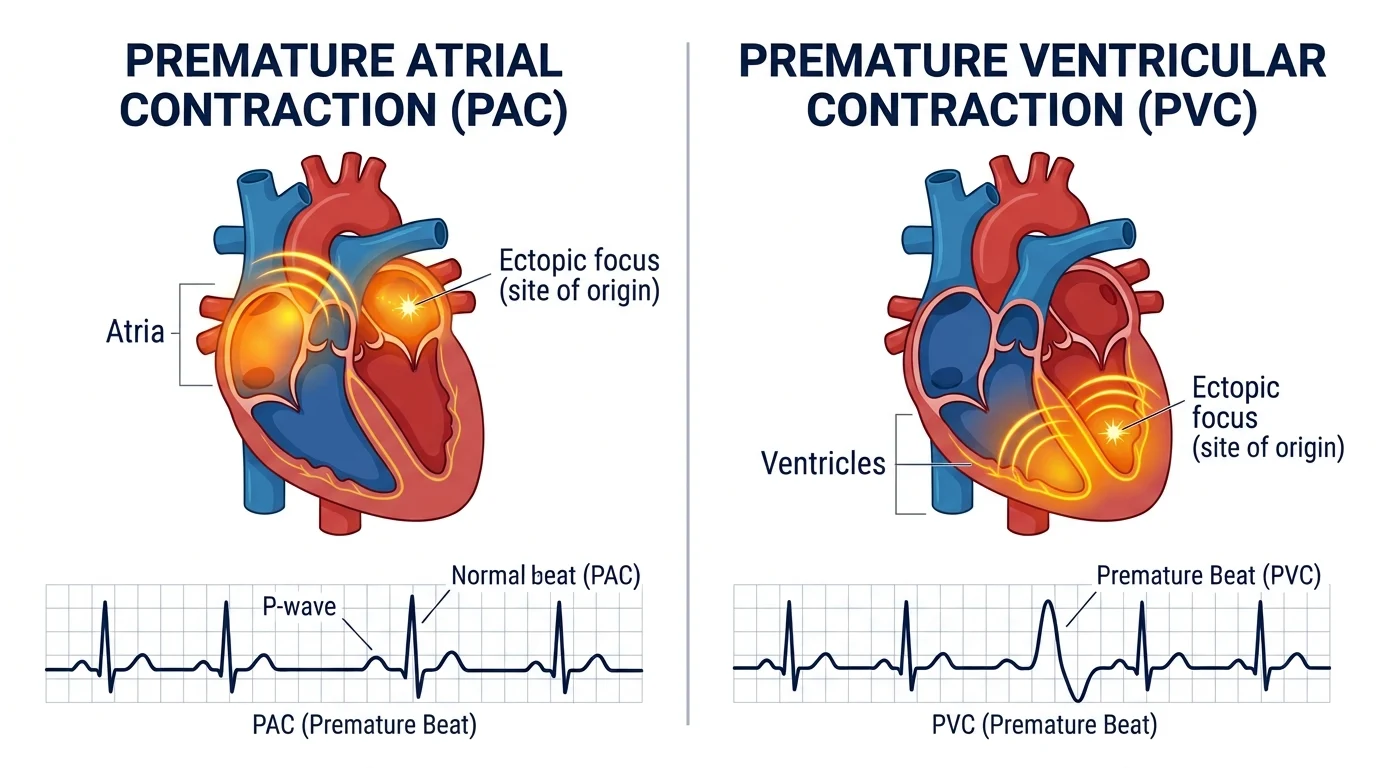
Quick Answer: PVC vs PAC compares two types of extra heartbeats: premature ventricular contractions and premature atrial contractions. PACs begin in the heart’s upper chambers, while PVCs start in its lower chambers. Both are common and often harmless, but frequent episodes may require medical evaluation. Their significance depends on symptoms, frequency, heart health, and individual risk factors.
Have you ever felt your heart skip a beat, flutter, or suddenly thump in your chest? These sensations can sometimes result from premature heartbeats. Two common types are premature atrial contractions (PACs) and premature ventricular contractions (PVCs).
Although PACs and PVCs can feel almost identical, they begin in different parts of the heart. A PAC starts in the upper chambers, called the atria, while a PVC begins in the lower chambers, called the ventricles.
Understanding PVC vs PAC can help you make sense of an electrocardiogram (ECG) report or a conversation with your healthcare professional. Both types occur in healthy people, and occasional episodes often do not require treatment. However, frequent premature beats or symptoms associated with an underlying heart condition may need further investigation.
This guide explains the main differences, common symptoms, possible causes, diagnosis, and treatment options. It also explains when you should seek medical attention.
What Is a PAC?
A premature atrial contraction, or PAC, is an early heartbeat that begins in the atria rather than following the heart’s usual electrical timing.
The atria are the two upper chambers of the heart. They receive blood and help move it into the lower chambers.
A PAC occurs when an electrical signal starts earlier than expected in the atrial tissue. This creates an extra heartbeat that may interrupt the normal rhythm temporarily.
Common PAC Symptoms
Some people do not notice PACs at all. Others may experience:
- A fluttering sensation in the chest
- A skipped heartbeat followed by a stronger beat
- Brief palpitations
- A momentary feeling that the heart has paused
PACs can occur because of stress, caffeine, alcohol, poor sleep, or other factors. They may also occur in people with underlying heart conditions.
Occasional PACs are often harmless. However, frequent PACs may be associated with a higher risk of developing atrial fibrillation, so persistent symptoms deserve medical attention.
What Is a PVC?
A premature ventricular contraction, or PVC, is an early heartbeat that begins in one of the heart’s two lower chambers, known as the ventricles.
Because the electrical signal starts in an unusual location, the heartbeat follows a different electrical pathway from a typical heartbeat. This can make the beat look different on an ECG.
Common PVC Symptoms
PVCs may cause sensations such as:
- A skipped or missed heartbeat
- A strong thump in the chest
- Fluttering or pounding
- Brief awareness of an irregular rhythm
- Occasional lightheadedness
Some PVCs produce no noticeable symptoms. Others can feel surprisingly strong because the heartbeat following the premature beat may be more forceful.
Occasional PVCs are common and often harmless. However, frequent PVCs can sometimes affect the heart’s pumping function, particularly when they occur in a high proportion of total heartbeats.
PVC vs PAC: Key Differences
| Feature | PAC | PVC |
|---|---|---|
| Full name | Premature atrial contraction | Premature ventricular contraction |
| Origin | Upper heart chambers | Lower heart chambers |
| Electrical signal | Starts early in the atria | Starts early in the ventricles |
| ECG appearance | Often has a narrow QRS complex | Often has a wider QRS complex |
| Common sensation | Flutter or skipped beat | Thump or skipped beat |
| General outlook | Often harmless when occasional | Often harmless when occasional |
| Possible concern | Frequent episodes may be associated with atrial fibrillation | Frequent episodes may affect heart function |
The ECG appearance can help clinicians distinguish the two. However, symptoms alone cannot reliably tell you whether you are experiencing a PAC or a PVC.
Which Is More Dangerous: PVC or PAC?
Neither type is automatically more dangerous than the other. The significance depends on how frequently the premature beats occur, whether symptoms are present, and whether the person has an underlying heart condition.
Frequent PACs can be associated with an increased risk of atrial fibrillation, an irregular rhythm originating in the atria.
Frequent PVCs may sometimes weaken the heart muscle over time. This is more concerning when premature beats make up a substantial proportion of the heart’s total beats.
For both conditions, the overall clinical picture matters more than the abbreviation alone. Your healthcare professional may recommend additional tests based on your symptoms and medical history.
How Are PACs and PVCs Diagnosed?
Doctors commonly use an electrocardiogram (ECG or EKG) to record the heart’s electrical activity and identify premature beats.
If the episodes occur occasionally and do not appear during a standard ECG, a healthcare professional may recommend a portable heart monitor, such as a Holter monitor.
Other tests may include an echocardiogram, which uses ultrasound to examine the heart’s structure and pumping function. Blood tests may also be appropriate when a clinician suspects contributing factors such as thyroid problems or electrolyte imbalances.
The appropriate evaluation depends on the person’s symptoms, examination, and medical history.
Treatment and Prevention
Occasional PACs and PVCs often do not require specific treatment if the heart is otherwise healthy and symptoms are mild.
Depending on the situation, a healthcare professional may recommend:
- Getting consistent, adequate sleep
- Managing stress
- Reducing caffeine if it triggers symptoms
- Limiting alcohol
- Avoiding nicotine and recreational stimulants
- Addressing underlying medical conditions
If symptoms are troublesome or premature beats occur frequently, a doctor may consider medication. In selected cases, a procedure called catheter ablation can target the area responsible for abnormal electrical activity.
Do not start medication or make major changes to prescribed treatment without medical advice.
When Should You Seek Medical Help?
Arrange a medical assessment if palpitations are frequent, persistent, worsening, or accompanied by other symptoms.
Seek emergency medical care if a rapid or irregular heartbeat occurs with chest pain, severe shortness of breath, fainting, or severe dizziness.
If an ECG report mentions PACs or PVCs, ask your healthcare professional what the findings mean in your particular case. The number of premature beats and your overall heart health help determine whether further evaluation is necessary.
Frequently Asked Questions
Can PACs and PVCs occur together?
Yes. A person can experience both types of premature heartbeat. An ECG or heart monitor can help identify them.
Can stress cause PACs or PVCs?
Stress may trigger or increase palpitations in some people. Caffeine, alcohol, poor sleep, and other factors may also contribute.
Are PACs more common than PVCs?
Both are common, but their frequency varies among individuals and populations. A heart monitor can help determine how often they occur in a particular person.
Can PACs or PVCs go away on their own?
Yes. Occasional premature beats may become less noticeable or occur less frequently when contributing triggers are addressed. Persistent symptoms should be assessed.
Can a smartwatch distinguish PACs from PVCs?
A smartwatch may record some rhythm abnormalities, but it cannot always reliably distinguish PACs from PVCs. A clinical ECG or appropriate heart monitoring may be needed.
Do PACs or PVCs always mean heart disease?
No. Both can occur in people without known heart disease. However, frequent episodes or concerning symptoms may require further investigation.
Conclusion
The main difference in PVC vs PAC is where the premature heartbeat begins. PACs originate in the upper chambers of the heart, while PVCs originate in the lower chambers. Both can cause palpitations, fluttering, or a sensation of a skipped heartbeat.
Occasional premature beats are often harmless, but frequent episodes may need evaluation. PACs can be associated with a higher risk of atrial fibrillation, while frequent PVCs can sometimes affect the heart’s pumping function.
Neither type is automatically more dangerous. The number of premature beats, accompanying symptoms, and underlying heart health all influence their significance.
If you experience persistent palpitations or receive an ECG report mentioning PACs or PVCs, discuss the findings with a healthcare professional. Seek emergency care if palpitations occur with chest pain, severe breathing difficulty, or fainting.
1 thought on “PVC vs PAC: Which Heart Rhythm Is More Concerning?”