
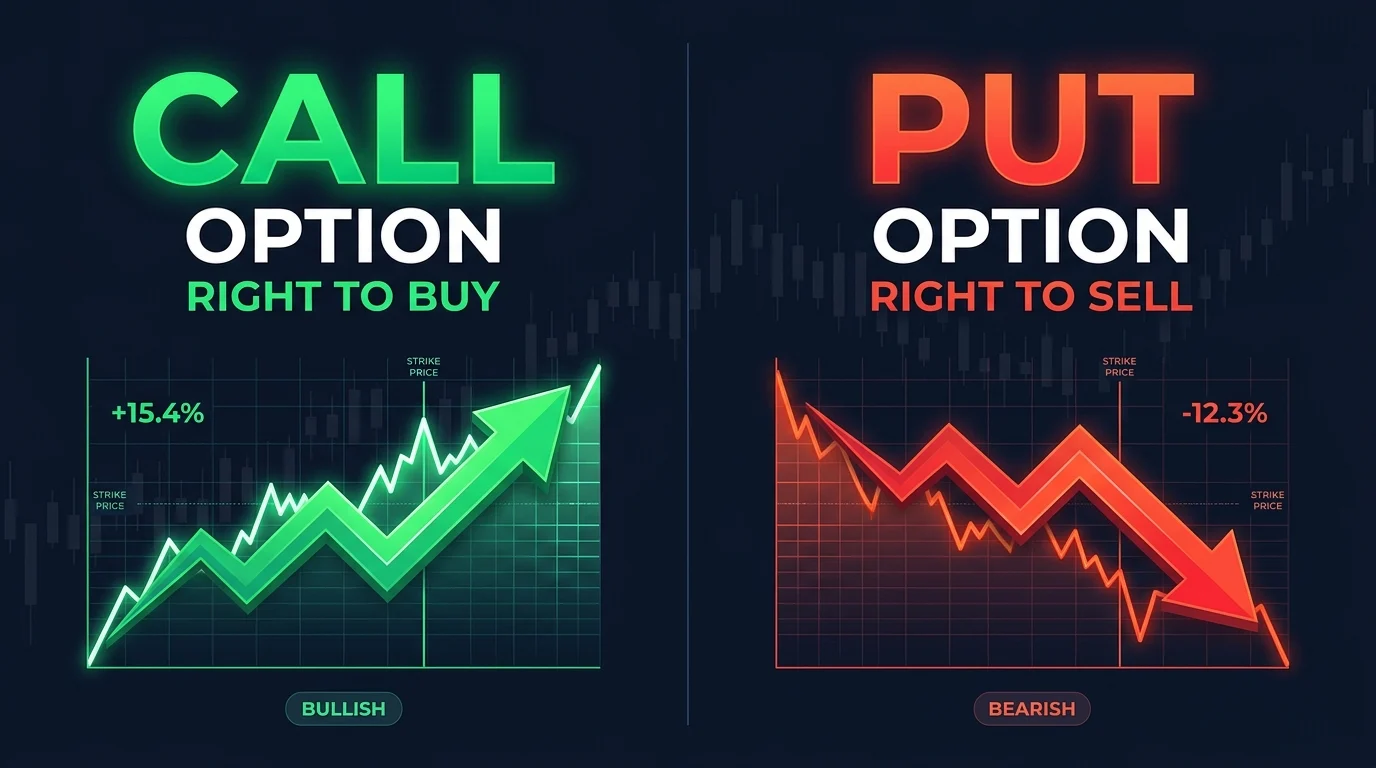
Quick Answer: A call vs put comparison comes down to what the option gives you the right to do. A call option gives the buyer the right to buy an asset at a set price before or at expiration. In contrast, a put option gives the buyer the right to sell an asset at a set price.
Options trading can seem confusing when you first encounter terms like calls, puts, strike prices, and premiums. However, understanding the difference between call and put options makes the basics much easier to follow.
Both calls and puts are financial contracts linked to an underlying asset, such as a stock or an exchange traded fund. Traders use them to speculate on price movements, while investors may use them to hedge against potential losses.
The main difference is simple: buyers generally purchase calls when they expect an asset’s price to rise and puts when they expect it to fall. Nevertheless, traders can also use these options for income strategies or portfolio protection.
In this guide, you’ll learn how call and put options work, explore practical examples, and understand their potential risks. These basics can help you recognize how options behave before deciding whether they fit your financial goals.
What Is a Call Option?
A call option gives the buyer the right, but not the obligation, to buy an underlying asset at a specific price. This price is called the strike price.
Traders often buy calls when they expect the asset’s market price to increase before the option expires.
Example: Imagine a stock currently trades at $100. You buy a call option with a $105 strike price and pay a $3 premium per share.
If the stock rises to $115 at expiration, the option has $10 of intrinsic value per share. After subtracting the $3 premium, your profit is $7 per share, assuming one share per unit for this illustration and excluding fees.
However, if the stock remains below $105 at expiration, the option may expire worthless. In that case, you lose the $3 premium.
What Is a Put Option?
A put option gives the buyer the right, but not the obligation, to sell an underlying asset at a specific strike price.
Traders often buy puts when they expect a stock’s price to fall. Investors also use puts to help protect shares they already own.
Example: Suppose a stock trades at $100. You buy a put option with a $95 strike price and pay a $2 premium per share.
If the stock falls to $85 at expiration, the put has $10 of intrinsic value per share. After subtracting the $2 premium, your profit is $8 per share under this simplified example.
On the other hand, if the stock stays above $95 at expiration, the put may expire worthless, leaving you with a loss equal to the premium paid.
Call vs Put: Key Differences
| Feature | Call Option | Put Option |
|---|---|---|
| Buyer’s right | Buy the asset | Sell the asset |
| Common outlook | Bullish | Bearish |
| Benefits when | Price rises above the strike enough to cover the premium | Price falls below the strike enough to cover the premium |
| Maximum loss for buyer | Premium paid | Premium paid |
| Typical use | Speculation or upside exposure | Speculation or downside protection |
| Common risk | The option may expire worthless | The option may expire worthless |
Keep in mind that a call or put buyer can lose the entire premium. Meanwhile, option sellers face different risks. An uncovered call seller, for example, can face theoretically unlimited losses if the underlying asset’s price keeps rising.
When Should You Use a Call or Put?
Your expectations and goals help determine which option strategy may be relevant.
Consider a call when:
- You expect the underlying asset’s price to rise.
- You want exposure to potential upside without buying the shares outright.
- You understand that the option can lose value as expiration approaches.
Consider a put when:
- You expect the underlying asset’s price to fall.
- You want to hedge shares you already own.
- You want to understand how downside exposure may affect your portfolio.
However, predicting direction alone is not enough. The strike price, premium, time until expiration, and changes in implied volatility can all affect an option’s value.
Common Mistakes to Avoid
1. Ignoring the premium: An option can move in the expected direction and still produce a loss if the price movement is not large enough.
2. Forgetting expiration: Options have limited lifespans. As expiration approaches, time value generally declines, all else being equal.
3. Confusing buying with selling: Buying an option and writing an option create different rights, obligations, and risk profiles.
4. Assuming puts always make money when stocks fall: The stock may not fall far enough to offset the premium paid.
5. Trading without a risk plan: Options can be complex and may result in rapid losses. Understand the contract and potential outcomes before trading.
Practice: Call or Put?
Choose the option that best matches each situation.
- You expect a stock to rise from $50 to $70.
Answer: A call may fit that bullish outlook. - You own shares and want protection against a potential decline.
Answer: A put may provide downside protection. - You expect a stock to fall and want to speculate on that decline.
Answer: A put may fit that bearish outlook.
These answers describe common uses, not guaranteed outcomes or personal investment recommendations.
Frequently Asked Questions
Is a call better than a put?
Neither is automatically better. A call may suit a bullish outlook, while a put may suit a bearish outlook or a hedging goal. The right choice depends on your strategy, costs, and risk tolerance.
Can you lose money buying a call?
Yes. If the option expires without value, the buyer can lose the entire premium paid.
Can you lose money buying a put?
Yes. If the underlying asset does not fall enough, the put may expire worthless and the buyer can lose the premium.
Are calls bullish and puts bearish?
Usually, buying calls reflects a bullish outlook, while buying puts reflects a bearish outlook. However, traders also use both types in more complex strategies.
What is the strike price?
The strike price is the price at which the option contract allows the buyer to purchase the underlying asset with a call or sell it with a put, subject to the contract’s terms.
What is an option premium?
The premium is the price paid to purchase an option. It is generally the buyer’s maximum loss when buying a standard call or put and holding it without additional positions.
Can beginners trade options?
Beginners can study options, but trading them involves risks that may be difficult to assess. Learn how pricing, expiration, and contract terms work before risking money.
What is the biggest difference between a call and a put?
A call gives the buyer the right to buy an asset at the strike price. A put gives the buyer the right to sell it at the strike price.
Conclusion
The difference between a call and a put lies in the right each contract provides. A call gives the buyer the right to buy an asset, while a put gives the buyer the right to sell it.
Generally, traders buy calls when they expect prices to rise and puts when they expect prices to fall. Nevertheless, both options involve premiums, expiration dates, and risks. Understanding these features is essential before considering options trading.