
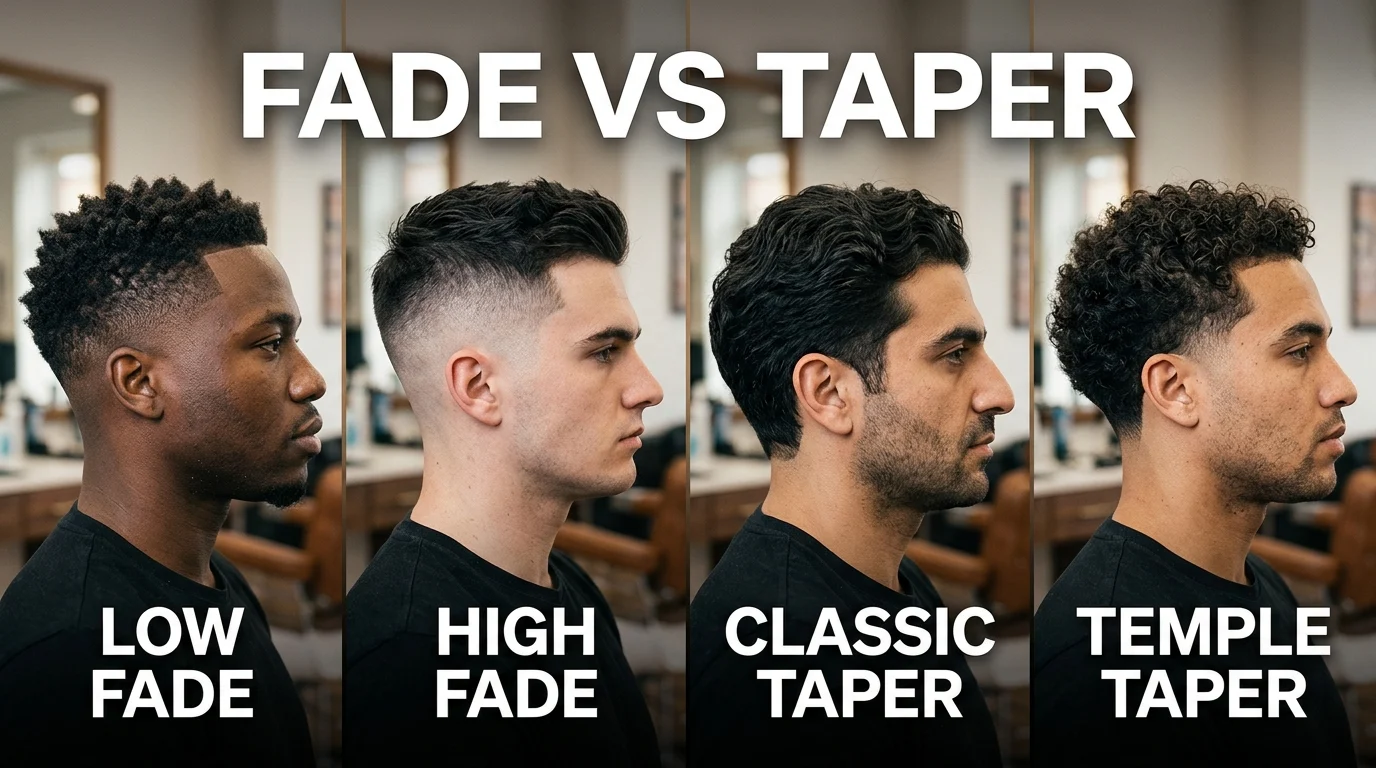
Quick Ans: A fade gradually blends hair from very short or nearly bare skin into longer hair as it moves up the head. A taper gradually shortens hair around the sideburns and neckline while leaving more length on the sides. Both styles create a clean look, but a fade usually offers a sharper contrast, whereas a taper looks more subtle and natural.
Choosing between a fade and a taper can feel confusing, especially when barbers sometimes use these terms interchangeably. Although both haircuts gradually shorten the hair, they differ in how much hair they remove, where the blending begins, and how noticeable the final result looks.
A fade often creates a bold, modern appearance because the hair blends down to very short stubble or bare skin. In contrast, a taper keeps more hair around the sides while gradually shortening the sideburns and neckline. As a result, it usually looks softer and more understated.
Your choice depends on your personal style, hair texture, face shape, and daily grooming routine. For example, you might prefer a skin fade for a sharp, high contrast look or a classic taper for a professional appearance.
In this guide, you will learn the main differences between a fade and a taper, explore popular styles, and discover how to choose the right haircut for your needs.
What Is a Fade Haircut?
A fade haircut gradually blends the hair from longer lengths on top to very short hair or bare skin near the sides and back. The blending usually extends upward from the lower part of the head.
Barbers create different fade styles by changing the starting point and the amount of contrast.
Popular Types of Fades
- Low fade: Starts close to the ears and neckline for a subtle, balanced appearance.
- Mid fade: Begins around the middle of the sides, creating a noticeable blend.
- High fade: Starts higher on the head for a bold, dramatic look.
- Skin fade: Blends the hair down to bare skin.
- Drop fade: Curves downward behind the ears, following the shape of the head.
A fade works well with textured crops, quiffs, pompadours, curls, and many other hairstyles. However, very short fades may require frequent barber visits to maintain their sharp appearance.
What Is a Taper Haircut?
A taper haircut gradually shortens the hair around the sideburns and neckline. Unlike many fades, a classic taper leaves more length on the sides and back.
Consequently, the haircut looks natural and neat without creating an extremely short area around the entire lower sides of the head.
Popular Types of Tapers
- Classic taper: Keeps the sides relatively full while shortening the hair near the ears and neckline.
- Low taper: Creates a subtle transition around the sideburns and lower neckline.
- Temple taper: Shortens the hair around the temples while keeping most of the sides longer.
- Tapered neckline: Cleans up the hairline at the back of the neck without dramatically changing the sides.
A taper pairs well with side parts, textured hairstyles, curly hair, and professional cuts. Moreover, it can be a practical choice if you want a polished appearance without a dramatic change.
Fade vs Taper: Key Differences
| Feature | Fade | Taper |
|---|---|---|
| Main area | Often blends across much of the sides and back | Mainly focuses on sideburns and neckline |
| Shortest length | Can reach bare skin | Usually leaves some hair, depending on the style |
| Appearance | Sharp, modern, and high contrast | Subtle, classic, and natural |
| Maintenance | Often needs more frequent touch ups | Usually grows out more softly |
| Styling options | Works with bold and modern styles | Works with classic and versatile styles |
| Best for | People who want a noticeable blend | People who prefer a clean, understated cut |
Keep in mind that barbers can create different variations. For instance, a low fade may look quite subtle, while a high taper can create a more noticeable finish.
Fade vs Taper: Which One Should You Choose?
The right choice depends on your preferred look and how much maintenance you want.
Choose a Fade If:
- You prefer a sharp, modern haircut.
- You want strong contrast between the sides and the top.
- You like styles such as a high fade, skin fade, or drop fade.
- You do not mind visiting your barber regularly to maintain clean blending.
Choose a Taper If:
- You prefer a classic, natural appearance.
- You want to keep more length on the sides.
- You need a versatile haircut for work, school, or formal occasions.
- You prefer a style that can grow out more gradually.
For curly or textured hair, both options can work beautifully. A fade can emphasize the curls on top, while a taper can frame the face without removing too much volume.
Can You Combine a Fade and a Taper?
Yes. Some haircuts combine elements of both styles. For example, a barber might create a taper around the temples and neckline while keeping a gradual fade elsewhere.
However, these terms describe different approaches, so explain the exact result you want rather than relying on the name alone.
When visiting a barber, bring a reference photo and specify three things: how short you want the sides, where you want the blend to begin, and how much length you want to keep on top.
Common Mistakes to Avoid
1. Assuming every fade reaches the skin. A skin fade does, but other fades can leave short hair at the bottom.
2. Thinking a taper and a fade are identical. Both involve gradual blending, yet they typically differ in placement and coverage.
3. Choosing a haircut without considering upkeep. A sharp fade may need more frequent trims than a subtle taper.
4. Asking for a haircut without explaining the details. Show your barber a photo and discuss the length, blend, and neckline.
Frequently Asked Questions
Is a fade better than a taper?
Neither is universally better. A fade suits people who prefer a sharper, more noticeable blend, whereas a taper works well for a classic and understated look.
Does a taper last longer than a fade?
A taper often grows out more naturally because it leaves more length around the sides. However, the time between haircuts depends on your hair growth and how precise you want the finish to remain.
Is a low fade the same as a low taper?
No. A low fade usually blends the hair across a broader area near the bottom of the sides. A low taper mainly shortens the hair around the sideburns and neckline.
Which haircut looks more professional?
Both can look professional. Nevertheless, a classic taper or low fade often creates a conservative appearance that works well in formal settings.
Can you get a taper with long hair?
Yes. A taper can keep the sides and top relatively long while cleaning up the sideburns and neckline.
Is a skin fade a taper?
No. A skin fade reduces the hair to bare skin at the shortest point. A traditional taper usually preserves more hair, although some modern variations can overlap in appearance.
Which is easier to maintain?
A taper is often easier to maintain because it grows out more subtly. In comparison, a very short fade can lose its crisp appearance as the hair grows.
What should I tell my barber?
Explain whether you want a fade or taper, identify the height you prefer, and show a reference photo. Also, mention whether you want a natural neckline or a sharper finish.
Conclusion
The main difference between a fade and a taper is how much of the sides and back the barber blends and how short the hair becomes. A fade generally creates a stronger contrast, while a taper keeps the look more natural and understated.
Ultimately, choose a fade if you want a sharp, modern finish. On the other hand, choose a taper if you prefer a classic haircut with a softer transition. Either way, clear instructions and a reference photo can help you get the result you want.