
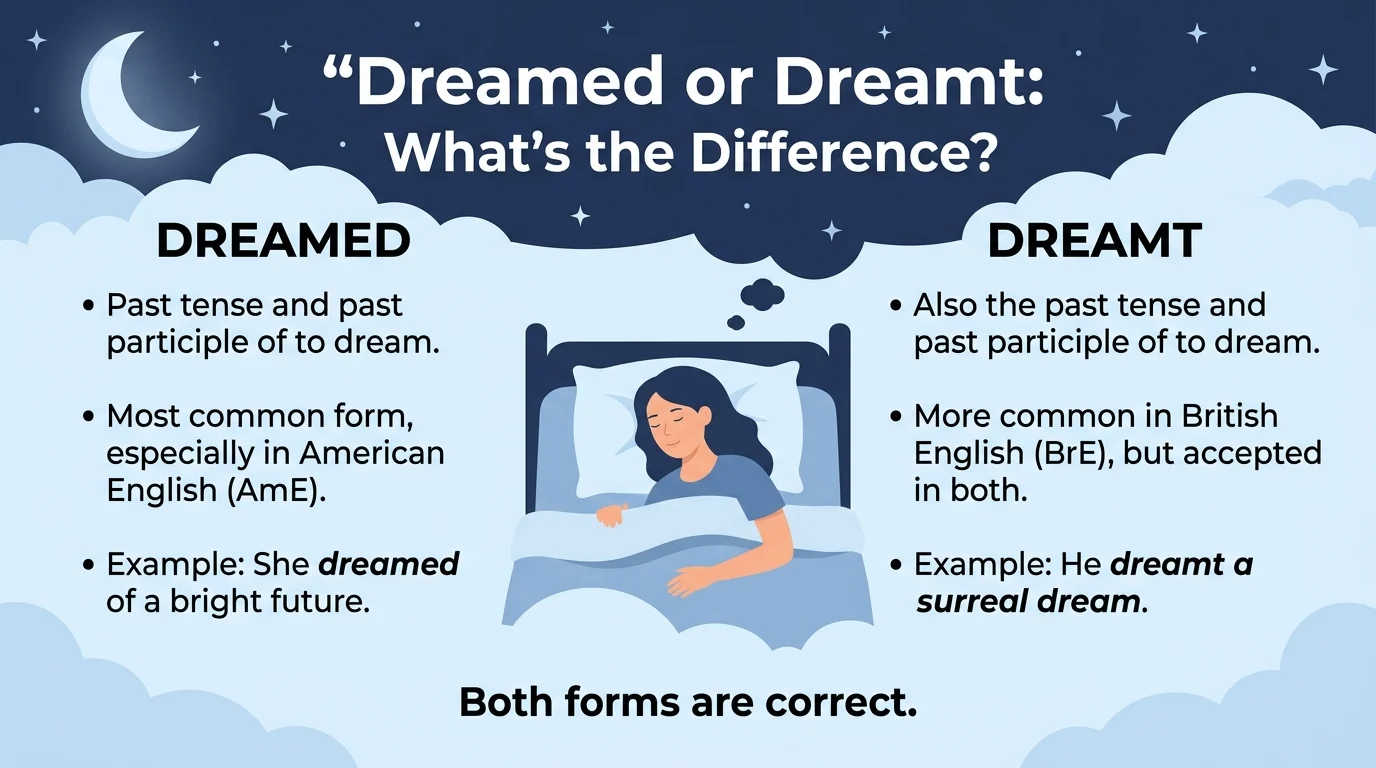
Quick Ans: Dreamed and dreamt are both correct past tense and past participle forms of dream. Dreamed is more common in American English, while dreamt is especially common in British English. Both forms have the same meaning, so your choice usually depends on regional preference, writing style, and personal usage.
Dreamed or dreamt can be confusing because both forms describe something that happened in the past. If you have seen sentences such as “I dreamed about flying” and “I dreamt about flying,” you may wonder which one is correct.
The good news is that both are correct. The difference is mainly related to regional and stylistic preference. Dreamed is widely used in American English, while dreamt is particularly common in British English and other varieties influenced by British usage.
Both forms can describe sleeping dreams, hopes, ambitions, or imagined situations. For example, you can say, “She dreamed of becoming a writer” or “She dreamt of becoming a writer.”
Understanding the difference helps you write naturally and avoid correcting a form that is already grammatically correct.
Quick Answer and Key Takeaway
| Word | Common Usage | Example |
|---|---|---|
| Dreamed | More common in American English | I dreamed about my old school. |
| Dreamt | Common in British English | I dreamt about my old school. |
Key takeaway: Use dreamed or dreamt according to your preferred English style. Both forms are grammatically correct and have the same meaning.
Definition and Explanation
Dreamed and dreamt are forms of the verb dream.
The verb can describe a mental experience during sleep:
- I dreamed about a strange place.
- I dreamt about a strange place.
It can also describe a hope or ambition:
- She dreamed of becoming a doctor.
- She dreamt of becoming a doctor.
The two forms don’t have different meanings. The main difference is usage preference.
Dreamed follows the regular past tense pattern by adding ed.
Dreamt is an irregular form that changes the ending of the word.
Is This a Grammar, Usage, or Vocabulary Issue?
This is mainly a usage and spelling variation, rather than a grammar problem.
Both forms work as the past tense and past participle of dream.
| Present | Past | Past Participle |
|---|---|---|
| dream | dreamed | dreamed |
| dream | dreamt | dreamt |
For example:
Past: I dreamed about the trip.
Past: I dreamt about the trip.
Perfect: I have dreamed about this moment.
Perfect: I have dreamt about this moment.
Both versions are grammatically acceptable.
Real World Usage Examples
Workplace
Dreamed: She dreamed of starting her own company.
Dreamt: She dreamt of starting her own company.
Recap: Both forms work when describing a professional ambition.
Academic Writing
Dreamed: The participant dreamed about returning to university.
Dreamt: The participant dreamt about returning to university.
Recap: Follow the spelling style required by your institution or publication.
Everyday Writing
Dreamed: I dreamed that I was flying.
Dreamt: I dreamt that I was flying.
Recap: Both forms are natural when talking about dreams during sleep.
Regional or Global Usage Differences
Regional preference is the main reason you see both spellings.
Dreamed is especially common in American English. Dreamt is widely used in British English and is also found in other varieties of English.
However, these are preferences rather than strict rules. You may find dreamed in British writing and dreamt in American writing.
| Writing Style | Common Form |
|---|---|
| American English | dreamed |
| British English | dreamt |
| International writing | Either, depending on style |
| Formal writing | Follow the required style guide |
The most important point is consistency.
When NOT to Use It
Avoid these common mistakes:
- Don’t assume dreamt is incorrect because you normally use dreamed.
- Don’t assume dreamed is wrong simply because a British writer uses dreamt.
- Don’t use both forms randomly within the same formal document.
- Don’t change dreamt to dreamed when editing British style writing unless there is a specific reason.
- Don’t confuse dreamed or dreamt with the present tense dream.
- Don’t use dreamt when you need the noun dream.
- Don’t treat the two forms as having different meanings.
Common Mistakes and Corrections
| Correct Sentence | Incorrect Sentence | Why |
|---|---|---|
| I dreamed about you. | I dream about you yesterday. | A past event needs a past tense. |
| She dreamt of becoming a singer. | She dreamt to become a singer. | “Dream of” is the natural structure for an ambition. |
| He dreamed that he was flying. | He dreamed he fly. | The verb after the past reporting verb should fit the sentence structure. |
| I have dreamed about this moment. | I have dream about this moment. | The perfect tense requires a past participle. |
| She dreamt about her childhood. | She dreamt about her childhood yesterday and dreamed about it today. | Mixing forms unnecessarily can make formal writing less consistent. |
Simple Decision Rule
Use dreamed if you prefer the common American form. Use dreamt if you prefer the common British form. Both are correct, so focus on consistency.
Exercises With Answers
Choose dreamed or dreamt.
- American style: I ___ about my childhood.
- British style: She ___ of becoming a writer.
- American style: He has ___ about this opportunity.
- British style: We ___ that we were flying.
- American style: They ___ of visiting Italy.
Answers
- dreamed
- dreamt
- dreamed
- dreamt
- dreamed
Related Concepts and Comparisons
Dreamed and dreamt are similar to other verbs that have both regular and irregular past forms.
| Regular Form | Alternative Form |
|---|---|
| dreamed | dreamt |
| learned | learnt |
| burned | burnt |
| spelled | spelt |
The preferred form can vary by region and writing style.
FAQs
Is dreamed or dreamt correct?
Both are correct. Dreamed is more common in American English, while dreamt is especially common in British English.
Is dreamt the British spelling?
Yes. Dreamt is widely used in British English, although dreamed can also appear in British writing.
Is dreamed the American spelling?
Yes. Dreamed is the more common form in American English.
Do dreamed and dreamt mean the same thing?
Yes. Both forms have the same meaning and can describe a sleeping dream or a hope or ambition.
Which is more common, dreamed or dreamt?
Usage varies by region. Dreamed is especially common in American English, while dreamt is strongly associated with British English.
Can I use dreamt in American English?
Yes. It is grammatically correct, although dreamed is generally more common in American usage.
Can I use dreamed in British English?
Yes. British writers can use dreamed, although dreamt is a common British form.
Is dreamt a proper word?
Yes. Dreamt is a standard English word and a correct past tense and past participle of dream.
Should I write dreamed or dreamt in formal writing?
Either can be appropriate. Follow the spelling conventions of your audience, publisher, school, or organization.
Conclusion
The choice between dreamed or dreamt is mainly a matter of regional preference and writing style. Both forms are correct past tense and past participle forms of dream, and neither changes the basic meaning of the sentence.
Dreamed is more common in American English, while dreamt is especially common in British English. You can use either form when talking about dreams during sleep, hopes, ambitions, or imagined experiences.
The key is consistency. If your document follows American spelling conventions, dreamed will usually fit naturally. If it follows British spelling conventions, dreamt may be the preferred choice.
Don’t automatically correct one form to the other. Instead, consider the audience and style of the writing. Once you know this simple regional difference, choosing between the two becomes easy.
Practical tip: Pick one spelling style before you start writing and use it consistently throughout your article, essay, email, or other formal content.