
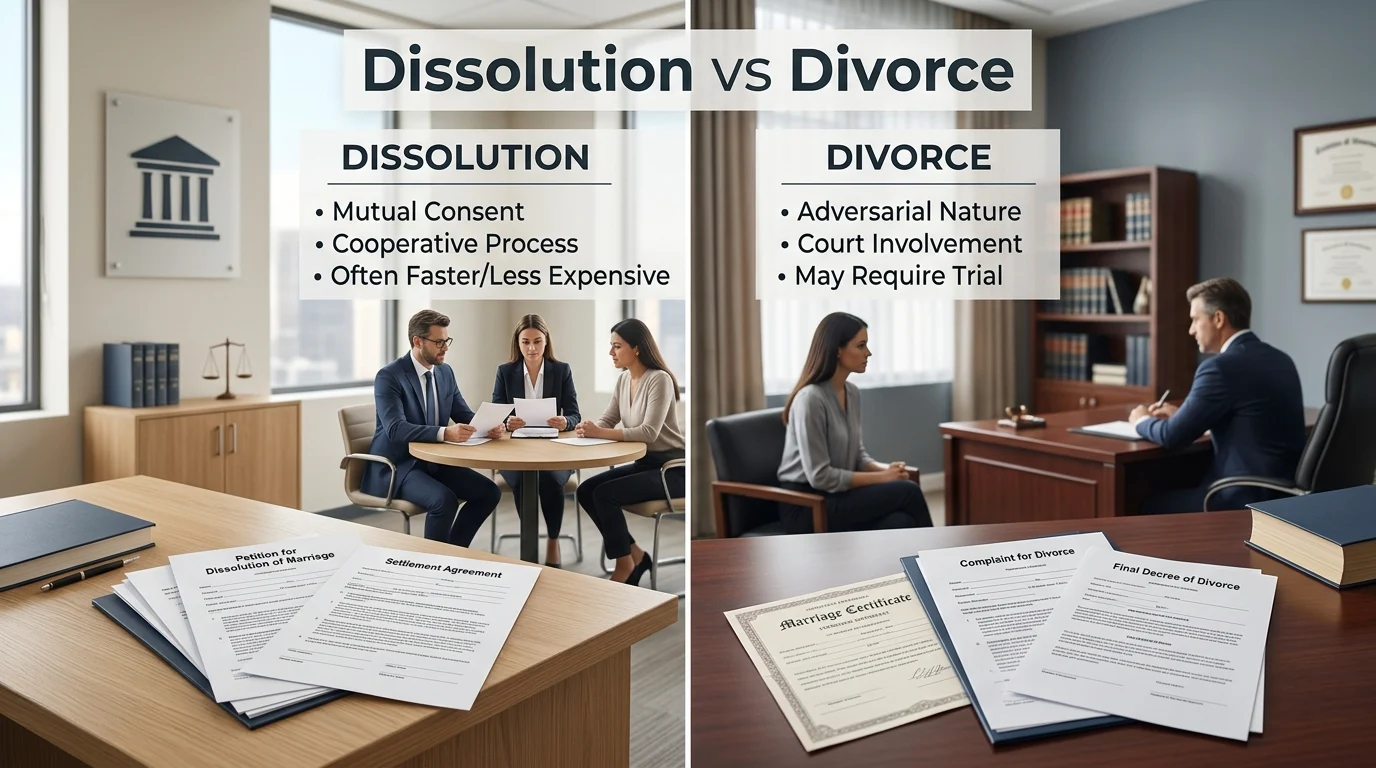
Quick Ans: Dissolution and divorce can both refer to the legal ending of a marriage, but the terminology depends on the jurisdiction. In many places, dissolution is simply another term for ending a marriage through a legal process. However, some jurisdictions use specific rules and procedures for dissolution, so the exact meaning can vary.
Dissolution vs divorce can be confusing because both terms are often used when talking about legally ending a marriage. In everyday conversation, people usually say “divorce,” while some courts and legal systems use the word “dissolution.”
The difference is not always as simple as choosing one word over the other. Legal terminology varies by country, state, and jurisdiction. In some places, dissolution of marriage is the formal legal term for divorce. In others, dissolution can describe a particular type of proceeding with its own requirements.
Both processes can involve important matters such as property, finances, children, child support, and spousal support. Because the exact rules depend on local law, it is important to understand how your jurisdiction uses these terms.
This guide explains the basic difference between dissolution and divorce, shows how the words are used, and provides simple examples to make the distinction easier to understand.
Quick Answer and Key Takeaway
In many legal systems, dissolution of marriage means the legal ending of a marriage and is essentially another term for divorce. However, some jurisdictions use “dissolution” for specific legal procedures or types of marital termination.
Simple rule: Divorce is the familiar everyday term, while dissolution is often the more formal legal term.
Dissolution vs Divorce: Definition and Explanation
What Is Dissolution?
Dissolution generally means the legal ending or termination of something.
When used in family law, dissolution of marriage means ending a legally recognized marriage. The court process may address issues such as property division, child custody, child support, and spousal support.
For example:
The couple filed for dissolution of marriage after deciding to separate.
In some jurisdictions, the official court documents may use “dissolution” rather than “divorce.”
What Is Divorce?
Divorce is the legal process through which a marriage is ended.
For example:
They decided to get a divorce after years of separation.
The word is widely understood in everyday English and is commonly used when discussing the end of a marriage.
However, the exact legal procedure called divorce varies depending on where the case is filed.
Is This a Grammar, Usage, or Vocabulary Issue?
Dissolution vs divorce is primarily a legal vocabulary and usage issue.
Both words can describe the ending of a marriage, but their precise legal meanings depend on the jurisdiction.
In everyday writing, “divorce” is usually easier for a general audience to understand. In legal documents, however, “dissolution” may be the preferred term.
Therefore, context matters when choosing between the two words.
Real World Usage Examples
Everyday Conversation
My sister is going through a divorce.
This sentence uses the familiar everyday term.
My sister filed for dissolution of marriage.
This sounds more formal and legal.
Recap: “Divorce” is common in everyday conversation, while “dissolution” often sounds more formal.
Legal Documents
The parties filed a petition for dissolution of marriage.
A court or attorney may use this terminology when referring to a formal legal proceeding.
Recap: Legal terminology may differ from ordinary conversation.
Family and Financial Matters
The divorce agreement addressed property division and child support.
The dissolution proceeding addressed property division and child support.
Both sentences can describe similar matters when the jurisdiction uses dissolution as its legal terminology.
Recap: Either process may involve financial and family related issues.
Key Differences Between Dissolution and Divorce
| Feature | Dissolution | Divorce |
|---|---|---|
| Basic meaning | Legal ending of a marriage | Legal ending of a marriage |
| Common usage | Often formal or legal | Common everyday term |
| Legal meaning | Depends on jurisdiction | Depends on jurisdiction |
| May involve children | Yes | Yes |
| May involve property | Yes | Yes |
| May involve support | Yes | Yes |
The important point is that dissolution does not universally mean something different from divorce. The terminology depends on the applicable law.
Regional or Global Usage Differences
Legal terminology varies significantly between jurisdictions.
For example, some US jurisdictions officially use dissolution of marriage in their family law procedures. Other jurisdictions commonly use divorce.
Outside the United States, terminology can also vary based on the country’s legal system.
Because family law is jurisdiction specific, you should not assume that a legal term has exactly the same meaning everywhere.
When NOT to Use These Terms Interchangeably
Be careful about treating dissolution and divorce as identical when:
- You are completing official court forms.
- You are reading a legal document from a specific jurisdiction.
- A court distinguishes between different types of marital proceedings.
- You are discussing a specific legal procedure.
- You are giving legal information for a particular country or state.
In these situations, use the terminology required by the relevant court or legal authority.
Common Mistakes and Corrections
| Correct Sentence | Incorrect Assumption | Why |
|---|---|---|
| Divorce is a legal process for ending a marriage. | Divorce always has the same procedure everywhere. | Laws vary by jurisdiction. |
| Dissolution may be the formal legal term for divorce. | Dissolution always means something different from divorce. | The terms can overlap. |
| Check local law before filing. | Every jurisdiction uses the same terminology. | Family law differs by location. |
| Legal documents may use dissolution. | Only lawyers use the word dissolution. | Courts and official documents may use it. |
Easy Decision Rule
Use divorce when speaking generally about the legal ending of a marriage.
Use dissolution when discussing the formal terminology used by a particular court, jurisdiction, or legal document.
Exercises With Answers
Choose dissolution or divorce.
- They announced that they were getting a ______.
- The court document referred to the ______ of marriage.
- The exact legal terminology depends on the ______.
- “Divorce” is generally more familiar in everyday ______.
- Always check the terminology used by the local ______.
Answers
- divorce
- dissolution
- jurisdiction
- conversation
- court
Related Concepts and Comparisons
Dissolution vs Legal Separation
Dissolution ends the marriage, while legal separation generally allows spouses to live separately without legally ending the marriage.
Divorce vs Annulment
Divorce ends a legally valid marriage. An annulment generally involves a legal determination that a marriage was invalid or should be treated as legally void under applicable law.
Dissolution of Marriage vs Separation
Separation means spouses live apart or separate their lives. Dissolution generally refers to the legal termination of the marriage.
FAQs
Is dissolution the same as divorce?
In many jurisdictions, dissolution of marriage is simply the formal legal term for divorce. However, the exact meaning and procedure depend on local law.
What is the difference between dissolution and divorce?
The main difference is often terminology rather than the basic result. Both can refer to legally ending a marriage, but different jurisdictions may use the terms differently.
Is dissolution of marriage a divorce?
In many legal systems, yes. “Dissolution of marriage” can be the formal term used for the legal process commonly called divorce.
Why do some courts say dissolution instead of divorce?
Some jurisdictions use dissolution as their official family law terminology. The choice of terminology is determined by local law.
Is dissolution better than divorce?
These terms do not represent universally different levels or outcomes. The appropriate term depends on the legal system and the specific proceeding.
Can dissolution involve child support?
Yes. A dissolution proceeding can address child support when children are involved, depending on the applicable law.
Does dissolution end a marriage?
Generally, dissolution of marriage means legally ending the marriage. The exact procedure and legal consequences depend on the jurisdiction.
What is the difference between dissolution and legal separation?
Dissolution generally ends the marriage, while legal separation allows spouses to remain legally married while living separately under a formal arrangement.
Is divorce the same in every state?
No. Divorce laws, procedures, terminology, and requirements can vary between states and other jurisdictions.
Conclusion
Dissolution vs divorce is mainly a question of legal terminology and jurisdiction. In many places, dissolution of marriage is simply the formal legal term for ending a marriage, while divorce is the word most people use in everyday conversation.
However, the terms should not automatically be treated as identical in every legal situation. Courts and jurisdictions can have different terminology, procedures, and requirements. This is especially important when completing official forms or discussing a specific family law case.
Both dissolution and divorce may involve matters such as property division, child custody, child support, and spousal support. The exact issues depend on the circumstances and applicable law.
The easiest way to remember the distinction is this: divorce is the familiar general term, while dissolution is often the formal legal term. If you are dealing with an actual legal matter, always check the terminology used by your local court or legal authority.