
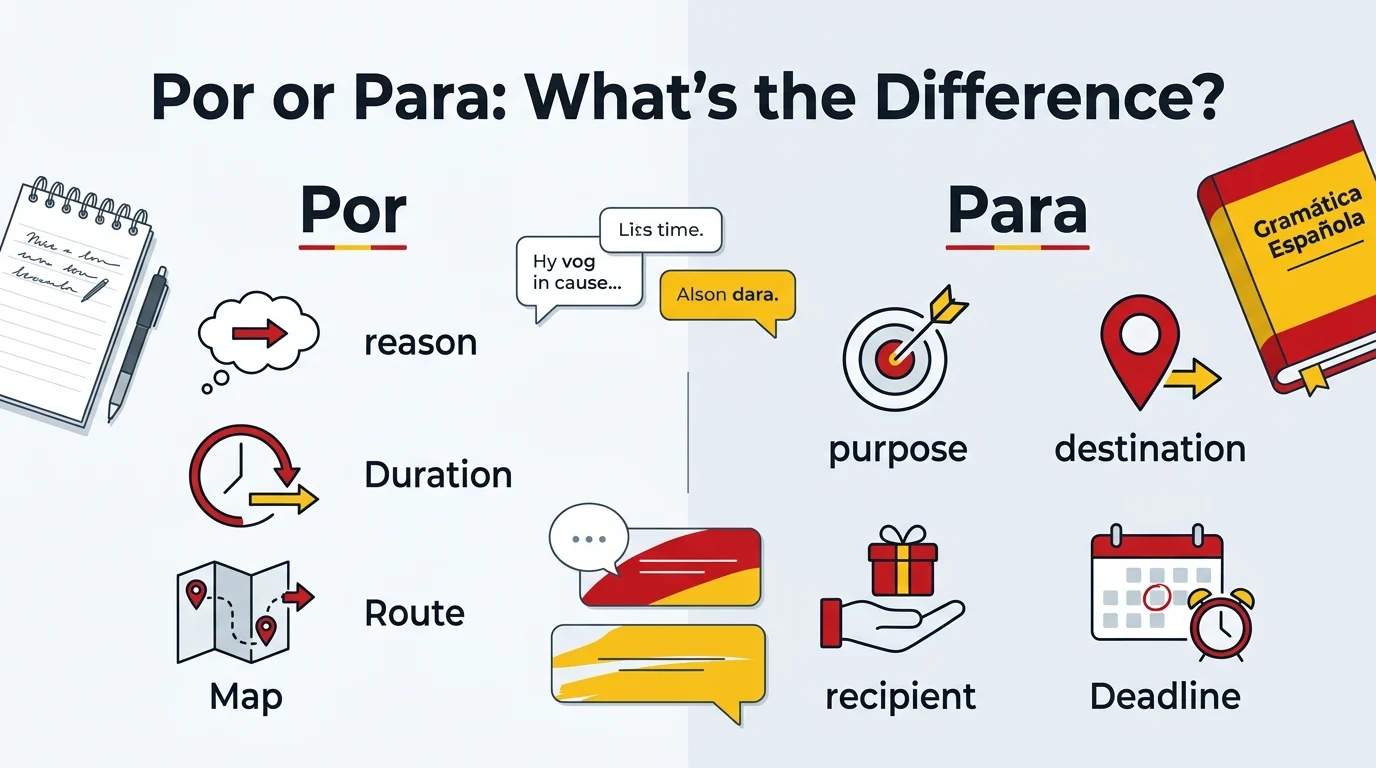
Quick Ans: Por and para are both Spanish prepositions, but they have different uses. Para often expresses purpose, destination, a recipient, or a deadline, while por commonly expresses a reason, duration, exchange, movement through an area, or means. Learning the basic patterns makes it much easier to choose between por and para correctly.
Por or para is one of the most common challenges for Spanish learners. Both words can sometimes translate into English as “for,” which makes the difference confusing. However, Spanish uses them in different situations.
The key is to focus on the relationship each preposition describes. Para often points toward a goal, destination, purpose, or intended recipient. Por often explains a reason, route, duration, exchange, or method.
For example, Estudio para aprender means “I study in order to learn,” while Gracias por ayudarme means “Thank you for helping me.” The English word “for” appears in both translations, but Spanish uses different prepositions.
Once you learn the main patterns, por and para become much easier to recognize and use naturally.
Quick Answer and Key Takeaway
| Use | Por | Para |
|---|---|---|
| Purpose | Usually no | Yes |
| Destination | Usually no | Yes |
| Recipient | Usually no | Yes |
| Deadline | Usually no | Yes |
| Duration | Yes | Usually no |
| Reason | Yes | Usually no |
| Exchange | Yes | Usually no |
| Movement through an area | Yes | Usually no |
Simple rule: Think of para as pointing toward a goal or destination. Think of por as describing a reason, route, duration, exchange, or means.
Definition and Explanation
What Does Para Mean?
Para commonly introduces a purpose, destination, recipient, or deadline.
Examples:
- Estudio para el examen.
I study for the exam. - Este regalo es para Ana.
This gift is for Ana. - Salimos para Madrid.
We are leaving for Madrid. - Necesito el informe para el lunes.
I need the report by Monday.
What Does Por Mean?
Por commonly expresses a reason, duration, movement through a place, exchange, or means.
Examples:
- Lo hice por ti.
I did it because of you / for your sake. - Viví allí por dos años.
I lived there for two years. - Caminamos por el parque.
We walked through the park. - Te doy diez dólares por el libro.
I’ll give you ten dollars for the book.
Is This a Grammar, Usage, or Vocabulary Issue?
Por and para are primarily a grammar and usage issue. They are both prepositions, but they serve different grammatical functions.
English learners often translate “for” directly into Spanish. This can lead to mistakes because one English preposition may correspond to different Spanish prepositions.
Instead of translating word for word, identify the meaning first.
Goal or intended result? Think para.
Reason, duration, route, exchange, or means? Think por.
Real World Usage Examples
Workplace
- Este informe es para el director.
This report is for the director. - Trabajé por tres horas.
I worked for three hours.
Recap: Use para for an intended recipient and por for duration.
Academic
- Estudio para aprender español.
I study to learn Spanish. - Gracias por explicar la lección.
Thank you for explaining the lesson.
Recap: Purpose usually takes para, while a reason or cause often takes por.
Everyday
- Salimos para casa.
We are heading home. - Pasamos por el supermercado.
We passed through the supermarket.
Recap: Destination takes para, while movement through a place commonly takes por.
Regional or Global Usage Differences
Unlike spelling differences such as traveled and travelled, the distinction between por and para is a core feature of Spanish grammar.
Spanish speakers across different countries generally use both prepositions, although individual expressions and regional preferences can vary.
For learners, the safest approach is to learn the standard grammatical patterns first rather than relying only on English translations.
When NOT to Use It
Avoid these common mistakes:
- Don’t automatically translate every English “for” as para.
- Don’t use por when you mean a destination.
- Don’t use para to express a completed duration.
- Don’t confuse purpose with reason.
- Don’t use para simply because the English sentence contains “for.”
- Don’t assume por and para are interchangeable.
- Don’t memorize isolated translations without learning the meaning behind each use.
Common Mistakes and Corrections
| Correct Sentence | Incorrect Sentence | Why |
|---|---|---|
| Estudio para aprender. | Estudio por aprender. | Para expresses purpose. |
| Gracias por tu ayuda. | Gracias para tu ayuda. | Por is used with thanks. |
| Este regalo es para María. | Este regalo es por María. | Para identifies the recipient. |
| Viví allí por tres años. | Viví allí para tres años. | Por expresses duration. |
| Caminamos por el parque. | Caminamos para el parque. | Por can express movement through an area. |
Simple Decision Rule
Use para when you’re pointing toward a goal, destination, recipient, or deadline. Use por when you’re explaining a reason, duration, route, exchange, or means.
Exercises With Answers
Choose por or para.
- Estudio ___ aprender español.
- Gracias ___ tu ayuda.
- Este regalo es ___ mi madre.
- Trabajé ___ cinco horas.
- Salimos ___ Madrid mañana.
- Caminamos ___ el centro de la ciudad.
Answers
- para
- por
- para
- por
- para
- por
Related Concepts and Comparisons
A useful way to remember the difference is to compare the ideas behind each preposition.
| Meaning | Preposition | Example |
|---|---|---|
| Purpose | para | Estudio para aprender. |
| Destination | para | Salgo para Madrid. |
| Recipient | para | Es para Juan. |
| Deadline | para | Es para mañana. |
| Reason | por | Lo hice por ti. |
| Duration | por | Estudié por dos horas. |
| Route | por | Pasamos por el parque. |
| Exchange | por | Lo compré por diez euros. |
FAQs
What is the difference between por and para?
Para commonly expresses purpose, destination, recipient, or deadline. Por commonly expresses reason, duration, route, exchange, or means.
Is por or para used for purpose?
Use para to express purpose or an intended result. For example, Estudio para aprender español means “I study to learn Spanish.”
When do you use por instead of para?
Use por when expressing ideas such as reason, duration, movement through an area, exchange, or means.
Does para mean “for” in Spanish?
It can mean “for,” but its use is more specific than the English word “for.” It commonly identifies a recipient, purpose, destination, or deadline.
Does por mean “for” in Spanish?
Yes, por can translate as “for” in some contexts. It can also mean “through,” “by,” “because of,” or other expressions depending on the sentence.
How do I remember por vs para?
A useful shortcut is to associate para with a goal or destination and por with a reason, route, duration, or exchange.
Is por used for time duration?
Yes. Por can express how long something lasts, such as Trabajé por tres horas, meaning “I worked for three hours.”
Which preposition is used for a destination, por or para?
Para is commonly used for a destination. For example, Salimos para Madrid means “We are leaving for Madrid.”
Why is por used in “gracias por”?
The expression gracias por introduces the reason for the thanks. For example, Gracias por ayudarme means “Thank you for helping me.”
Conclusion
Understanding por or para becomes much easier when you stop translating the English word “for” directly. Although both Spanish prepositions can sometimes translate as “for,” they describe different relationships.
Use para when you have a goal, purpose, destination, recipient, or deadline in mind. Use por when you’re talking about a reason, duration, route, exchange, or means.
The most useful beginner rule is simple: para points toward something, while por explains the circumstances around something. This won’t cover every advanced use, but it gives you a reliable starting point for everyday Spanish.
As you encounter new expressions, learn them in complete sentences rather than memorizing isolated translations. With regular practice, the difference between por and para will become much more natural.
Practical tip: Before choosing the preposition, ask yourself whether you’re expressing a goal or destination. If yes, try para. If you’re explaining why, how long, through where, or in exchange for what, por is often the better choice.