
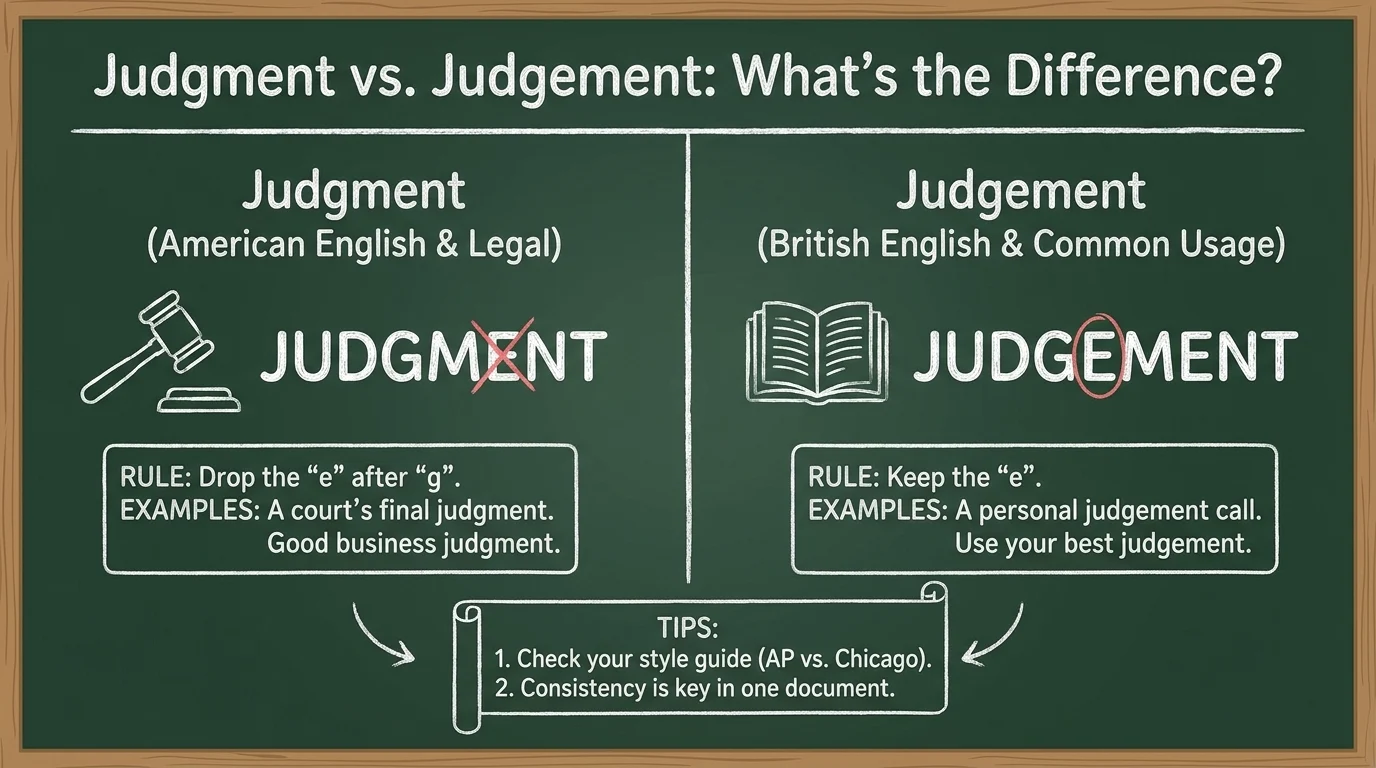
Quick Ans: Judgment and judgement are both correct spellings of the same word. Judgment is the preferred spelling in American English, while judgement is more common in British English and some other varieties. Both forms mean the ability to make a decision or an opinion formed after careful thought.
Are you confused about whether to write judgment or judgement? Both spellings are accepted, so the choice can depend on the variety of English you are using.
The word can describe a person’s ability to make sensible decisions. For example, “She showed good judgment during the crisis.” It can also mean an official decision made by a court.
The main difference is the extra “e.” American English generally prefers “judgment,” while British English often uses “judgement.” However, the spelling “judgment” also appears in British English, especially in legal contexts.
This small spelling difference matters when you are writing for a specific audience. Consistency is especially useful in academic work, business writing, and professional documents.
Fortunately, the rule is simple. Both words have the same pronunciation and meaning. You mainly need to choose the spelling that matches your audience and style guide.
Quick Answer: Judgment or Judgement?
| Spelling | Common Usage | Meaning |
|---|---|---|
| Judgment | More common in American English | Decision, opinion, or ability to decide |
| Judgement | More common in British English | Decision, opinion, or ability to decide |
Both spellings are correct. Choose one style and use it consistently throughout your writing.
Definition and Explanation
Judgment
“Judgment” is a noun. It can mean the ability to make sensible decisions or an opinion formed after considering information.
Example: He showed excellent judgment.
It can also refer to a formal decision made by a court.
Example: The judge delivered the final judgment.
Judgement
“Judgement” is also a noun with the same meanings.
Example: She used her best judgement.
British dictionaries commonly list “judgement” as a standard spelling. However, “judgment” is also widely accepted, particularly in legal writing.
| Word | Part of Speech | Meaning | Example |
|---|---|---|---|
| Judgment | Noun | Decision or opinion | I trust her judgment. |
| Judgement | Noun | Decision or opinion | I trust her judgement. |
The meaning does not change when you add the “e.” The main difference is regional spelling preference.
Is This a Grammar, Usage, or Vocabulary Issue?
This is mainly a spelling and usage issue, not a grammar issue.
Both forms are nouns and both can be used correctly. The choice usually depends on the type of English you are writing.
American style generally prefers “judgment.” British style commonly uses “judgement.” However, British legal writing often uses “judgment” without the extra “e.”
Therefore, don’t assume that “judgement” is always wrong in American writing or that “judgment” is always wrong in British writing. Check the style required for your publication, school, workplace, or legal document.
Real World Usage Examples
Workplace Examples
“Good judgment is essential when making important business decisions.”
“Her judgement helped the team avoid a serious mistake.”
Both sentences are correct. The spelling simply reflects different English conventions.
Recap: Choose the spelling that matches your workplace style.
Academic Examples
“The researcher used professional judgment when evaluating the results.”
“Students should develop sound judgement when assessing sources.”
Both forms work in academic writing.
Recap: Academic writers should follow their institution or publication’s preferred spelling.
Everyday Examples
“I trust your judgment.”
“She showed great judgement in that situation.”
Both sentences express the same idea.
Recap: The meaning stays the same in everyday use.
Regional or Global Usage Differences
The biggest difference is regional preference.
American English generally uses judgment. British English commonly uses judgement.
Canadian, Australian, and other varieties may use “judgement” more often, although usage can vary by context and publication.
Legal writing creates an interesting exception. The spelling “judgment” is widely used in legal contexts, including British legal usage.
As a result, both spellings can appear in British publications. When in doubt, follow the style guide for your audience.
When NOT to Use It
Do not treat “judgement” as an incorrect spelling simply because you normally use “judgment.”
Do not switch between “judgment” and “judgement” randomly within the same article.
Avoid changing a quoted source’s original spelling just to match your preferred style.
Do not assume that adding the “e” changes the meaning.
In legal writing, check the required terminology before choosing between the two forms.
Common Mistakes and Corrections
| Correct Sentence | Incorrect Sentence | Why |
|---|---|---|
| She showed good judgment. | She showed good judgement. | “Judgment” is preferred in many American style guides. |
| She showed good judgement. | She showed good judgment. | “Judgement” is commonly preferred in British usage. |
| The court issued its judgment. | The court issued its judgement. | “Judgment” is widely used in legal contexts. |
| I trust your judgment. | I trust your judgements. | Use the singular when referring to one person’s decision making ability. |
Decision Rule: Use judgment for American style and judgement for general British style. In legal writing, judgment is often preferred.
Exercises With Answers
Choose the appropriate spelling for each sentence.
- She showed excellent _____ during the crisis.
- The court delivered its final _____.
- British style commonly uses _____.
- American style generally uses _____.
- Both spellings have the same meaning.
Answer Key
- judgment or judgement
- judgment
- judgement
- judgment
- True
Related Concepts and Comparisons
Readers may also search for judgment vs judgement, judgment spelling, judgement spelling, American vs British spelling, canceled vs cancelled, traveled vs travelled, gray vs grey, and practice vs practise.
FAQs
Is judgment or judgement correct?
Both spellings are correct. “Judgment” is generally preferred in American English, while “judgement” is more common in British English.
What is the difference between judgment and judgement?
There is no difference in meaning. The main difference is spelling preference, with “judgment” more common in American usage and “judgement” common in British usage.
Is judgment the American spelling?
Yes. “Judgment” is the preferred spelling in American English. It is also used in some British contexts, especially legal writing.
Is judgement the British spelling?
Yes. “Judgement” is a common British spelling. However, British English also uses “judgment,” particularly in legal contexts.
Which spelling should I use in formal writing?
Use the spelling preferred by your audience or style guide. If you’re writing for an American publication, “judgment” is usually the safer choice.
Is judgment spelled without an e?
Yes. “Judgment” is a standard spelling without an “e.” It is especially common in American English and legal writing.
Does judgement mean the same as judgment?
Yes. “Judgement” and “judgment” have the same meaning. Both can refer to a decision, opinion, or ability to make sensible decisions.
Why does judgment sometimes have no e?
English spelling conventions allow “judgment” without the “e.” American English generally prefers this shorter form, while British usage often keeps the “e.”
Conclusion
Judgment and judgement are both correct spellings. The main difference is regional preference rather than meaning.
American English generally favors judgment, while British English commonly uses judgement. However, British legal writing often uses judgment, so context can influence the choice.
Both forms can describe a person’s ability to make sensible decisions, an opinion, or a formal court decision. Therefore, you won’t change the meaning by choosing one spelling over the other.
The most useful rule is to consider your audience. If you are writing for an American audience, choose “judgment.” If you are following British spelling conventions, “judgement” is usually appropriate. Above all, keep your spelling consistent throughout the same piece of writing.
Practical tip: Check your target audience before writing. Then choose judgment or judgement and stick with that spelling throughout your article.