
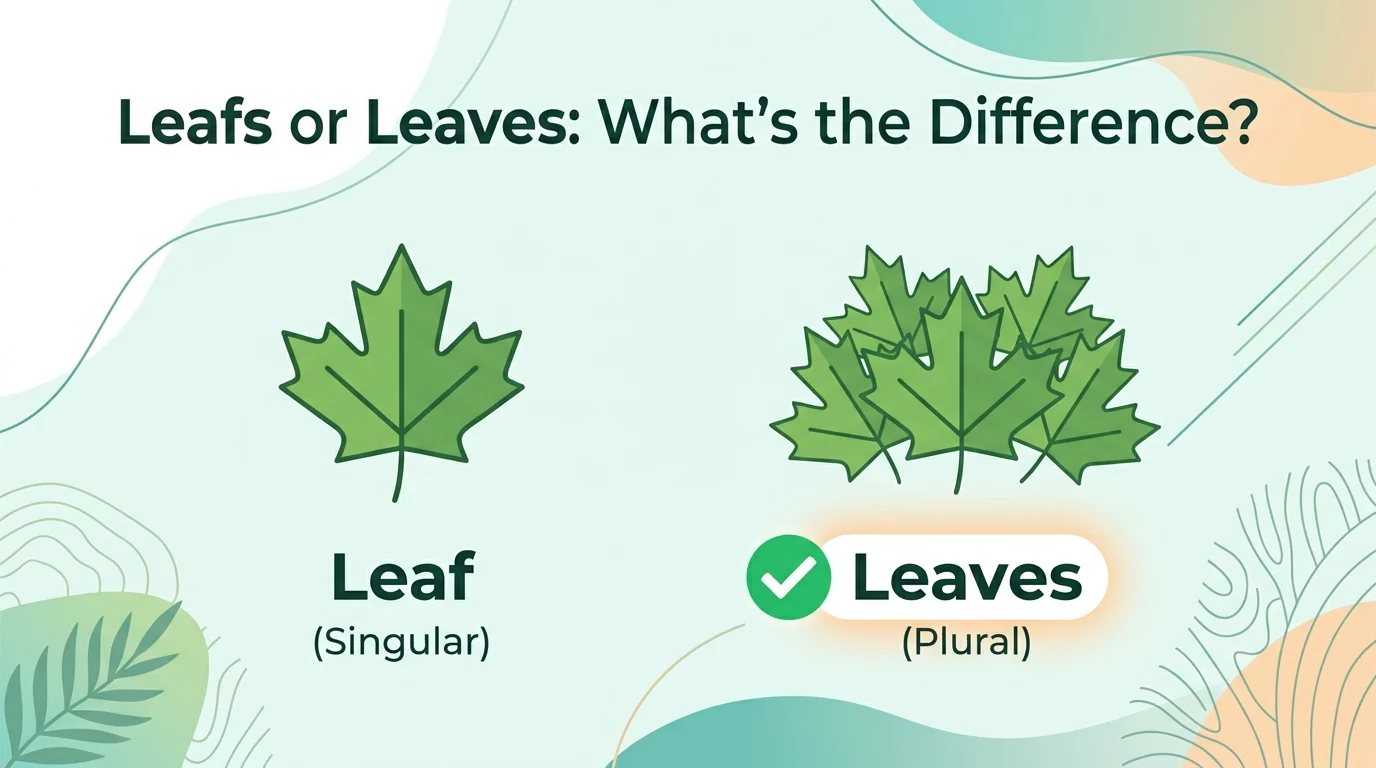
Quick Ans: “Leaves” is the correct plural of “leaf” when you mean the parts of a plant or tree. “Leafs” is usually incorrect in this meaning. However, “leafs” can be correct as the third person singular form of the verb “leaf,” although that use is rare.
Are you confused about whether to write “leafs or leaves”? The answer depends on how you are using the word.
When you talk about more than one leaf on a tree or plant, use “leaves.” For example, “The tree has green leaves.” This is the standard plural form of the noun “leaf.”
The confusion happens because many English nouns form their plurals by simply adding “s.” For example, “book” becomes “books” and “car” becomes “cars.” However, “leaf” follows a different pattern. Its common plural form changes the ending from “f” to “ves.”
You may also encounter “leafs” as a verb. In this case, it means that someone or something leaves or removes leaves from something, although this use is uncommon.
For everyday writing, school assignments, and general English, remember one simple rule: if you mean more than one part of a plant, write “leaves.”
Quick Answer and Key Takeaway
| Word | Use | Example |
|---|---|---|
| Leaf | Singular noun | A leaf fell from the tree. |
| Leaves | Plural noun | The tree has many leaves. |
| Leaves | Verb | She leaves at six. |
| Leafs | Rare verb form | The machine leafs through the material. |
Quick rule: One plant leaf is a “leaf.” More than one is “leaves.”
Definition and Explanation
Leaf
“Leaf” is a noun that means the usually flat, green part of a plant or tree.
Example: The leaf is turning yellow.
Its plural form is “leaves.”
Example: The leaves are turning yellow.
Leaves
“Leaves” is the standard plural of “leaf.”
Example: Dry leaves covered the ground.
“Leaves” can also be a verb. It is the third person singular form of “leave.”
Example: She leaves work at five.
Leafs
“Leafs” is not the normal plural of “leaf.” Therefore, you should not write “leafs” when talking about several leaves on a tree.
“Leafs” can appear as a verb in specialized or uncommon contexts, but most writers will rarely need it.
| Form | Meaning | Example |
|---|---|---|
| Leaf | One plant leaf | The leaf is green. |
| Leaves | More than one leaf | The leaves are green. |
| Leaves | Goes away | He leaves at noon. |
| Leafs | Rare verb form | The device leafs through material. |
The main point is easy: use “leaves” as the plural of “leaf.”
Is This a Grammar, Usage, or Vocabulary Issue?
This is mainly a grammar and spelling issue involving an irregular plural noun.
“Leaf” does not normally form its plural by adding “s.” Instead, it changes to “leaves.”
The same pattern appears in words such as “knife” and “wife,” which become “knives” and “wives.”
However, not every word ending in “f” follows this rule. For example, “roof” normally becomes “roofs.” Therefore, it is better to learn each plural form rather than apply one rule to every word.
Real World Usage Examples
Workplace Example
“The office plants have large green leaves.”
Here, “leaves” refers to the parts of the plants.
Recap: Use “leaves” when discussing multiple plant leaves.
Academic Example
“The researchers examined the leaves under a microscope.”
The sentence refers to more than one leaf.
Recap: “Leaves” is the correct plural in scientific and academic writing.
Everyday Example
“The leaves are falling from the trees.”
This is a common everyday use.
Recap: In ordinary English, “leafs” is not the plural form of “leaf.”
Regional or Global Usage Differences
There is no major difference between American and British English here. Both varieties use “leaf” as the singular noun and “leaves” as its usual plural.
The same spelling applies in other major varieties of English as well.
The verb “leaves” also has the same spelling and meaning across English varieties.
When NOT to Use It
Do not use “leafs” when you mean several leaves on a tree.
Do not write “The tree has many leafs.” Write “The tree has many leaves.”
Do not assume every noun ending in “f” forms its plural with “ves.”
Avoid using the rare verb “leafs” unless the context specifically requires it.
Do not confuse the noun “leaves” with the verb “leaves.” Context tells you which meaning applies.
Common Mistakes and Corrections
| Correct Sentence | Incorrect Sentence | Why |
|---|---|---|
| The tree has many leaves. | The tree has many leafs. | “Leaves” is the plural of “leaf.” |
| A leaf fell from the tree. | A leaves fell from the tree. | “Leaf” is singular. |
| She leaves work at five. | She leafs work at five. | “Leaves” is the verb form of “leave.” |
| The leaves are turning brown. | The leafs are turning brown. | Use “leaves” for multiple plant leaves. |
Decision Rule: If you mean more than one plant leaf, always choose “leaves.”
Exercises With Answers
Choose the correct word.
- The tree has hundreds of _____.
- A _____ fell onto my car.
- She _____ the office at six.
- The autumn _____ covered the ground.
- There is one _____ on the branch.
Answer Key
- leaves
- leaf
- leaves
- leaves
- leaf
Related Concepts and Comparisons
Readers may also search for leaf plural, leaf vs leaves, irregular plural nouns, nouns ending in f, knife vs knives, life vs lives, wife vs wives, and common plural spelling rules.
FAQs
Is leafs or leaves correct?
“Leaves” is correct when you mean more than one leaf. “Leafs” is generally incorrect as the plural noun form.
What is the plural of leaf?
The plural of “leaf” is “leaves.” For example, “The leaves are falling from the tree.”
Why does leaf become leaves?
“Leaf” has an irregular plural form. Instead of simply adding “s,” English changes the ending to form “leaves.”
Can leafs ever be correct?
Yes, but only in rare verb uses. In normal writing, use “leaves” when referring to multiple parts of a plant.
Is leaves a noun or a verb?
“Leaves” can be either a noun or a verb. As a noun, it means more than one leaf. As a verb, it can mean goes away, as in “She leaves at five.”
What is the difference between leaf and leaves?
“Leaf” refers to one plant leaf, while “leaves” normally refers to more than one. “Leaves” can also function as the verb form of “leave.”
Is leaves the plural of leaf in English?
Yes. “Leaves” is the standard plural of “leaf” in English.
Do all words ending in f change to ves?
No. Some words change to “ves,” while others simply add “s.” For example, “knife” becomes “knives,” but “roof” becomes “roofs.”
Conclusion
When choosing between “leafs or leaves,” use “leaves” when you mean more than one leaf. “Leaf” is singular, while “leaves” is its standard plural form.
For example, you can say, “A leaf fell from the tree,” but you should say, “Several leaves fell from the tree.” The spelling changes from “f” to “ves,” so “leafs” is not the normal plural form.
Remember that “leaves” has another common use. It can be the verb form of “leave,” as in “She leaves home at seven.” Context makes the meaning clear.
There is little difference between major varieties of English. American and British English both use “leaves” as the plural of “leaf.”
Practical tip: if you’re talking about several green parts of a plant, choose “leaves,” not “leafs.”